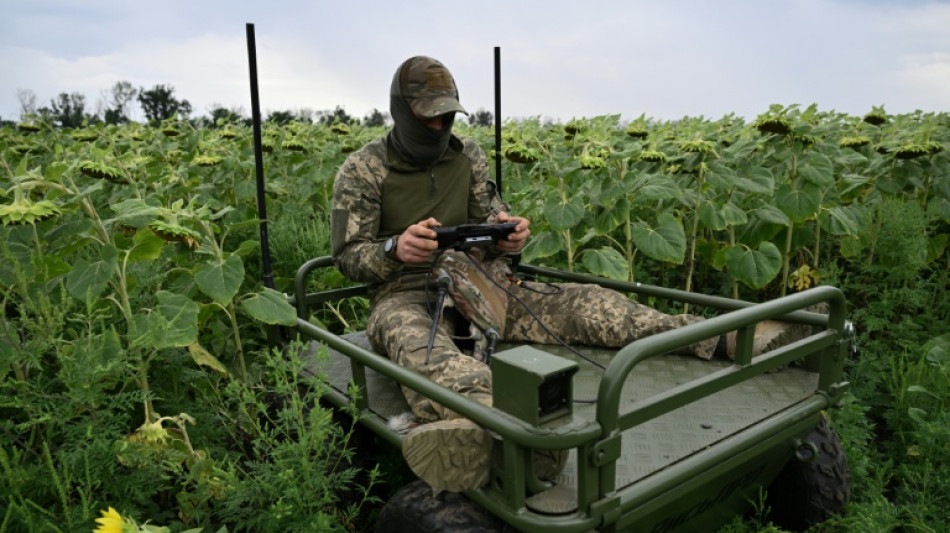
Under a drone canopy, Ukraine army medics rely on robots and luck / Photo: © AFP

 England's Nations League surge helps heal World Cup wounds

 Mayor of opposition stronghold Izmir defects to Erdogan party
 Mertens beats Gauff to set up Swiatek clash at China Open
 Benin full of pride at role in Messi's last dance

 France suspends stun grenade use at student protests ahead of PM speech
 Indonesian court hears 'negligence' complaint against state over fires, haze

 Rubio in Greece to urge against Western civilisation 'decline'
 Micron workers at Taiwan plant vote in favour of strike
 In 'The Social Reckoning,' Jeremy Allen White takes on Facebook's 'frightening' ambition
 Chip industry activists call for South Korea to recognise cancer cases

 Famine-scarred southern Madagascar braces for El Nino
 How the EU regulates lobbyists
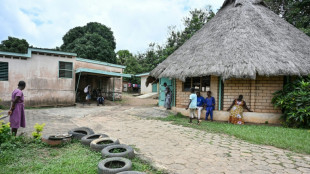 I.Coast refuge offers lifelong care for youngsters scorned as 'sorcerers'

 Indian central bank hikes rates for first time in more than 3 years
 Hotel Blacklist Launches New Accommodation Industry Risk Assessment Tool
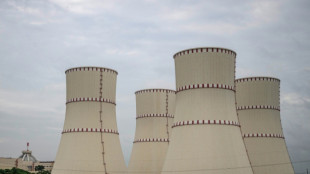 Bangladesh nuclear plant draws hope -- and worry
 US beat Canada 1-0 to wrap up four-win international break

 Turkey, Australia's joint COP31 leadership raises doubts
 For Turkish NGOs, COP31 offers rare space for action
 Sleep, appetite, gene-editing experts contend for Nobel chemistry prize

 Nobel Peace Prize haunted by the 'spectre' of Trump

 Africa launches own credit agency in bid for cheaper borrowing

 US, China, EU: three paths to regulating AI

 Australia's High Court rules against coal mine in landmark climate case
 Australia touts new funds for Pacific infrastructure at Fiji 'pre-COP'

When Magician, a Ukrainian serviceman, was remotely steering a robot hauling a wounded soldier away from the front line towards safety, the worst-case scenario played out on his monitor.
The 27-year-old, who asked AFP to identify him by his call sign in line with military protocol, was navigating the bot on a journey with life-or-death stakes when grey smoke appeared on his control screen. His machine had hit a mine.
The proliferation of cheap but deadly drones deployed by Russian and Ukrainian forces has irreversibly changed how the war is being waged -- including how frontline medics retrieve the wounded from the battlefield.
"For five minutes, that person's death was on my conscience," Magician told AFP.
He believed in that moment the mission -- and the soldier's life -- were lost.
The canopy of killer drones blanketing the skies over the front line is forcing military medics to find new ways to move wounded to field hospitals for treatment, including by robot.
At the beginning of Russia's full-scale invasion in early 2022, medics could rush onto the battlefield and carry hurt troops out by stretcher or vehicles.
Drones have made that almost impossible.
Military medic Olena Ivanenko recounted painful episodes when she was unable to reach wounded soldiers less than one kilometre (half-a-mile) away.
"I was hearing their voices on the radio and yet I couldn't do anything," she said.
- 'You're too far' -
The "kill zone," where drones make any movement potentially fatal, stretches for up to 10 kilometres (6 miles) behind the front line on the Ukrainian side, analysts say.
"When a brother or sister dies, it's already done. You can't bring them back, but when there is a chance to save someone and you can't do it because you're too far -- that's very tough," said Ivanenko, a medic with Ukraine's 412th regiment.
The excruciating helplessness has forced medics to get creative in their work.
Ivanenko said her unit often sends food or medication to stranded service members by aerial drone, even sending syringes filled with medicine and explaining remotely how to administer it.
Evacuation robots like Magician's are part of the solution, but only skilled operators can carry out delicate missions.
"It must be done verycarefully you shouldn't make any sudden movements," said Krop, a robot operator in the 5th brigade who also used his military call-sign.
At a training ground in eastern Ukraine, he demonstrated to AFP the nimble movements the robots are capable of, steering it via a hand-held controller complete with a screen and triggers on the sides.
Krop sent the robot ploughing through a sunflower field, and spun the machine in one spot while another pilot held on to the platform for carrying the wounded.
- 'Shaking' -
Their attitudes shift on mission said Bot, a pilot in the 5th brigade.
"It's someone's life," the 24-year-old told AFP. "It's not just a game or a toy. We're not playing."
The robots are slow, which means Russian drones can easily locate and target them, that is if they don't hit mines.
The toll of failed evacuations -- of lives lost -- weighs heavily on the pilots.
"You get half-an-hour of self-flagellation, and then you think 'dammit, it was the bastards who killed them. I wasn't the one who shot them'," Magician said.
Magician thought all was lost when his bot carrying the wounded soldier hit the mine.
But staring at the monitor showing plumes of smoke billowing from the vehicle, he saw a figure crawling to safety and the team dispatched another robot.
"At that moment you're driving and your whole body is shaking -- except the fingers holding the joystick," Magician said.
The return journey lasted hours, including moments that were painful for the wounded soldier, over potholes, dips and bumps.
"I felt a little sorry for him. Fifteen kilometres in a shaking basket isn't very comfortable," Magician said.
"But I pulled him out."
O.Bulka--BTB