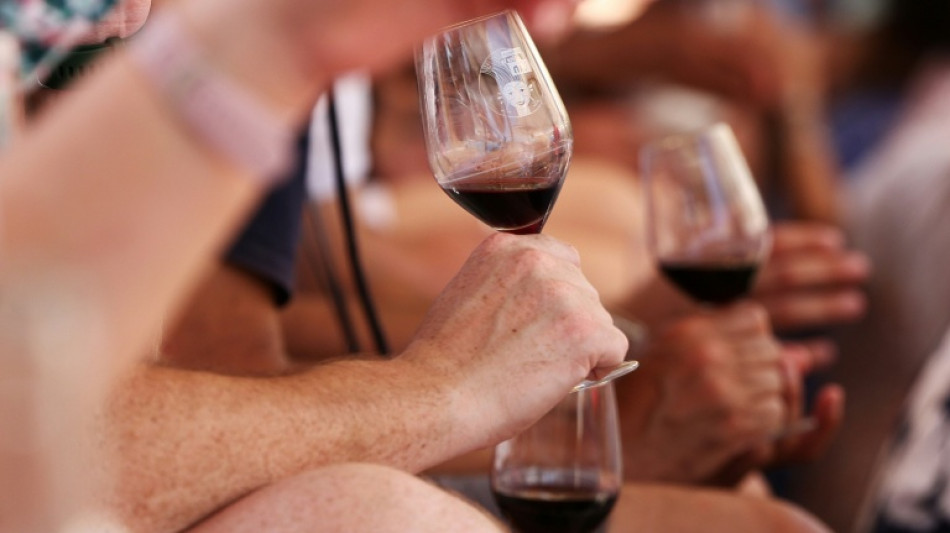
Embattled Bordeaux winemakers see Trump's tariffs as latest blow / Photo: © AFP

 England's Nations League surge helps heal World Cup wounds

 Mayor of opposition stronghold Izmir defects to Erdogan party
 Mertens beats Gauff to set up Swiatek clash at China Open
 Benin full of pride at role in Messi's last dance

 France suspends stun grenade use at student protests ahead of PM speech

 Indonesian court hears 'negligence' complaint against state over fires, haze
 Rubio in Greece to urge against Western civilisation 'decline'
 Micron workers at Taiwan plant vote in favour of strike

 In 'The Social Reckoning,' Jeremy Allen White takes on Facebook's 'frightening' ambition

 Chip industry activists call for South Korea to recognise cancer cases
 Famine-scarred southern Madagascar braces for El Nino

 How the EU regulates lobbyists
 I.Coast refuge offers lifelong care for youngsters scorned as 'sorcerers'
 Indian central bank hikes rates for first time in more than 3 years

 Hotel Blacklist Launches New Accommodation Industry Risk Assessment Tool

 Bangladesh nuclear plant draws hope -- and worry

 US beat Canada 1-0 to wrap up four-win international break

 Turkey, Australia's joint COP31 leadership raises doubts

 For Turkish NGOs, COP31 offers rare space for action
 Sleep, appetite, gene-editing experts contend for Nobel chemistry prize
 Nobel Peace Prize haunted by the 'spectre' of Trump

 Africa launches own credit agency in bid for cheaper borrowing

 US, China, EU: three paths to regulating AI
 Australia's High Court rules against coal mine in landmark climate case
 Australia touts new funds for Pacific infrastructure at Fiji 'pre-COP'

The sun is shining, the grapes are ripe and a good harvest is expected but a heavy cloud is looming over Laurent Dubois's vineyard in southwestern France.
"It's not up to me to pay the Trump tax!" he fumes, faced with the 15 percent in customs duties that is to hit his products in US President Donald Trump's trade war.
Trump's long-threatened tariffs are just the latest blow to be sustained by Bordeaux winemakers, who are operating in an increasingly tough market as consumer tastes change.
The duties imposed could have been worse and on their own will not destroy the industry, winemakers emphasise, but they say they are an extra burden they could so without.
Dubois, 57, a major figure in the Bordeaux region famous for its fruity reds, exports 70 percent of his production to 25 countries, including 10 percent to the United States.
The ninth generation to lead the Chateau Les Bertrands in Reignac, north of Bordeaux, Dubois is already seeing the effects of the 15 percent levy, which is being imposed after the EU failed to secure an exemption for wines and spirits.
- 'Narrow margins' -
"For our last shipment, a client in Texas asked us to give him a price," Dubois told AFP. "But I'm French, I didn't vote for Trump. So it's not up to me to pay, knowing that our margins are very narrow."
The United States is by far the largest export market for Bordeaux wines, with sales of over 400 million euros ($469 million) or 20 percent of the total.
China comes next on 300 million euros and the UK on 200 million euros, according to the Bordeaux Negoce union.
Customs duties, combined with the weakness of the dollar against the euro, constitute "a double whammy" for the price of bottles on the American market, said Dubois.
He said he expects a "small drop" in his exports to the United States but remains phlegmatic: "It could have been worse because a few months ago, Trump announced taxes of 50 percent or even 200 percent."
His opinion is echoed by Laurent Rousseau, a winegrower in Abzac, near Saint-Emilion in the Bordeaux region, for whom the US market represents 43 percent of sales.
"There will be a price adjustment but there is no expected market shutdown. After that, I don't know what will happen in December" during the annual renegotiation of the contract with his importer, he said.
- 'It's scary' -
Export difficulties have led to overproduction and a collapse in wholesale prices in recent years.
A subsidised uprooting plan has reduced the cultivated area to 90,000 hectares (222,000 acres), compared to 103,000 two years ago.
US customs duties add to these difficulties, against a backdrop of a chronic decline in wine consumption as lifestyles change in France and elsewhere.
"It's bad news, yet again," said Dubois. "We had to reduce our area by about 10 percent (to 130 hectares), we did the uprooting.
"And then we see a number of companies, winegrowers who are shutting down or are in receivership. It's scary. We say to ourselves: 'The next one will be me'."
Further north, the vineyards of Cognac are also being hit by the customs duties, as the United States is the largest market for the famous spirit.
China -- the second-largest destination for a sector that is 98 percent export-dependent -- has previously imposed taxes or price increases.
Bertrand de Witasse, a winemaker who supplies the Remy Martin distillery, saw his orders drop by 25 percent during a renegotiation in May.
"We're all affected," he admitted. "But as they say in Cognac, 'You're a billionaire for one year and a poor man for 10'.
"So, the years you're a billionaire, you have to save and avoid wasting money."
French winemakers are far from being the only Europeans affected.
On Thursday, the Italian Wine and Spirits Federation (Federvini) expressed "its deep concern" at the lack of an exemption for "wines, spirits, and vinegars".
"We are seeing a missed opportunity," said Federvini president Giacomo Ponti, emphasising that "the agreement could have fully recognised the strategic importance" of our sectors "in transatlantic relations."
T.Bondarenko--BTB