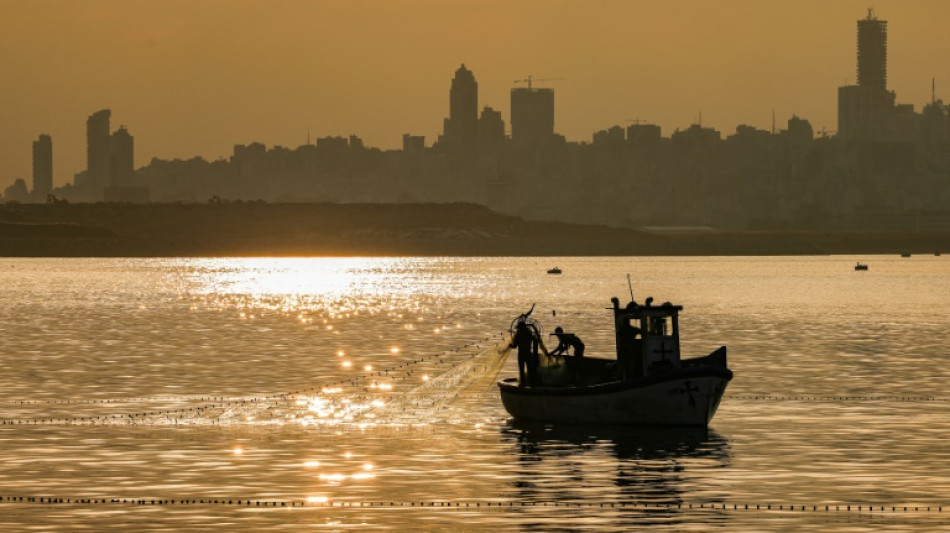
WTO fishing deal: the net results / Photo: © AFP

 As species decline, green turtles offer glimmer of hope

 Brothers Scott and Beauden Barrett named to start for All Blacks

 EU trade chief seeks to dial down China tensions

 'Never again Bolsonaro': thousands march ahead of Brazil election runoff

 After botched execution, US woman was nearly taken off life support before revival

 Searing AIDS drama 'Elsinore' opens London film festival

 Evicted pensioner who sparked Spain housing protests dies: tenant union

 Golf star Rahm quitting LIV tour over 'unacceptable' terms
 Thousands march fearing return of a Bolsonaro presidency in Brazil
 French PM denies police ordered to confront student protesters

 Rubio touts US power, calls on Europe to emerge from 'slumber'
 Trump says 'we don't think' Russian plague is bio-weapon

 Five children among 26 killed in Ukraine after Russian strikes

 Man City should 'accept' punishment for rule breaches, says Lineker

 US woman who survived botched execution is awake and speaking

 From 1800s to modern pharma: a Nobel-winning chemistry quest

 Southampton boss Eckert given suspended ban over 'Spygate'
 Russia warns of 'false' information as second plague case reported

 IEA ready to release more oil reserves if necessary

 HSBC 'consults' over UK unit job cuts amid AI adoption

 UK court quashes five ex-traders' Libor rate rigging convictions
 XM Receives “Global Customer Experience Leader Award 2026” at the TrustFinance Performance Awards
 Stocks slide as oil climbs on Mideast flareup

 Heavy casualties in Ukraine after Russian strikes

 French wine harvest set to hit historic low

The World Trade Organization's agreement on fisheries subsidies -- its first environmentally focused accord -- enters into force on Monday after years of thorny negotiations at a time of heightened international trade tensions.
Agreed by more than 100 WTO members, including the United States, the European Union and China, the agreement sets binding rules requiring governments to consider the legality and sustainability of the fishing activities they subsidise.
The discussions towards the deal began all the way back in 2001, with WTO members finally reaching an agreement by consensus in June 2022.
Below are the main points of the agreement, which will be celebrated with a ceremony at the WTO's Geneva headquarters Monday after being ratified by two-thirds of the membership.
Broader rules regarding subsidies for activities that contribute to overcapacity and overfishing remain under negotiation.
- Bans -
The deal bans subsidies to any vessel or operator engaged in illegal, unreported and unregulated (IUU) fishing, or the fishing of overexploited stocks.
However, a country can grant or maintain subsidies implemented "to rebuild the stock to a biologically sustainable level".
The agreement also prohibits subsidies for unregulated fishing on the high seas, including areas outside the jurisdiction of coastal countries, thus providing protection in cases where stock management measures are lacking.
According to a widely cited study in the Marine Policy journal, global fisheries subsidies totalled $35.4 billion in 2018, of which $22 billion contributed to increased fishing fleet capacity.
- Notification and dispute settlement -
The agreement says countries must "take special care and exercise due restraint" when granting subsidies to vessels not flying their own flag, and when granting them to fishing or related activities if the status of the stocks concerned is unknown.
Besides regular notifications of subsidies, WTO members are required to update the organisation on how the agreement is being implemented.
This includes, for example, the status of fish stocks, information on vessels receiving subsidies, and a list of vessels and operators that the country has determined to be engaged in IUU fishing.
In the event of disagreements, countries can refer matters to the WTO's dispute settlement body.
- Developing countries -
The agreement provides a "peace clause" to the world's least-developed countries (LDCs) and developing countries, exempting them from subsidy bans within their own exclusive economic zones for two years.
Furthermore, developing countries and LDCs whose annual share of the global fish catch does not exceed 0.8 percent can submit their fisheries notifications to the WTO every four years instead of every two years.
They will also benefit from technical assistance, and the WTO has set up a special fund to support them, which to date has received $18 million in voluntary contributions.
- Agreement could be thrown overboard -
If the second agreement outlining comprehensive rules on overcapacity and overfishing is not adopted within four years, the first agreement will be "immediately terminated", unless WTO members decide otherwise.
L.Janezki--BTB