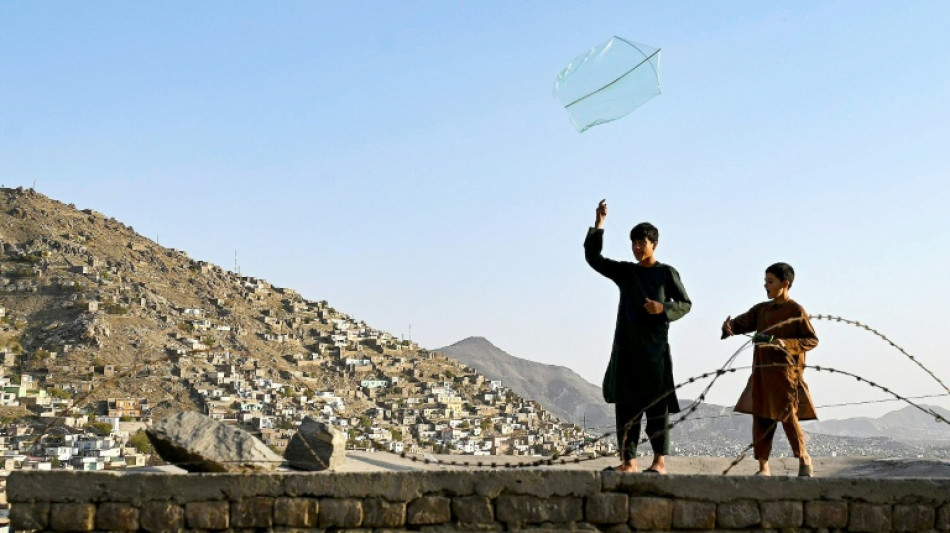
'I couldn't reach them': Afghans abroad despair at blackout / Photo: © AFP

 Sri Lanka's de Silva quits as Test captain

 Alcaraz feeling 'mentally fresh' ahead of Shanghai return

 Israel drastically reduces British diplomatic presence in Jerusalem
 Stocks fall further as oil surge fans fresh inflation worries

 North Korea demands South show 'utmost respect' to restore relations
 Saudi says three dead in airport attacks claimed by Houthis

 'Mad dream': New showcase for African film opens in London

 All Blacks coach Rennie says Wallabies exit 'part of the game'

 The growing protests against India's poll body - and PM Modi
 Stocks fall further as oil spike fans fresh inflation worries

 Bad COP, worse COP? EU tempers hopes for UN climate summit

 Rookie Henry named in Wallabies midfield to face All Blacks

 Housing crisis set to dominate Spain's snap election
 Gas, health care, utilities: high costs squeeze US midterm voters

 New Zealand Rugby seeks injunction over PNG Chiefs name
 Samsung expects 780% quarterly operating profit jump on AI boom

 Guardians survive with 9-3 win over White Sox

 Saudi Arabia says 3 dead at airports after Houthis claim attacks
 Stocks slide as oil sees volatile trading day over Iran war fears

 Microsoft pushes AI vision with new, expensive Surface laptop

 Five children among 28 killed in Russian strikes on Ukraine

 Odell Beckham Jr signs with Minnesota Vikings

 Saudi Arabia says three dead at airports after Houthis claim attacks

 Trump plans to turn Florida golf course into presidential retreat

 WHO says cannot conduct full risk assessment on Russia plague reports

Afghans around the world are despairing at being unable to reach their loved ones at home after a Taliban-enforced internet blackout took effect on Monday.
Internet connection in Afghanistan is now operating at less than one percent of normal levels, according to internet governance watchdog Netblocks, after Taliban authorities imposed a blackout lasting "until further notice" on Monday.
The blackout spells worse conditions for the population of one of the world's poorest countries, who have already endured decades of conflict, a protracted humanitarian conflict, and an earthquake a month ago.
But the shutdown is deeply distressing for Afghans abroad too, many of them displaced against their will and fearful for the wellbeing of their loved ones at home.
"My mom, my sisters and my brothers, they are in Afghanistan. One day, I called them like 20 or 10 times, but I couldn't reach them," Mehdi, a 29-year-old Afghan restaurant worker in Pakistan, told AFP.
"I don't know how they survive and how they live," he said, explaining that on top of cutting off basic communication, he is no longer able to send money home to support his household.
- 'The whole family is anxious' -
Shadowy supreme leader Hibatullah Akhundzada ordered the blackout to combat what Taliban authorities consider "vice".
The outage will hinder social media access, prevent women from circumventing an education ban via online programmes, censor media, and make it impossible for people like Mehdi to support their families financially through money transfers.
The United Nations has warned of a "very dire situation" with "serious human rights ramifications".
"The whole family is anxious," Nooriya Qaderi, 59, an Afghan refugee in New Delhi, told AFP. "Because of these problems I can't talk to my family... everyone is worried."
"We can't communicate... (and) sending money has become very difficult," he told AFP.
"There are so many challenges. No one knows how long the blackout will go on for."
At the beginning of 2025, 13.2 million people had access to the internet in Afghanistan -- around 30.5 percent of the population, according to the specialist website DataReportal, with around 4.05 million social media users.
Rahimullah Habiboghli is in his twenties and came to France alone five years ago. He has been unable to reach his family since the blackout took effect.
"I can't believe it. It cannot last, it's just not possible. No country in the world is completely cut off from the internet," Habiboghli told AFP.
The young man is the founder of an association that supports education in Afghanistan, and he regularly raises funds to transfer home -- a practice he is unsure about how to continue.
In 2024, Kabul had touted its 9,350-kilometre (5,800-mile) fibre optic network, largely built by former US-backed governments, as a "priority" to bring the country closer to the rest of the world and lift it out of poverty.
"They want to keep their people in the dark, preventing them from seeing the world so they can stay in power and the population can be free," Habiboghli said.
burs-video-cc/phz
C.Kovalenko--BTB