'Wonder weapon'? Five things about US Tomahawks coveted by Ukraine / Photo: © GETTY IMAGES NORTH AMERICA/AFP

 Crew splashes down after 8-month mission on International Space Station

 Protests, clashes as S. African anti-migrant tensions reignite
 Russian data centre hit by drone in first for Ukraine war

 'Fighting for our future': France high school students vow no let-up
 Kyiv entering 'survival' mode amid Russian strikes surge: mayor tells AFP
 Verdict due in Mexico trial over murders of Australia, US surfers
 B2PRIME Welcomes Christina Barbash as Commercial Manager

 Russia forcing Kyiv into 'survival' mode before winter, mayor tells AFP

 Closing arguments begin in Maradona death trial

 UEFA president Ceferin to stand for re-election in 2027

 Nearly 300,000 Nepalis at flood risk: study

 Riyadh kindergarten hit by interception debris as Houthis say targeted airport
 Alex Bodi mizează, alături de CRIF, pe investiții transparente și pe prevenirea riguroasă a spălării banilor

 Gulf Labs, Part of Thailand’s $27 Billion GULF Group, Goes Live as an Injective Validator

 EU okay for winter despite 'historically low' gas stocks: operators
 Rwanda to host F1 Grand Prix: sources close to both sides

 EU top diplomat says bloc in favour of UN Lebanon peacekeepers' extension

 Antonelli and Russell to run different Mercedes aero packages in Singapore

 WTO hikes 2026 trade growth forecast on AI boom
 'I love that challenge': Hamilton prays for rain in Singapore

 G.Bissau moves towards postponement of December general election

 Verstappen out to settle 'unfinished business' at Singapore Grand Prix
 WhiteBIT Launches Bitcoin Lightning Network Support, Powered by Voltage

 Oil surges, stocks sink as US reportedly eyes fresh Iran strikes

 Anne Carson: modern takes on Greek classics

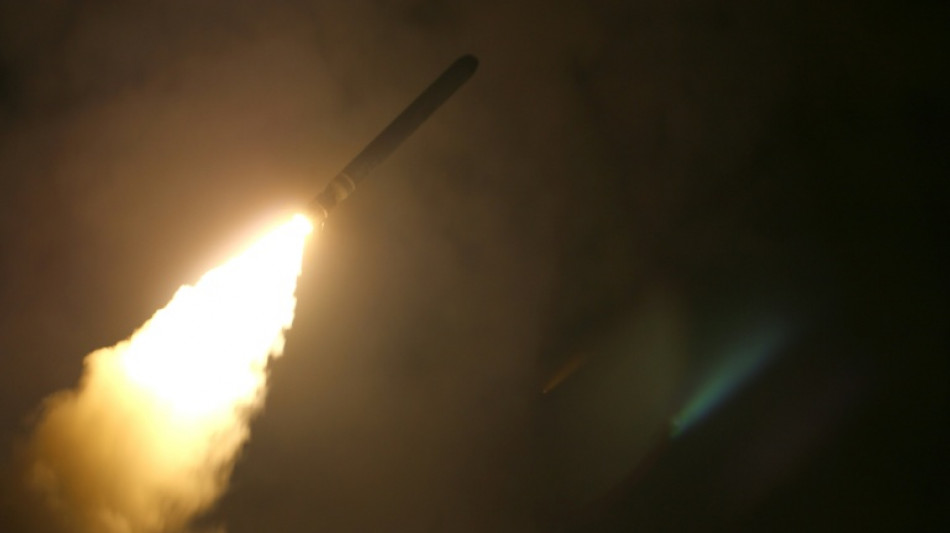
The Tomahawk cruise missile, set to be at the centre of talks between Donald Trump and Ukrainian President Volodymyr Zelensky, has been a mainstay of the US armed forces for over four decades and repeatedly used with success in the theatre of war.
Ukraine is eager to obtain the American missiles which would allow Kyiv to strike deep into Russian territory and give its armed forces a significant boost three-and-a-half years into the conflict sparked by the February 2022 full-scale invasion.
Some analysts and observers question if for all the avowed prowess of the Tomahawk it would in any way tip the balance in the war.
But their delivery would be a symbol of American support for Kyiv in the wake of the disastrous Oval Office meeting between Zelensky and Trump in February and a strong signal to Russian President Vladimir Putin that Trump is losing patience with Moscow.
Trump announced Thursday one day ahead of the talks with Zelensky that, following a call with Putin, he would meet the Russian leader at an unspecified date in Budapest.
Here are five things to know about the Tomahawk:
- Mainstay of US armed forces -
The Tomahawk is a cruise missile that has been in service for 42 years and since then used in almost all US military interventions.
Fired from submarines or surface ships, the BGM-109 Tomahawk flies up to 1,600 kilometers (1,000 miles) in range, at 880 km/h (550 mph) and a few dozen meters above the ground.
According to US Navy budget documents 8,959 missiles have been produced since the programme began and more than 2,350 have been fired.
A version of the Tomahawk carrying a nuclear warhead was retired from service in 2013.
- Repeatedly used in conflict -
The Tomahawks were first fired in a conflict during the US-led Operation Desert Storm against Saddam Hussein's Iraq in 1991 and repeatedly in US military interventions since then.
Most recently, some 80 missiles were still fired in January 2024 against the Tehran-backed Huthi rebels in Yemen, and another 30 against the Isfahan nuclear site in Iran in June when the US joined Israel's war against the Islamic republic.
The Tomahawk is also in service with the British Navy. Japan decided last year to acquire 400, and Australia and the Netherlands are also considering acquiring them.
- Wanted by Ukraine -
With its 450-kilogramme explosive charge, the Tomahawk can be used against air defense sites, command centers, airfields, or any heavily defended target.
Ukraine could with a Tomahawk target at least 1,655 targets of interest, including 67 air bases in Russia, well beyond Moscow, according to the US-based Institute for the Study of War (ISW).
Stacie Pettyjohn, a researcher at the CNAS think tank, estimated the US could supply 20-50 units.
The US Navy has only ordered 57 for 2026, an insufficient number for its manufacturer Raytheon to quickly ramp up production, according to German missile researcher Fabian Hoffmann. They would therefore have to be taken from US stocks.
Ukraine would also rather launch the missiles from land rather than sea but the land-based launchers are in very limited supply: the US Army currently has only two batteries of four launchers, and the Marine Corps only four.
- No game changer -
Like the battle tanks or the F-16s and Mirages already sold to Ukraine, the Tomahawk is not "a wonder weapon that is going to win the war," Pettyjohn wrote on X while adding that they have "have a notable strategic and operational effect".
"I don't believe that a weapons system can radically change the situation in Ukraine," agreed the head of the French Army, General Pierre Schill.
Especially since, with the homegrown Flamingo cruise missile, "the Ukrainians have developed deep strike capabilities, which they built themselves and are now using on the ground," said Schill.
- Warning to Russia -
Schill said the possible delivery of Tomahawks is "above all a political and strategic signal from Mr Trump to Mr Putin to say 'I told you I wanted us to move towards peace, I am ready to support the Ukrainians'" if there is no progress.
Putin has warned that the supply of Tomahawks to Kyiv would constitute a "whole new level of escalation, including in relations between Russia and the United States".
Trump on Wednesday described the Tomahawk as an "incredible weapon, very offensive weapon".
"Do they want to have Tomahawks going in their direction? I don't think so," he said.
J.Horn--BTB