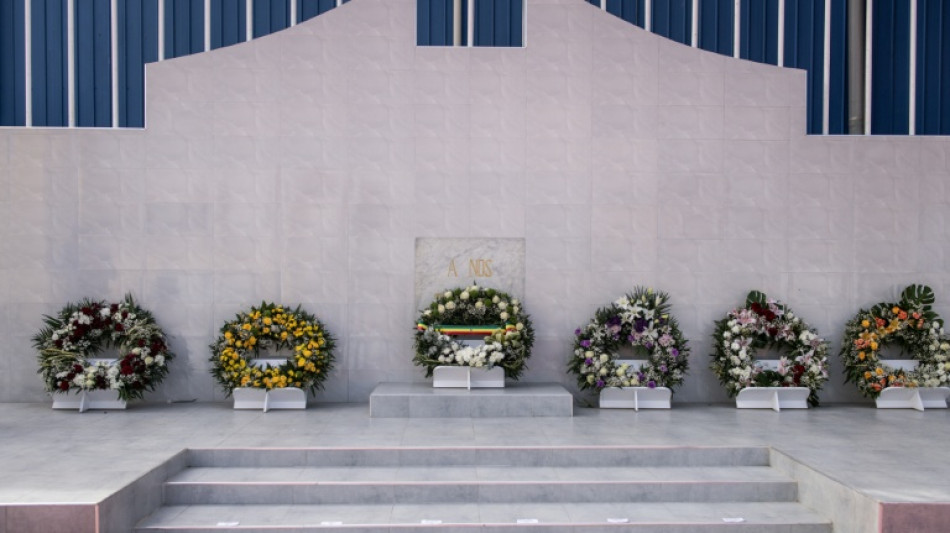
Report calls French massacre of WWII African riflemen premeditated, covered up / Photo: © AFP/File

 Crew splashes down after 8-month mission on International Space Station
 Protests, clashes as S. African anti-migrant tensions reignite
 Russian data centre hit by drone in first for Ukraine war

 'Fighting for our future': France high school students vow no let-up
 Kyiv entering 'survival' mode amid Russian strikes surge: mayor tells AFP
 Verdict due in Mexico trial over murders of Australia, US surfers
 B2PRIME Welcomes Christina Barbash as Commercial Manager
 Russia forcing Kyiv into 'survival' mode before winter, mayor tells AFP
 Closing arguments begin in Maradona death trial
 UEFA president Ceferin to stand for re-election in 2027
 Nearly 300,000 Nepalis at flood risk: study
 Riyadh kindergarten hit by interception debris as Houthis say targeted airport
 Alex Bodi mizează, alături de CRIF, pe investiții transparente și pe prevenirea riguroasă a spălării banilor
 Gulf Labs, Part of Thailand’s $27 Billion GULF Group, Goes Live as an Injective Validator

 EU okay for winter despite 'historically low' gas stocks: operators
 Rwanda to host F1 Grand Prix: sources close to both sides
 EU top diplomat says bloc in favour of UN Lebanon peacekeepers' extension
 Antonelli and Russell to run different Mercedes aero packages in Singapore

 WTO hikes 2026 trade growth forecast on AI boom

 'I love that challenge': Hamilton prays for rain in Singapore

 G.Bissau moves towards postponement of December general election
 Verstappen out to settle 'unfinished business' at Singapore Grand Prix
 WhiteBIT Launches Bitcoin Lightning Network Support, Powered by Voltage

 Oil surges, stocks sink as US reportedly eyes fresh Iran strikes
 Anne Carson: modern takes on Greek classics
French forces' 1944 massacre of African World War II troops demanding pay in Senegal was "premeditated" and covered up, with previous death tolls vastly underestimated, according to a paper submitted to the Senegalese president, an exclusive copy of which was obtained by AFP.
According to French colonial authorities at the time, at least 35 infantrymen were killed during the massacre at the Thiaroye camp, near Dakar.
This toll is likely significantly low, according to the committee of researchers who authored the report, who said the "most credible estimates put the figure at 300 to 400" deaths.
The 301-page report, submitted Thursday to President Bassirou Diomaye Faye, additionally calls on France to officially request forgiveness.
Below are the report's main points:
- 'Premeditated' and underestimated -
According to the committee, which was led by historian Mamadou Diouf, the report "restores" facts that were "deliberately hidden or buried in masses of administrative and military archives and released sparingly".
"The true death toll of the tragedy is difficult to determine today, especially regarding the number of dead and injured", the researchers wrote.
But they said previous reports of some 35 or 70 deaths were "contradictory and patently false" and that "more than 400 riflemen vanished as if they had never existed".
The most credible toll, they said, is 300 to 400 deaths.
The massacre "was intended to convince people that the colonial order could not be undermined by the emancipatory effects of the Second World War", the report said.
For this reason "the operation was premeditated, meticulously planned and executed thusly in coordinated actions", the report said.
If the riflemen had been armed "they would have defended themselves", it concluded, adding that "nowhere was the slightest act of resistance mentioned".
The report additionally concluded that the killings were not limited to the Thiaroye camp but that some were likely killed at the train station.
- 'Wall of smoke and mirrors -
Historically, around 1,300 soldiers from several countries in west Africa were sent to the Thiaroye camp in November 1944, after being captured by Germany while fighting for France.
Discontent soon mounted over unpaid backpay and unmet demands that they be treated on a par with white soldiers.
On December 1, French forces opened fire on them.
"In the days following the massacre, the French authorities did everything they could to cover up" the killings, the report said.
This included altering the riflemen's departure records from France and arrival records in Dakar, as well as the number of soldiers present in Thiaroye and other facts.
The report also concluded that "some administrative and military archives are inaccessible or inconsistent, while others have disappeared or been falsified".
Due to the transfer of documents to France, there is a significant absence of source material relating to the massacre in Dakar, where the archives of France's former west African colonies are concentrated, it said.
While the committee reported that its research benefited from collaboration in French archives, it said that "several of our questions and requests encountered a wall of smoke and mirrors".
- Burial and graves -
The report concluded that the riflemen were buried somewhere in the military camp cemetery or southwest of the Thiaroye camp.
While several theories have been put forward regarding the exact site, the report said that archaeological surveys indicate that the victims are indeed buried in the cemetery.
Seven graves consisting of buried coffins with "generally well-preserved" skeletons were excavated in the Thiaroye military cemetery by archaeologist from the research committee.
One skeleton, with a bullet located on the left side of the chest, lacked a skull and left ribs, while half its spine was missing, the report said.
In another grave, researchers discovered "the remains of iron chains at the bottom of the left and right tibia" (leg bone).
- Forgiveness -
The researchers recommended requesting that the European Court of Human Rights "declare that the Thiaroye massacre is a massive and clear violation" of the riflemen's human rights.
It also called on France to "officially express a request for forgiveness to the families, communities and populations of the countries from which the riflemen came".
W.Lapointe--BTB