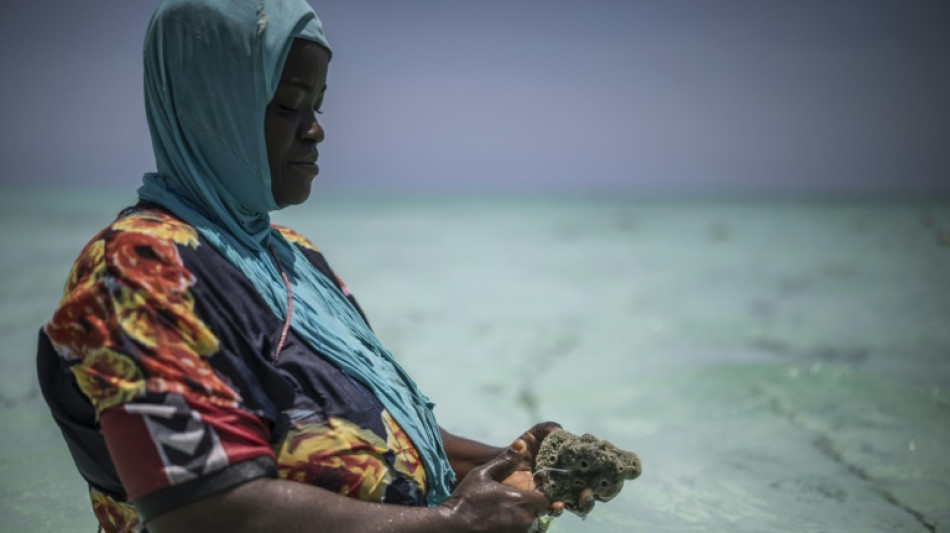
Zanzibar women turn to sponge farming as oceans heat up / Photo: © AFP

 Flydubai co-pilot planned suicide attack on Tel Aviv airport: UAE prosecutor

 Mike Ditka: Chicago Bears icon as player and coach

 Outrage over plan to livestream US military firing squad execution

 US sanctions: a 'test of resilience' for ICC

 NFL legend Mike Ditka dead at 86

 Hurricane Isaias set to strike Gulf Coast late Friday

 Trump forms panel to probe US Fed governor Lisa Cook

 Clashes in Durban as fresh anti-migrant riots erupt in South Africa

 France students plan more protests, UN 'concerned' over violence

 De Zerbi calls on struggling Spurs to react in Man Utd clash

 US sanctions on ICC: a 'test of resilience'

 Outrage over US military plan to livestream firing squad execution

 Argentina snap up defence guru Edwards ahead of World Cup

 BMW pulls car lease offer from German far-right politician

 Brazil election offers Jair Bolsonaro a shot at revenge

 Man Utd boss Carrick 'personally' affected by Man City verdict

 Evolution Metals & Technologies Corp. Raises Fiscal 2026 Revenue Guidance 62% at Midpoint to $10–$11 Million and Reaffirms $400–$460 Million Fiscal 2027 Outlook

 Red Bull's Verstappen takes pole position for Singapore GP sprint race

 Chelsea star Palmer 'committed' to England insists Alonso

 OpenAI denies firing researchers over AI safety warnings

 Turkey warns opposition, press over investment fund crisis

 Hurricane Isaias now major storm as it heads to US Gulf Coast

 Djokovic crashes out of Shanghai Masters in his first match

 EU says Turkey's crackdown on rights hampers membership bid

 Two Renoir paintings stolen in France recovered: mayor

Around 10 in the morning each day, women in hijabs and loose long dresses wade through Zanzibar's turquoise shallow tides to tend their sponge farms -- a new lifeline after climate change upended their former work.
Rising ocean temperatures, overfishing, and pollution have steadily degraded marine ecosystems around the island, undermining a key source of income for locals in Jambiani village who long depended on farming seaweed.
Instead, they have turned to sponge cultivation under a project set up by Swiss NGO Marine Cultures.
Hot temperatures have killed seaweed, and declining fish stocks have driven many fishermen to quit, said project manager Ali Mahmudi.
But sponges -- which provide shelter and food for sea creatures -- tend to thrive in warmer waters.
They are also lucrative as an organic personal care product, used for skin exfoliation. Depending on size, they can fetch up to $30 each and a single farm can have as many as 1,500 sponges.
From the shore, black sticks can be seen jutting out of the water, holding lines of sponges.
"I was shocked to learn that sponges exist in the ocean," Nasiri Hassan Haji, 53, told AFP, recalling when she first learned about the practice more than a decade ago.
The mother-of-four once farmed seaweed, describing the work as labour-intensive with meagre returns.
In 2009, Marine Cultures launched a pilot farm with widowed women in Jambiani to test their potential in the archipelago, where more than a quarter of the 1.9 million population live below the poverty line.
With demand for eco-friendly products on the rise, the market has grown steadily, with the US National Oceanic and Atmospheric Administration estimating the value of the natural sponge market at $20 million in 2020.
"It has changed my life, I have been able to build my own house," said 53-year-old Shemsa Abbasi Suleiman, smiling with pride.
Many other women have now joined a cooperative to expand the project, but it was not always smooth sailing.
"At first I was afraid of getting into it because I did not know how to swim. Many discouraged me saying the water is too much and I will die," said Haji.
Thanks to an NGO programme, she learned to swim at the age of 39.
- Sponges restore coral reefs -
As well as making money for locals, sponges are beneficial to the marine environment.
Studies show that a sponge's skeletal structure aids carbon recycling within coral reef ecosystems, while its porous body naturally filters and purifies seawater.
An estimated 60 percent of the world's marine ecosystems have been degraded or are being used unsustainably, according to the United Nations, which warns that the "ocean is in deep crisis".
Sponges are also known to help restore coral reefs, which support 25 percent of marine life and are currently under threat.
"What attracted me to this is the fact that we are not destroying the environment," said Haji.
T.Bondarenko--BTB