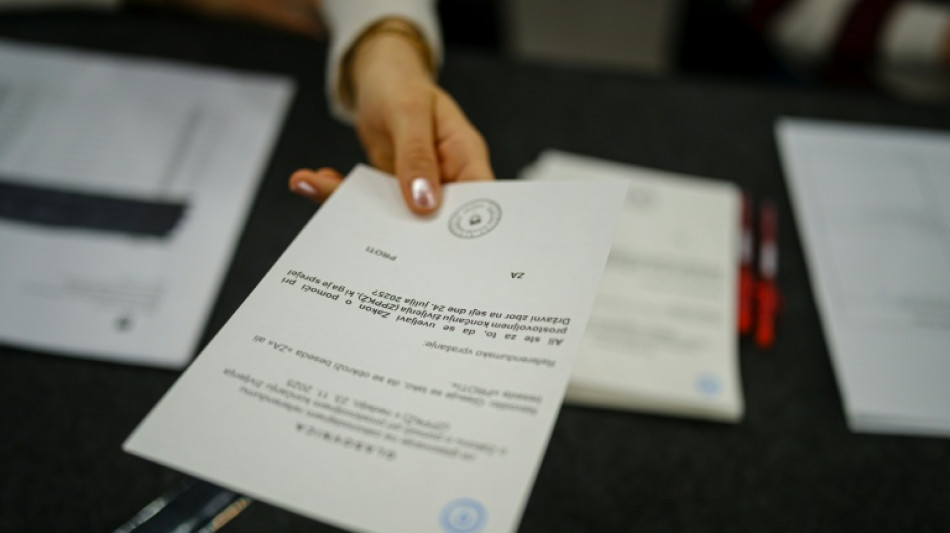
Slovenia referendum rejects contested assisted dying law / Photo: © AFP

 Three Mexicans convicted in murders of Australian, US surfers

 Powerful waves lash California coast as storm threatens more damage

 Trump hails Russia deal to release diesel as midterms loom

 Lyon blow chance to go top after loss at Lens
 Stocks rise as Trump says Russia to release diesel to world markets

 Wildfire smoke shuts schools in Amazon's biggest city

 Turkey jails 2 journalists pending trial for fund crisis 'misinformation'

 Major earthquake rocks Panama, triggers tsunami warning

 Indian jailed in France for leading sadist Nazi cult that tortured girls

 'Iron Mike' Ditka hailed as 'gold standard' NFL legend

 Flydubai co-pilot planned suicide attack on Tel Aviv airport: UAE prosecutor

 Mike Ditka: Chicago Bears icon as player and coach

 Outrage over plan to livestream US military firing squad execution

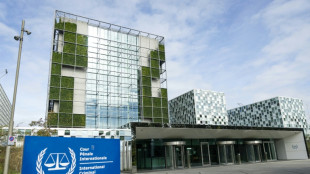
 US sanctions: a 'test of resilience' for ICC
 NFL legend Mike Ditka dead at 86
 Hurricane Isaias set to strike Gulf Coast late Friday
 Trump forms panel to probe US Fed governor Lisa Cook
 Clashes in Durban as fresh anti-migrant riots erupt in South Africa

 France students plan more protests, UN 'concerned' over violence
 De Zerbi calls on struggling Spurs to react in Man Utd clash
 US sanctions on ICC: a 'test of resilience'
 Outrage over US military plan to livestream firing squad execution

 Argentina snap up defence guru Edwards ahead of World Cup

 BMW pulls car lease offer from German far-right politician

 Brazil election offers Jair Bolsonaro a shot at revenge

Slovenians on Sunday voted to suspend a new law to legalise assisted dying in a referendum held after critics mounted a campaign against the legislation.
Around 53 percent of voters had rejected the law, while 47 percent voted in favour, meaning its implementation will be suspended for at least one year.
Slovenia's parliament had approved a law in July allowing assisted dying after a 2024 referendum supported it.
But the new vote was called after a civil group, backed by the Catholic Church and the conservative parliamentary opposition, gathered 46,000 signatures in favour of a repeat, exceeding the 40,000 required.
The result means parliament cannot vote again on a bill that deals with the same issue over the next 12 months.
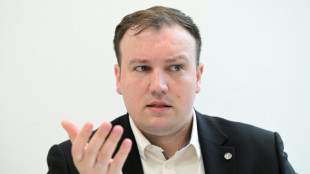
Ales Primc, the head of Voice for the Children and the Family, the NGO that organised the no vote campaign, reacted to the results saying "solidarity and justice" had won.
"Slovenia rejected the government's health, pension and social reforms based on death and poisoning," Primc was cited as saying by the Slovenian news agency STA.
Several European countries, including Austria, Belgium, the Netherlands and Switzerland allow terminally ill people to receive medical help to end their lives.
Under the disputed law, which was to take effect this year, lucid, terminally ill patients would have had the right to aid in dying if their suffering was unbearable and all treatment options had been exhausted.
- 'Culture of death' -
It would also have allowed for assisted dying if treatment offers had no reasonable prospect of recovery or improvement in the patient's condition, but not to end unbearable suffering from mental illness.
At the Stozice sports hall, the largest polling station in Ljubljana, 63-year-old pensioner Romana Hocevar said she would vote in favour of assisted dying.
"I'm a stage four cancer patient, I would not like to suffer. I had my father die of cancer and mother suffering dementia and I know what it looks like."
Vid Ursic, a 24-year-old student, said it was "good that we get to vote on relevant issues" and added that he supported "the right for people to decide on their own lives".
But Marija Unuk, in her late fifties, said she had voted against the law "because I support the culture of life, not the culture of death".
Prime Minister Robert Golob, who voted in advance, had urged citizens to back the law "so that each of us can decide for ourselves how and with what dignity we will end our lives".
- 'Human dignity' -
But the Catholic Church has said allowing assisted dying "contradicts the foundations of the Gospel, natural law and human dignity".
In June 2024, 55 percent had backed the law. Ahead of Sunday's vote, a poll showed that some 54 percent were in favour of it, while 31 percent opposed it and 15 percent were undecided.
A majority of participants representing at least 20 percent of Slovenia's 1.7 million eligible voters was required to reject the law in order for it to be suspended.
Turnout at the referendum was 40.9 percent -- just enough for the no vote to meet the threshold.
While several European countries already allow terminally ill people to receive medical help to end their lives, in others it remains a crime, even in cases of severe suffering.
In May, France's lower house of parliament approved a right-to-die bill in a first reading. The British parliament is debating similar legislation.
C.Kovalenko--BTB