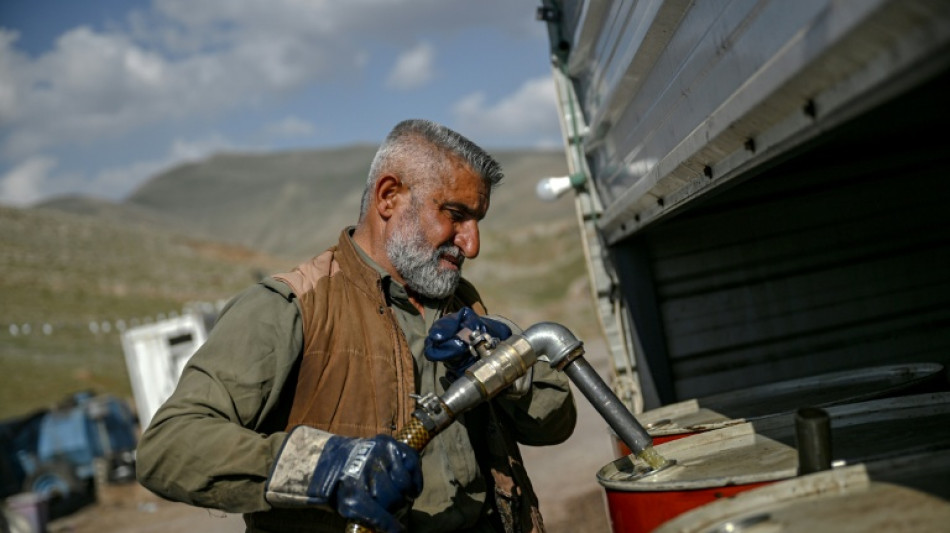
War forces lengthy detours for Iranian truck drivers to Iraq / Photo: © AFP

 Flydubai co-pilot planned suicide attack on Tel Aviv airport: UAE prosecutor

 Mike Ditka: Chicago Bears icon as player and coach
 Outrage over plan to livestream US military firing squad execution
 US sanctions: a 'test of resilience' for ICC
 NFL legend Mike Ditka dead at 86

 Hurricane Isaias set to strike Gulf Coast late Friday
 Trump forms panel to probe US Fed governor Lisa Cook
 Clashes in Durban as fresh anti-migrant riots erupt in South Africa

 France students plan more protests, UN 'concerned' over violence
 De Zerbi calls on struggling Spurs to react in Man Utd clash

 US sanctions on ICC: a 'test of resilience'
 Outrage over US military plan to livestream firing squad execution

 Argentina snap up defence guru Edwards ahead of World Cup
 BMW pulls car lease offer from German far-right politician
 Brazil election offers Jair Bolsonaro a shot at revenge
 Man Utd boss Carrick 'personally' affected by Man City verdict
 Evolution Metals & Technologies Corp. Raises Fiscal 2026 Revenue Guidance 62% at Midpoint to $10–$11 Million and Reaffirms $400–$460 Million Fiscal 2027 Outlook

 Red Bull's Verstappen takes pole position for Singapore GP sprint race

 Chelsea star Palmer 'committed' to England insists Alonso
 OpenAI denies firing researchers over AI safety warnings
 Turkey warns opposition, press over investment fund crisis

 Hurricane Isaias now major storm as it heads to US Gulf Coast

 Djokovic crashes out of Shanghai Masters in his first match

 EU says Turkey's crackdown on rights hampers membership bid

 Two Renoir paintings stolen in France recovered: mayor
Rubbing his hands together to warm them, Iranian truck driver Reza curses the more than 300-kilometre detour he was forced to make to enter Iraq after the war closed most of the usually busy border crossings.
Originally from the small town of Piranshahr in northwestern Iran, he normally drives just 20 minutes to the Haji Omeran crossing, but it has been shut since the start of Israeli-US air strikes on Iran on February 28.
"I waited five nights, it never opened," he told AFP on Wednesday in the car park on the Iraqi side of another border crossing further south, Bashmarq, which also connects Iran to Iraq's Kurdistan region.
Like the other drivers who spoke to AFP, Reza is being identified by a pseudonym, having requested anonymity out of concern for his safety.
The roads were quiet, said Reza, adding that his two wives and three sons remained at home.
"The Americans are only targeting military installations," he said from the vast car park near the crossing, where just 20 trucks were waiting, compared to hundreds in normal circumstances.
Services like water, gas and electricity were still running, Reza stressed, as were phones, but "only for local connections", including the domestic intranet.
In a country whose economy has been suffocated for years by international sanctions, the war has brought imports to a halt: the trucks that used to leave from the north no longer go down to Tehran or Bandar Abbas, a major Iranian port in the south, said Reza, who usually hauls food products.
"Prices have gone down, except for chicken," said Akbar Jafari, 37, from Kermanshah, a five-hour drive away.
Unlike Reza, he sent his family, including his wife and seven-year-old son, to his father-in-law's in the countryside when the strikes began.
"The problems are in the city centre," Jafari said.
- Abandoned checkpoints -
"The Basij (paramilitary force) abandoned the checkpoints they had set up in the city after the Mahsa Amini protests," he said, referring to the 2022 mass demonstrations sparked by the death in custody of Amini, who had been arrested for not wearing a headscarf properly.
"And in the evening, they leave their posts for fear of bombing," he said.
Life has gradually slowed down, with schools closed since the start of the air strikes and not reopening until after the break for Nowruz, the Persian New Year, starting on March 21.
Jafari and Reza have already decided against celebrating the important Iranian holiday -- the government has declared 40 days of mourning following the death of supreme leader Ali Khamenei on the first day of the war.
"Anyone who celebrates Nowruz will be in serious trouble," Reza said.
Still, the truck driver said Khamenei's death "changes nothing" in his own life.
"What we want is someone who truly serves the people."
Though Reza "wants the war to end", he said "only the Americans can change the regime", which recently cracked down on a wave of anti-government protests, leaving several thousand dead, according to NGOs.
Fellow trucker Zaheed, 37, said that "in the first few days, people were very afraid of the bombings, but you get used to it: the jets are constantly flying overhead, day and night, but it's like seeing a bird cross the sky".
His town of Mariwan, 30 kilometres (18 miles) from Bashmarq, was bombed, and several civilians were hit, four of whom died, he said.
"At first, many people left, but since then they've come back," he said.
His wife, however, still goes to her father's village with their 10- and 5-year-old children as soon as he hits the road: "She's scared when I leave."
As he climbed back into the cab, he added: "We used to live well in our town, before".
W.Lapointe--BTB