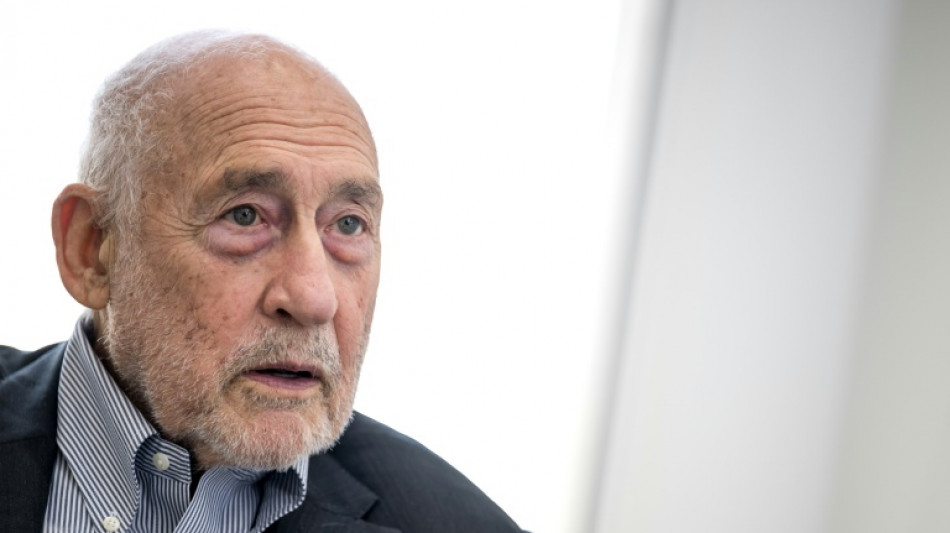
Stagflation risk in US 'quite high': Nobel-winning economist Stiglitz / Photo: © AFP

 US leads fresh Ukraine peace push with Miami talks
 Verstappen continues resurgence with pole for Singapore sprint
 Cuban ration book, symbol of the revolution, gathers dust
 Stocks advance, oil retreats as Trump rules out pre-vote Iran attack

 Man City case causing 'uncertainty' for whole Premier League, says Iraola
 Talks with Iran can only succeed without threats, president says
 Home hope Zheng sets up Mertens clash in China Open semis
 Lombardia promises gripping end to season in Pogacar absence
 Barca skipper Raphinha out against Getafe and Galatasaray
 MEXC and Payward Highlight Collaboration as Crypto and TradFi Converge at TOKEN2049
 EU states agree beefed-up European financial markets watchdog

 Eritrea, Ethiopia trade barbs as Tigray rebels retreat
 Kompany 'proud' of Man City success despite guilty verdict
 Man City will win appeal over financial charges, says Maresca
 Fernandez logs record lap at Indonesia MotoGP practice
 Navi Pillay: S.Africa's global rights activist and Nobel winner

 Ufunded Launches “Spotlight” Series, Documenting the Minds Shaping Modern Trading
 Russell goes fastest in practice for smoggy Singapore GP
 For exiled Russian director Zvyagintsev, triumph without belonging
 Home hope Zheng storms into China Open semi-finals
 Zverev churns out win in Shanghai Masters opener

 Hurricane Isaias strengthens en route to US Gulf Coast
 US activists deploy poll volunteers over Trump intimidation fears
 Saint Laurent designer Vaccarello leaves after glittering decade
 'Tough to stay here': Nepal flood survivors wait for homes

The war in the Middle East has put the United States at high risk of falling into stagflation, Nobel Prize-winning economist Joseph Stiglitz told AFP on Monday.
Even before the war erupted on February 28 with a barrage of US and Israeli strikes on Iran, Stiglitz said the US economy was already "close to stagflation" -- a troublesome blend of high inflation and anaemic growth.
There were a number of "readings for slow growth before the war", he said in an interview at the United Nations' European headquarters in Geneva, "and this just... pushes us over the brink".
The Middle East war has virtually halted activity in the strategically vital Strait of Hormuz, through which a fifth of the world's crude oil supplies and a substantial amount of gas normally run, sending oil prices soaring.
Global oil prices have surged by 40 to 50 percent after Iran choked off the waterway and attacked energy and shipping industry targets in the Gulf in response to the US-Israeli war against the Islamic republic.
This has sparked fears of a shock to a global trading system, which is already under stress from US President Donald Trump's tariff offensive as well as the fragmentation of supply chains since the Covid-19 pandemic and Russia's war in Ukraine.
- 'Unbalanced' -
Stiglitz, who jointly won the Nobel Economics Prize in 2001 for his analysis of markets with asymmetric information, said the United States was the country most at risk of falling into stagflation, as it did during the oil shocks in the 1970s.
"The risk of stagflation seems to be quite high for the US," said the professor at Columbia University in New York.
The situation elsewhere was not as clear-cut, said Stiglitz, who served as chief economist at the World Bank in the late 1990s after being the chairman of US president Bill Clinton's council of economic advisers.
While Europe would certainly face inflationary pressures on energy too, it was also seeing a growth "stimulus" as it dramatically ramps up defence spending, after Washington "made it very clear that you cannot depend on the US for your defence", he said.
Trump's policies had meanwhile significantly weakened the US economy even before the war, he maintained.
Stiglitz pointed to troubling indicators, like the lack of labour force growth in 2025 and last month's hike in unemployment.
And while there had been growth, it had been "unbalanced", he said, with around a third coming from the creation of artificial intelligence data centres.
The stock market, meanwhile, "is doing well because it's dominated by AI and tech firms", he said.
"If you look at the rest of the stock market, it's just languishing."
- Trump 'destroyed confidence' -
At the same time, Stiglitz said he expected to see Trump's tariff policy boost inflation.
Typically, when applying tariffs, a country could expect to see the value of its currency rise, since it is buying fewer goods abroad, which should lower inflation, the economist said.
But in this case, he pointed out that "the dollar has gotten weaker".
That, he said, is because "Trump has destroyed confidence in America and the dollar".
"The weaker dollar means that, rather than less inflation from the tariffs, there's more inflation... Everything we import is more expensive in dollar terms."
Added to that now is inflation from the war, as well as greater uncertainty among households and businesses.
They "don't know what the tariffs are going to be, (or) how long this war is going to last. They don't know what energy prices are going to be", Stiglitz said.
Businesses, he insisted, "can't invest in these circumstances".
P.Anderson--BTB