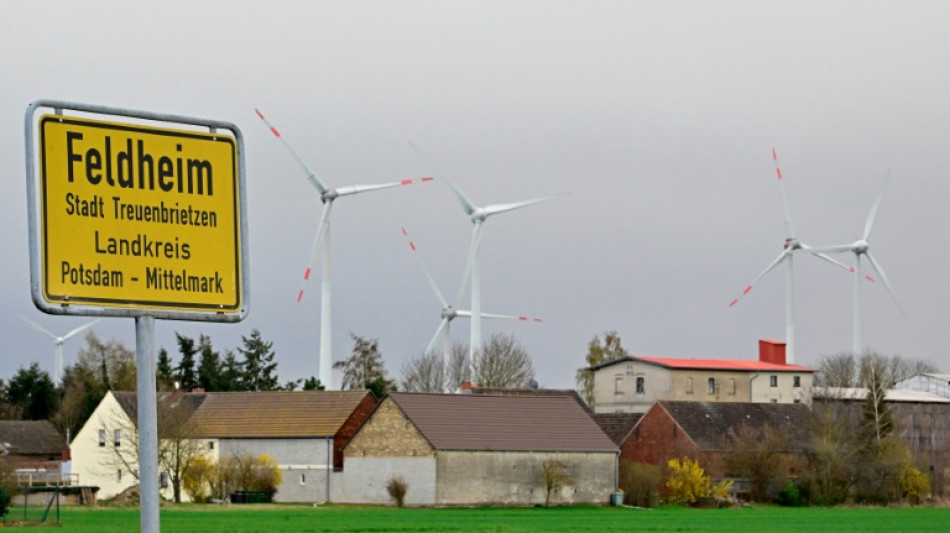
German 'green village' rides out Mideast energy storm / Photo: © AFP

 Ukraine takes Russia fight to 'scorching sands' of Sahel
 Chinese AI tool pulled to prevent 'misuse' after South Korea hacks

 Asian stocks mostly up as traders weigh AI, oil dips after surge

 Walking through flames: orangutans rescued in Indonesia fires
 LeBron shines in pre-season debut for re-tooled 76ers
 Okinawa resolution calls for revision of US forces pact after murder

 Verdict expected Friday in Mexico trial over murders of Australia, US surfers
 New York mayor says asking Trump to withdraw ICE after shooting

 Walking through flames: orangutan rescued in Indonesia fires
 James shines in pre-season debut for re-tooled 76ers

 Fuel, fertilizer costs strain US farmers' support for Republicans in midterms

 Trump's 'super intelligence' rebrand to sell AI faces uphill battle
 Fiji demands US provide evidence Chinese official paid bribes for Beijing
 More than just football: How scandal-tainted City led Manchester's rebirth
 Record Eden Park streak creates tension for All Blacks
 EU trade chief seeks 'tangible outcomes' in China talks
 Man City face Anfield cauldron after guilty Premier League verdicts

 CNN, MS Now, Politico urge judge to extend White House access

 Trump administration to launch new vaccine research center

 Russian strikes kill 30 in Ukraine frontline city, talks set in US
 US military to livestream firing squad execution of Fort Hood shooter
 Aces star Wilson wins record-extending fifth WNBA MVP
 Undefeated 49ers seek Seahawks revenge

 Madrid mourns evicted retiree, 'icon' of Spain housing protests

 OpenAI revenue gap report rattles AI stocks
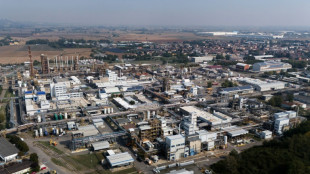
While the world frets about surging energy prices pushed up by the Middle East war, one small German village has been reaping the benefits of its turn to climate-friendly renewables.
Surrounded by wind turbines and studded with solar panels, Feldheim, population 130, boasts its own electricity and heating networks, supplied entirely by cheap local energy, also including biogas.
When it comes to keeping the lights on, "what's happening in the rest of the world doesn't really interest us," 56-year-old Michael Knape, who served as Feldheim mayor for almost a quarter-century, told AFP.
Feldheim, 80 kilometres (50 miles) southwest of Berlin, started its move towards clean renewables in the 1990s after German unification and by 2010 was boasting of its "energy self-sufficiency".
The small village has since attracted attention from across the world as an example of Germany's decades-old energy transition project away from fossil fuels and nuclear power.
The process has benefited from unique local conditions and significant investments.
Like much of the eastern state of Brandenburg where it is located, Feldheim sits on a flat, windswept plain, meaning the tens of nearby wind turbines generate plenty of energy.
While one of them provides enough power for the whole village, the others earn it money through taxes and charges levied on the operators.
As for heating, a biogas plant runs on slurry and leftover grain from an agricultural cooperative. On very cold evenings, the village gets a boost from a woodchip-fired heating plant.
Excess energy is stored in a battery for use in periods with little sun or wind, so-called "dark lulls".
"We hope it always stays like this, this model makes us happy," said Petra Richter, 62, a long-time resident of Feldheim.
Like her neighbours, she pays an average of 12 cents before tax per kilowatt hour of electricity, less than half the price usually paid elsewhere in Germany.
Her oil-powered boiler was replaced 15 years ago with pipes carrying communal hot water and a heat exchanger, and the same system has been in place ever since.
- 'Economically it works' -
According to Knape, who has just handed over the mayor's post, the municipality saves several hundred thousand euros a year by doing without fossil fuels.
"Obviously I can't compare a small village with a big city, but economically it works," he said.
The Middle East war has once again highlighted Germany's dependence on foreign energy imports, with the government taking steps to limit price rises at petrol stations.
Europe's top economy is still suffering from the cut-off of plentiful and cheap Russian gas imports after the 2022 full-scale invasion of Ukraine.
In this context, Knape argued, Feldheim could become "a successful export product" for Germany, just as the mighty automobile once was.
The village has made energetic efforts to publicise its model, attracting visitors including former chancellor Olaf Scholz but also professionals and politicians from the United States, India and even North Korea.
An information centre welcomes more than 3,000 people a year, schoolchildren come from across the state, and the technically curious can explore the inner workings of a wind turbine.
However, even in Feldheim, there are limits to how far residents can be truly insulated from the global energy shock.
Although the village has an e-car charging station, Richter is among the locals who do not have an electric vehicle and for whom petrol remains a crucial resource.
"We have to use the car every day," she said, adding that the spike in prices at the pump was "no longer bearable".
Richter pointed out that the village's energy independence may not be guaranteed in the long term, with the biogas plant nearing the end of its service life.
"We have to think about new solutions," she said.
H.Seidel--BTB