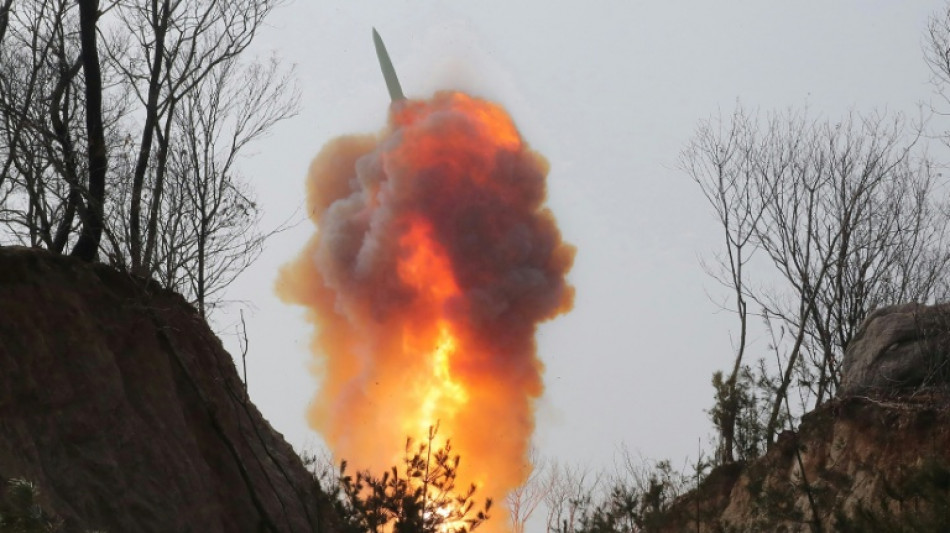
Crunch nuclear proliferation meeting at UN amid raging global wars / Photo: © KCNA VIA KNS/AFP/File

 Bid by Italy's Intesa bank to take over MPS gets boost
 Stablecoins Are Quietly Becoming Business Infrastructure, NOWPayments Data Shows
 Oil surges, stocks sink as US reportedly eyes new Iran strikes

 Woman in botched US execution walking, mentally 'foggy': lawyer
 Farhan hopes Pakistan's new combination takes off in Sri Lanka T20Is

 Teenager Andreeva seals China Open semi-final with Bartunkova
 Britain's Burnham says open to Germany joining warplane project

 Kovac's tough love has Dortmund dreaming of title charge
 China announces candidate for WHO chief

 South Korea test-fires its first homegrown hypersonic weapon: presidency

 ONAR Advances Nasdaq Listing Preparation Following Advertise Purple Acquisition and Financing

 Thailand opens extradition process for reporter sought by China

 France struggles to wean social housing off gas

 Germany lifts GDP forecast as economy withstands Iran war
 Sri Lanka appoints Kusal Mendis as Test captain
 Norris confident McLaren can shine in Singapore
 Alex Bodi pushes ahead with expansion: ALIX LASERS showroom planned for Bucharest
 Fossil fuels off COP31 agenda as global output keeps rising

 Haze not 'a threat' to Singapore F1 race: organisers

 COP31 organisers say to seek 'ambitious' action with their text
 Bartunkova thrashes Muchova to reach China Open semi-finals
 Drone hits Yandex data centre, in first such attack on Russia
 Oil prices surge and stocks sink on fresh inflation worries

 AI startup Manus raises $500m after Meta acquisition blocked by China

 From refuge to repatriations: Malaysia's Myanmar U-turn

Signatories of the landmark nuclear non-proliferation treaty will meet at the UN from Monday as hopes fade they can reach agreement and tensions soar between the atomic powers.
In 2022, during the last review of the treaty that is considered the cornerstone of non-proliferation, UN Secretary-General Antonio Guterres warned humanity was "one misunderstanding, one miscalculation away from nuclear annihilation."
The situation has only worsened since then.
"I think there is a shared, if you will, sense of crisis by all states parties," said Izumi Nakamitsu, the UN High Representative for Disarmament Affairs.
"We don't have any bilateral arms control agreements between the two largest nuclear weapon states," she said referring to the February expiration of the New Start treaty between Moscow and Washington.
"We are also beginning to see quantitative increase of nuclear capabilities in all nuclear weapon states."
Nakamitsu said that mounting geopolitical tensions had halted the post-Cold War trend of disarmament.
The nuclear non-proliferation treaty (NPT), signed by almost all the countries on the planet -- with notable exceptions like Israel, India, and Pakistan -- aims to prevent the spread of nuclear weapons, to promote complete disarmament, and to encourage cooperation on civilian nuclear projects.
The nine nuclear-armed states -- Russia, the United States, France, the United Kingdom, China, India, Pakistan, Israel, and North Korea -- possessed 12,241 nuclear warheads in January 2025, according to the latest report by the Stockholm International Peace Research Institute (SIPRI).
The United States and Russia hold nearly 90 percent of nuclear weapons globally and have carried out major programs to modernize them in recent years, according to SIPRI.
China has also rapidly increased its nuclear stockpile, SIPRI said, with the G7 raising the alarm Friday over Moscow and Beijing boosting their nuclear capabilities.
US President Donald Trump has indicated his intention to conduct new nuclear tests because "other countries are doing it too."
In March, France's President Emmanuel Macron announced a dramatic shift in nuclear deterrence, notably an increase in the atomic arsenal, currently numbering 290 warheads.
- NPT could 'unravel' -
"It is obvious that trust is eroding, both inside and outside the NPT," Seth Sheldon of the International Campaign to Abolish Nuclear Weapons (ICAN), a Nobel Peace Prize laureate, told AFP.
He questioned the likely outcome of the four-week summit.
Decisions on the NPT have to be agreed by consensus, with the previous two conferences failing to adopt final political declarations.
In 2015, the deadlock was largely due to opposition by Israel's arch-ally Washington to the creation of a nuclear-weapon-free zone in the Middle East.
In 2022, the impasse was due mainly to Russian opposition to references to Ukraine's nuclear power plant at Zaporizhzhia, occupied by Moscow.
This year's summit could fall on any number of stumbling blocks.
The ongoing war in Ukraine, Iran's nuclear program and the war there, non-nuclear states' fears over proliferation and North Korea's developing arsenal could all be deal-breakers.
If there is a third consecutive failure, the treaty "might not implode overnight" said Christopher King, the conference's secretary-general.
But there is a risk "it will, over time, unravel."
Artificial intelligence could be a prominent issue as some countries call for all sides to keep human control over nuclear weapons.
K.Thomson--BTB