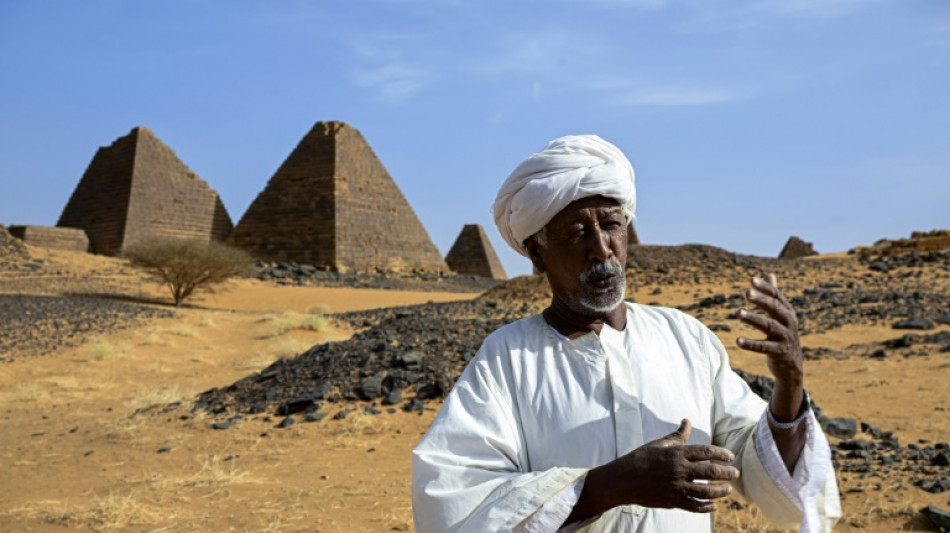
The loyal, lonely keepers of Sudan's pyramids / Photo: © AFP

 WhiteBIT Launches Bitcoin Lightning Network Support, Powered by Voltage

 Oil surges, stocks sink as US reportedly eyes fresh Iran strikes
 Anne Carson: modern takes on Greek classics

 Canada's Anne Carson wins Nobel literature prize

 Ethiopia drones hit Eritrean troops in Tigray

 Russian strike on buses kills 30 in frontline Ukrainian city

 Thailand begins extradition process against Chinese journalist

 Quarantine, unease and rumours: Russian city grapples with plague scare

 Taiwan says exports hit record in September on AI demand
 Marc Marquez vows to 'attack' Martin's lead at Indonesian MotoGP
 Diplomats, schools in Saudi take safety measures after blasts heard: sources to AFP

 In Beijing, EU trade envoy says deficit with China 'unsustainable'

 Sri Lanka's de Silva quits as Test captain

 Alcaraz feeling 'mentally fresh' ahead of Shanghai return

 Israel drastically reduces British diplomatic presence in Jerusalem
 Stocks fall further as oil surge fans fresh inflation worries

 North Korea demands South show 'utmost respect' to restore relations

 Saudi says three dead in airport attacks claimed by Houthis

 'Mad dream': New showcase for African film opens in London

 All Blacks coach Rennie says Wallabies exit 'part of the game'

 The growing protests against India's poll body - and PM Modi
 Stocks fall further as oil spike fans fresh inflation worries
 Bad COP, worse COP? EU tempers hopes for UN climate summit

 Rookie Henry named in Wallabies midfield to face All Blacks
 Housing crisis set to dominate Spain's snap election

Mostafa Ahmed Mostafa is the heir to a long line of groundskeepers who have guarded Sudan's ancient pyramids of Meroe. Now, three years into the war between the army and paramilitary forces, he stands near-solitary sentinel over his heritage.
"These pyramids are ours, it's our history, it's who we are," the 65-year-old said, flanked by the dark sandstone structures of the Bajrawiya necropolis, which is part of the Island of Meroe, a UNESCO World Heritage site.
Clad all in white, Mostafa cut a striking figure crossing the 2,400-year-old burial site, which holds 140 pyramids built during the Kingdom of Kush's Meroitic period.
None are intact. Some were decapitated, others reduced to rubble, first in the 1800s by dynamite at the hands of treasure-hunting Europeans, and then by two centuries of sand and rain.
A three-hour drive from the capital Khartoum, it was once Sudan's most visited heritage site. Now three years into the war between Sudan's army and the paramilitary Rapid Support Forces, only a lone camel's grunt cuts through the silence.
Archaeologist and site director Mahmoud Soliman gave AFP journalists a tour, explaining the Kush kingdom's matrilineal succession, trade routes and relationship with neighbouring Egypt.
"It's maybe the fourth time I've shown people around since the war broke out," the scientist said.
Together, he, Mostafa and young archaeologist Mohamed Mubarak man the site, cobbling together resources to keep the erosive rain and sands at bay.
Apart from a short-lived influx of visitors early in the war -- mostly displaced people desperate for something to do -- the site has stood largely abandoned.
- 'My grandmother Kandaka' -
It is worlds away from its pre-war days, when there were "regular weekend visits from Khartoum, busloads of 200 people per day", Soliman remembered fondly.
Sudan's heritage sites had experienced a resurgence, he explained, after the uprising of 2018-2019, when young Sudanese protested against autocrat Omar al-Bashir.
One chant went: "My grandfather Taharqa, my grandmother Kandaka" -- the former a Kush Pharaoh, the latter the name for ancient queens, and also used to honour the women icons of the revolution.
"Young people were taking more of an interest, they were organising trips to tourist sites and getting to know their own country," Soliman said.
Residents of the nearby Tarabil village -- named after the local word for "pyramids" -- sold souvenirs and rented camels and "were entirely dependent on the site".
On a breezy day in April, Khaled Abdelrazek, 45, rushed to the site as soon as he heard there were visitors. He squatted at the entrance, showed AFP journalists handmade miniature sandstone pyramids and reminisced about when there were "dozens of us selling".
In the months before the war, there were visits from documentary crews, a music festival and "big ideas for right after Eid al-Fitr", said Soliman -- all destroyed when the war broke out in the last days of Ramadan.
"I used to feel like I was teaching people about their culture," said Mubarak, who has worked at the site since 2018.
"Now, everyone's top priority is of course food and water and shelter. But this is also important. We need to protect this for future generations, we can't let it be destroyed or wither away."
- Distant dream -
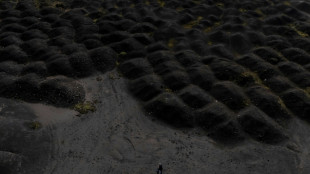
Near the site's entrance, the proud pyramids, each fronted by a small mortuary temple, are framed by rolling black sandstone hills.
The vista is breathtaking, but Soliman said his eyes see only danger: Is that crack in that pyramid new? Has that sand mound moved? Does the pipe scaffolding at that burial chamber entrance need to be redone before the rainy season?
"I think if the pyramids had been left in their original state we wouldn't have all these problems," Mubarak said.
The structures are smaller and steeper than their Egyptian neighbours, built to "withstand the sands and sweep away the rainwater, but every fracture creates issues".
The largest pyramid of the lot -- of Queen Amanishakheto, who reigned around the 1st century AD -- suffered more than just fractures and is now effectively a sandbox, fine sand swirling where her tomb once stood.
In 1834, Italian adventurer Giuseppe Ferlini, who destroyed dozens of pyramids, levelled Amanishakheto's and carted her jewellery off to Europe. It is now exhibited in the Egyptian museums in Berlin and Munich.
The outside of her temple wall still stands, where a larger-than-life carving of the queen shows her standing proud, holding a spear in one hand and smiting enemy captives.
Soliman showed AFP journalists more reliefs: the lion deity Apademak and motifs shared with Egypt, including the gods Amun and Anubis, lotus flowers and hieroglyphics.
He yearns for the day tourists and archeologists will return.
"This is just a distant dream, but I'd really like us to one day be able to do proper restoration on these pyramids," he said, as if he were not really allowing himself to hope.
"This place has so much potential."
J.Fankhauser--BTB