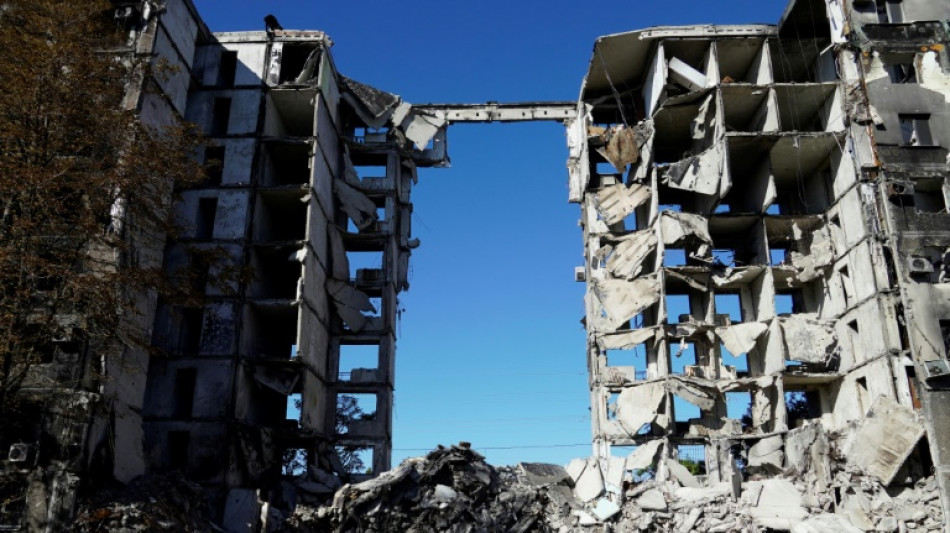
World economy to slow, 'paying the price of war': OECD / Photo: © AFP

 How we might hear new Dolly Parton music in the future

 Nvidia doubles revenue, forecasts even more AI spending

 Canada renews push to boycott US products

 Savio scores on debut as Spurs set-up League Cup tie with Liverpool

 Brazil sues Discord over child safety measures, demands $100 mln in damages

 Alberta NDP Urges Smith to Postpone Separation Vote Amid Trade War

 Fenerbahce stun Lyon in Champions League as AEK crush Levski

 Why Global Finance Still Relies on Wall Street Despite Diversification Trends

 Bethlehem Father Seeks Aid for Special Needs Children Amid Health Crisis
 LIV Golf to lay off majority of staff

 How narwhal 'scientists' track Arctic warming

 Iran says US sanctions will achieve nothing

 Essential Dolly: five key Parton songs

 Veteran promoter Warren says it's Joshua's job to agree Fury fight

 Ex-champ Wawrinka gets last-minute wildcard to US Open

 Brennan blasts to Vuelta stage five victory, Pogacar holds lead
 What could change for US teens on Instagram and Facebook
 Meta, US states agree $16.7 bn settlement in landmark teen safety case
 'Point of no return' if Israel-Hamas truce fails: US envoy to Gaza board

 Barcelona holding out hope for Alvarez as Atletico resist sale

 Werro basks in new status, shelves world record talk

 Bill Gates warns world unprepared for AI upheaval

 Prince Harry and family arrive back in Britain: UK media

 German plan for sugar tax on Coke Zero fizzles out

 Deadly flood hits Nepal-Tibet border, hundreds unaccounted for

The world economy will take a bigger hit than previously forecast next year due to the effects of Russia's war in Ukraine, the OECD said Monday.
In a bleak report titled "paying the price of war", the Paris-based organisation noted that the conflict aggravated inflationary pressure when the cost of living was already rising quickly.
Covid outbreaks are still having an impact on the global economy while growth has also been affected by rising interest rates as central banks scramble to cool red-hot prices, the OECD said.
"A number of indicators have taken a turn for the worse, and the global growth outlook has darkened," the Organisation for Economic Co-operation and Development said in the report.
Global growth stalled in the second quarter of this year and data in many economies "now point to an extended period of subdued growth", the OECD said.
The organisation slashed its 2023 growth forecast for the global economy to 2.2 percent, down from 2.8 percent in its previous estimate in June.
- German recession -
The outlook for nearly all nations in the Group of 20 top economies was cut, except for Turkey, Indonesia and Britain, though the latter is forecast to have zero growth.
Growth in the United States -- the world's biggest economy -- is forecast to slow to 0.5 percent in 2023.
The growth forecast for China, whose economy has been hit by strict Covid lockdowns, was cut sharply for this year to 3.2 percent while it was slightly lower to 4.7 percent for 2023.
Germany is now expected to go into recession next year with Europe's biggest economy now seen shrinking by 0.7 percent -- a 2.4-percentage-point drop from the previous forecast.
The country's economy has been hit the hardest in Europe as it has relied heavily on Russian supplies of natural gas, which Moscow has cut significantly in suspected retaliation to Western sanctions.
The eurozone as a whole will post meagre growth of 0.3 percent, a sharp downgrade from 1.6 percent.
The OECD kept its 2022 global growth forecast unchanged at three percent after previously lowering it.
To highlight the impact of Russia's invasion of Ukraine, the OECD said global output in 2023 is now projected to be $2.8 trillion lower than previously estimated before the conflict in December 2021.
- 'Significant uncertainty' -
The war has sent energy and food prices soaring over concerns about supply as Russia is a major oil and gas producer while Ukraine is a key exporter of grains to countries across the world.
Inflation had already been on the rise before the conflict due to bottlenecks in the global supply chain after countries emerged from Covid lockdowns.
"The effects of the war and the continuing impacts of Covid-19 outbreaks in some parts of the world have dented growth and put additional upward pressure on prices," the OECD said.
"Inflationary pressures have become increasingly broad-based, with higher energy, transportation and other costs being passed through into prices," it said.
The OECD raised its inflation forecast for the G20 to 8.2 percent for 2022 and 6.6 percent for next year.
Governments have announced emergency measures to help households and businesses cope with the soaring cost of living.
But the fiscal measures to offset energy costs "have been poorly targeted", the OECD said.
Central banks, meanwhile, have ramped up interest rates, a move necessary to tame inflation but that can also push economies into recession.
The monetary tightening is a "key factor slowing global growth", the OECD said.
The organisation warned that "significant uncertainty surrounds the projections" for the global economy.
More severe fuel shortages could shave off a further 1.25-percentage-points from Europe's economy in 2023 and a half-point for global growth
J.Bergmann--BTB