The disappearing Bulgarians: despair as young leave / Photo: © AFP

 How we might hear new Dolly Parton music in the future

 Nvidia doubles revenue, forecasts even more AI spending

 Canada renews push to boycott US products
 Savio scores on debut as Spurs set-up League Cup tie with Liverpool
 Brazil sues Discord over child safety measures, demands $100 mln in damages

 Alberta NDP Urges Smith to Postpone Separation Vote Amid Trade War

 Fenerbahce stun Lyon in Champions League as AEK crush Levski
 Why Global Finance Still Relies on Wall Street Despite Diversification Trends

 Bethlehem Father Seeks Aid for Special Needs Children Amid Health Crisis
 LIV Golf to lay off majority of staff
 How narwhal 'scientists' track Arctic warming
 Iran says US sanctions will achieve nothing

 Essential Dolly: five key Parton songs

 Veteran promoter Warren says it's Joshua's job to agree Fury fight

 Ex-champ Wawrinka gets last-minute wildcard to US Open

 Brennan blasts to Vuelta stage five victory, Pogacar holds lead
 What could change for US teens on Instagram and Facebook
 Meta, US states agree $16.7 bn settlement in landmark teen safety case

 'Point of no return' if Israel-Hamas truce fails: US envoy to Gaza board

 Barcelona holding out hope for Alvarez as Atletico resist sale

 Werro basks in new status, shelves world record talk

 Bill Gates warns world unprepared for AI upheaval

 Prince Harry and family arrive back in Britain: UK media

 German plan for sugar tax on Coke Zero fizzles out

 Deadly flood hits Nepal-Tibet border, hundreds unaccounted for

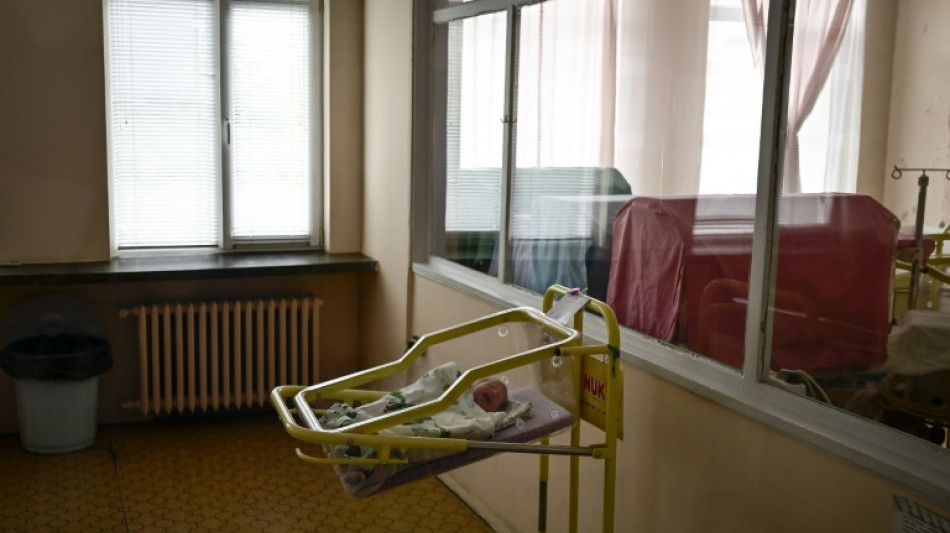
Empty corridors and only eight babies in their cribs. The maternity ward in the city of Gabrovo tells you everything you need to know about the drastic drop in the birth rate in Bulgaria.
"There are not many people of childbearing age left around here. The young left looking for jobs in the big cities or abroad," paediatrician Bistra Kamburova, 68, told AFP.
Gabrovo, huddled at the foot of the Balkan mountains, is symbolic of the population decline in the European Union's poorest member.
Once known as the "Bulgarian Manchester" for its booming industry, the town has lost half its people since 1985.
It is a familiar story across the country.
Corruption, lack of prospects and a spiral of political crises that will see Bulgarians vote Sunday in their fourth general election in 18 months, have chased its disillusioned young people away.
Analysts predict the election will once again return a fragmented parliament with no party able to cobble together a strong coalition.
Bulgaria has lost a tenth of its population in a decade, making it one of the world's fastest shrinking nations.
It now has 6.52 million people compared to close to 9.0 million inhabitants in 1989. And a quarter of the population is aged 65 or over.
- 'It's a desert' -
Gabrovo's industries employed thousands of workers during communism, before bankruptcies and privatisations laid the factories bare.
Now it has become the region with the lowest birth rate and the highest number of almost uninhabited villages in the country.
"I started working here in 1985. At that time the number of births was still quite high -- around 1,000 babies per year," said Dr Kamburova, whose two grown-up sons are among those who have left Gabrovo.
"But the factories were working, working, working," she added.
Last year only 263 babies were born in the Gabrovo region and looked after by the energetic paediatrician, who works on long after her retirement age for "miserable pay".
"The explanation is simple -- no employment, no young people, no babies," said midwife Mariana Varbanova.
Many of those who remain are keen to leave.
"In Gabrovo, you enjoy the peace and quiet and the fresh air, but it's a desert where you only meet elderly people," said Hristiana Krasteva, a 23-year-old speech therapist, who recently gave birth to a baby girl.
Her husband, who works as a carpenter, is getting ready to leave for Britain in search of a better future for his family.
- 'Grandchildren for rent' -
In front of the first public school in Bulgaria, founded in Gabrovo in 1835, high school student Ivo Dimitrov also wants to leave for western Europe to get "quality education and new horizons.
"It's chaos here," he said, denouncing the negligence of the political class.
Despite aid from Brussels since Bulgaria joined the EU in 2007 to help development, transport and tourism projects, Gabrovo needs fewer and fewer workers.
"It will take time to reverse the demographic trend," analyst Adrian Nikolov from the Sofia-based Institute for Market Economy told AFP.
Only 35 people live in the picturesque 17th-century village of Zaya some 25 kilometres from Gabrovo.
Apart from the locals, pensioners from France, Britain, Belgium, Russia, Italy and other countries have settled there attracted by the cheaper cost of living.
There is no polling station, and the village grocery store shut years ago for lack of customers.
"We decided to get together to go shopping. We get by somehow," said Marin Krastev, a retired electrician, whose daughter long ago left for Germany.
Once a week, the 77-year-old drives three other retired women from the village to the nearest shop.
To brighten up their lives, the elderly joined a municipal programme over the summer called "Grandchildren for Rent" that brought young people to Zaya to discover village life.
"They enjoyed the rabbits, as well as the home-grown tomatoes and peppers," the village's cultural centre chairwoman Boyana Boneva, 75, smiled.
M.Ouellet--BTB