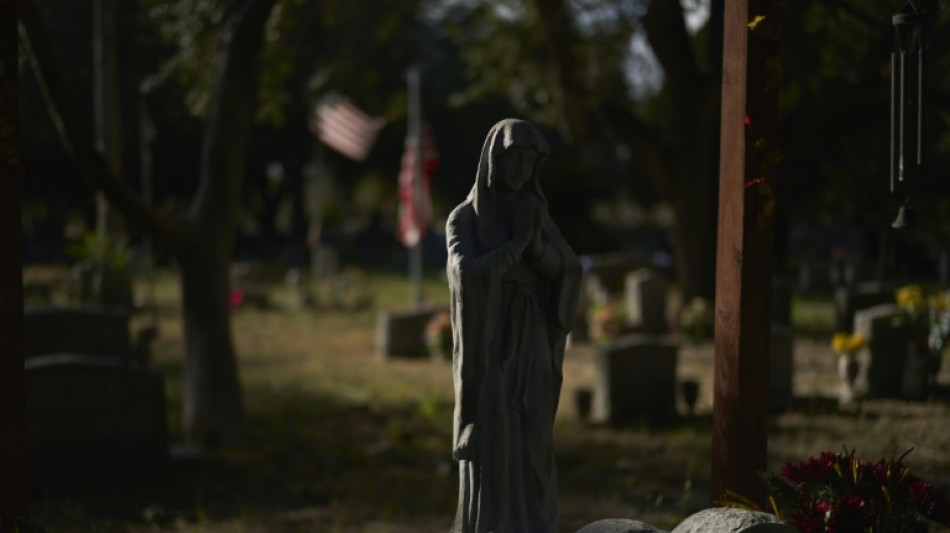
Anonymous graves mark the end of the line for migrants at US border / Photo: © AFP

 'Find your own room': Japan says can't handle added Asian Games numbers

 Fresh flood warnings for disaster-hit Nepal and Tibet, 1,400 still missing

 Most Asian stocks advance as attention turns to Warsh speech

 US mother's child murder trial puts spotlight on postpartum psychosis

 'End of an era': Players lament decline of the disc at Gamescom

 Air traffic controllers left early before deadly NY crash: report
 Golf media firm loses Callaway, PGA Tour deals over violent ad

 US to push economic pressure on Iran at G20 finance talks

 Kiss rotates Wallabies forwards for Argentina Test

 Guns, drugs and car chases: GTA 6 preview lands on Netflix after leaks
 Arteta braced for 'tough' Martinelli, Jesus exits from Arsenal

 Welbeck scores first Chelsea goal in League Cup win over Luton

 Arsenal face depleted Aston Villa, Spurs seek return on £300m spend

 Werro edges ever closer to elusive women's 800m world record

 Callaway cuts ties with golf media firm over violent ad

 Trump says Putin won't attack NATO territory

 Labor Day 2026: Complete Starter Tool Kit Under $375

 Tamil Nadu Govt Assigns Ministers to Oversee Chennai Monsoon Preparedness
 Alfred gets revenge on Jefferson-Wooden in Zurich 100m

 US Open men's singles: Three talking points

 Michael Strahan Welcomes Fifth Child with Girlfriend Kayla Quick

 Kuminga’s Timberwolves Deal Saves Millions in Taxes Despite Lower Pay Than Lakers Offer
 Trump says Russia is 'not going to attack' NATO territory

 OpenAI Tests 'Persistent Mode' for Codex AI Agent

 PSG to face Barcelona, Man City and Villa in Champions League as draw is made
Sheriff Urbino Martinez has collected the remains of so many dead migrants who have come across the US southern border that he is known as "The Undertaker."
"It's deadly out there," says Martinez, who patrols the small Texan county of Brooks, a few dozen kilometers (miles) from Mexico.
"We started keeping track of the dead bodies from 2009," he told AFP in his office, pointing to 20 thick volumes, where his department has information on 913 cases.
But, he says, that's only a fraction of the true human toll of the border crossings.
"I would multiply that times five, maybe even 10 for those bodies that will never be recovered."
The United States logged a record 2.3 million migrant encounters at its southern border in the year to September -- a key issue for some voters as they head to the polls for next month's midterm elections.
Many were sent back south; an unknown number made it into the country without being detected.
At least 700 people are known to have died in the attempt.
To avoid the checkpoint in Falfurrias, the main town in Brooks County, migrants are directed by human traffickers into vast farmsteds where dense vegetation, treacherous sands and soaring temperatures can prove fatal.
Sometimes, there isn't much of a person left to find.
Martinez's folders are labelled "human remains" -- a chillingly accurate description of the photographs that sometimes show partial torsos or just a few bones.
"If it's real hot, your body will decompose completely within 72 hours, and then the animals are going to tear whatever's left.
"The feral hogs, the rats, anything that's out there that can tear the limb off, they're going to do it. We found human bones inside a rat's den before."
Numbers are down in Brooks county this year -- Martinez has logged 80 bodies so far in 2022, all of which were processed through his mobile mortuary.
"It is less than last year but it is 80 too many," he says.
- No identification -
The death that Martinez finds in Brooks is not unique to his county.
The same pattern of tragedy is repeated all along the Texan border: desperate people dying as they flee the crushing poverty, violence and terror of their dysfunctional homelands.
In the border town of Eagle Pass, the municipal cemetery is strewn with rudimentary crosses that mark the graves of dozens of unknown dead; the men and women whose American dreams ended in anonymous graves.
Around 40 plaques, labelled John or Jane Doe, sit next to a small US flag.
Across town, the migrants are still coming, gambling that the possibility of death en route is better than the alternative.
"It was an ordeal," said Alejandra, a 35-year-old Colombian who crossed the rushing Rio Grande to reach Texas, even though she cannot swim. "But it was scarier to go back."
Cowering under a tree from the hot sun, Alejandra said she needed asylum because of the danger she faced from organized crime in Colombia.
"If we go back, they'll kill us," she said, looking at her three teenage children.
- Remains -
Corinne Stern, the chief coroner for southern Texas, says most of the migrants whose remains she examines died from heatstroke or dehydration.
"Up until about five years ago, (the border) took up about 30 percent of my time... Now it's taking up about 75 percent," says the doctor, who wears a necklace inscribed with the Hebrew word for "Life."
In the reception area of the morgue, a painting reads: "Let the dead teach the living."
Inside, a blackboard lists dozens of Jane and John Does.
The morgue is impeccably clean, but the smell of bodily decay is pervasive, permeating the masks visitors are required to wear.
The vast majority of border cases she receives have no identification, Stern says, as she examines the skeletal remains of a still-clothed female body.
Attached to the corpse is a small olive green backpack.
When the doctor picks it up, two lollipops fall out, their colorful wrappings a contrast to the earthy ochre that swathes the clothes and the bones.
DNA samples are extracted in an attempt to identify her, but for now she will be labeled as yet another Jane Doe, one of 250 Stern has dealt with this year.
- 'Where is my wife?' -
For Eduardo Canales, the open-endedness of anonymous death is too much to bear.
In 2013, Canales founded the South Texas Human Rights Center, installing water stations around ranches to prevent migrants from drinking the water in the cattle troughs, which can be toxic for humans.
Canales, 74, supplies blue plastic barrels that have location coordinates and a phone number to call for help.
But when he began receiving calls from family members looking for loved ones who had gone missing after crossing the border, he decided to expand his work.
"For me the most important thing is for families to be able to find closure," he says.
"Families don't stop looking, they never give up. They keep asking where is my wife, my brother, my daughter?"
Many were buried anonymously in the Falfurrias cemetery, but a partnership with Texas State University made it possible to exhume dozens of bodies and identify them by their fingerprints.
The effort has reduced the number of anonymous graves in Brooks: of the 119 people found in 2021, 107 were identified.
"But many more die and disappear without us ever finding them," Canales says, pointing to vast dusty plains.
"Here the only constant is death."
F.Pavlenko--BTB