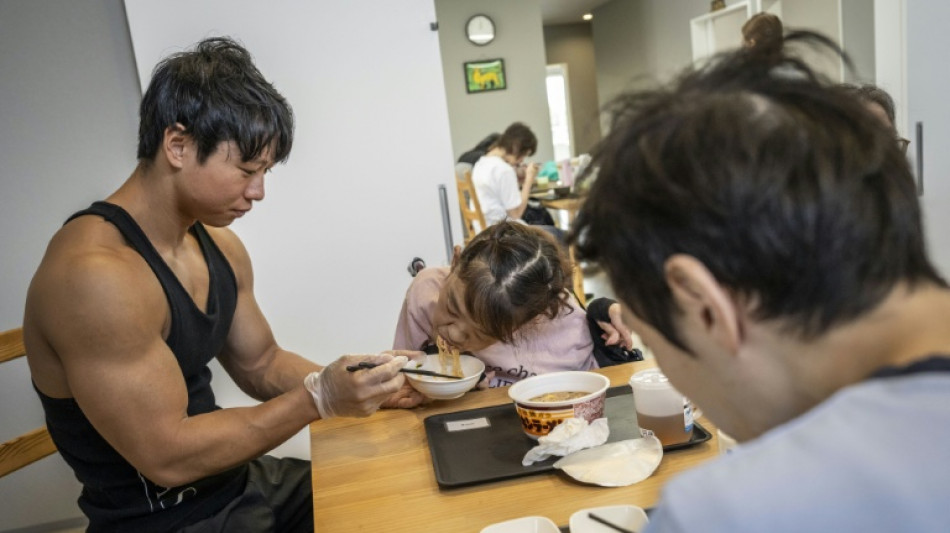
Young bodybuilders lift Japan's ailing care sector / Photo: © AFP

 How we might hear new Dolly Parton music in the future

 Nvidia doubles revenue, forecasts even more AI spending

 Canada renews push to boycott US products

 Savio scores on debut as Spurs set-up League Cup tie with Liverpool

 Brazil sues Discord over child safety measures, demands $100 mln in damages

 Alberta NDP Urges Smith to Postpone Separation Vote Amid Trade War

 Fenerbahce stun Lyon in Champions League as AEK crush Levski

 Why Global Finance Still Relies on Wall Street Despite Diversification Trends

 Bethlehem Father Seeks Aid for Special Needs Children Amid Health Crisis

 LIV Golf to lay off majority of staff

 How narwhal 'scientists' track Arctic warming

 Iran says US sanctions will achieve nothing

 Essential Dolly: five key Parton songs

 Veteran promoter Warren says it's Joshua's job to agree Fury fight

 Ex-champ Wawrinka gets last-minute wildcard to US Open

 Brennan blasts to Vuelta stage five victory, Pogacar holds lead

 What could change for US teens on Instagram and Facebook

 Meta, US states agree $16.7 bn settlement in landmark teen safety case
 'Point of no return' if Israel-Hamas truce fails: US envoy to Gaza board

 Barcelona holding out hope for Alvarez as Atletico resist sale

 Werro basks in new status, shelves world record talk

 Bill Gates warns world unprepared for AI upheaval

 Prince Harry and family arrive back in Britain: UK media

 German plan for sugar tax on Coke Zero fizzles out

 Deadly flood hits Nepal-Tibet border, hundreds unaccounted for

Muscles bulging, bodybuilder Takuya Usui settles a woman into her wheelchair at a Japanese care home, where jacked Gen Zers are helping to ease labour shortages in a struggling industry.
Gender stereotypes and poor pay have long discouraged Japanese young men from becoming caregivers, even as demand surges in a country with one of the world's oldest populations.
But Visionary, a firm based in the central city of Nagoya, has hit upon an unusual solution: luring male bodybuilders into the care sector with perks including paid gym time and subsidies for protein shakes.
"I used to find nothing appealing about this industry," Usui, a former fitness trainer, told AFP.
But then, "I was told I can actually put my muscles to use in this job, and I thought: 'Well, let's give it a try.'"
Wearing a black sleeveless vest that shows off his tan and biceps, Usui effortlessly lifts wheelchair user Madoka Yamaguchi out of bed, gives her lunch, brushes her teeth and helps her apply eye drops.
"He is so muscular that I don't have to worry that he might accidentally drop me," said 65-year-old Yamaguchi, who is unable to move her limbs.
"It's reassuring," she explained from Visionary's care home near Nagoya for people with disabilities.
An acute labour shortage plagues the caregiving industry in Japan --home to the world's second-oldest population after Monaco, according to the World Bank -- with nearly four vacancies for every job seeker.
Japan's labour ministry estimates a shortfall of about 570,000 caregivers by 2040, driven by low wages that fail to match the physically demanding nature of the work.
Men tend to stay away, leaving women -- mostly those aged 40 or older -- to make up over 70 percent of positions in care facilities, according to labour ministry data.
"I stood out a lot for being male and young," said 40-year-old Visionary CEO Yusuke Niwa, recalling his first job as a carer nearly 20 years ago.
It dawned on him that "being cool" was key to igniting interest among young men, and he set out to recruit people who resembled his own role models.
He considered, but ultimately dismissed, football players and martial arts fighters, before homing in on bodybuilders.
"Bodybuilders are extremely photogenic, cool and the embodiment of tireless hard work," Niwa said.
- 'Muscle-friendly' -
It was in 2018 -- a decade after he founded Visionary -- that Niwa unveiled the concept of "Macho Caregivers", a campaign to remove the stigma around the care industry.
Before then, the company had struggled to hire even a single carer a year, but the idea brought applications flooding in, including from young men.
The firm says it hired 168 people in the fiscal year 2024 alone.
Visionary now expects annual sales of 2.2 billion yen ($14.4 million) for this fiscal year ending in March 2026, roughly a 10-fold jump compared with the period before 2018.
The vast majority of new recruits are casual fitness enthusiasts.
But while all employees enjoy free gym access, the most generous benefits, such as two hours of paid weight training a day, are reserved for a select squad of competitive bodybuilders.
Among them is Hokuto Tatsumi, 27, an ex-serviceman in the Maritime Self-Defense Force enticed by the "most muscle-friendly work environment you could hope for".
Bodybuilders are adept at enduring the tedium of daily training and strict dietary regimens, he said.
That discipline "can be a great advantage for caregivers who support the same clients every day".
"It might seem simple but is actually quite challenging," Tatsumi said.
- 'Tremendous loss' -
In Japan, the need to care for ailing parents and other family members forces around 100,000 people to quit jobs every year, according to government data.
And 300,000 more are forecast to juggle their careers with caregiving at home by 2030, the data shows.
"That these workers are unable to fully realise their potential is such a tremendous loss," CEO Niwa said, adding that the care industry had to step up.
Over the past two years, wheelchair user Yamaguchi -- who enjoys painting and beadwork -- and elite bodybuilder Usui have built a striking friendship.
"Madoka here can't quite use her hands, but she uses her mouth (to control a paintbrush). I find that resourcefulness inspiring," Usui said, smiling at her.
Building more muscle was the motivation to sign up for the job, he said, but since then, "I learned there was more to caregiving than meets the eye".
I.Meyer--BTB