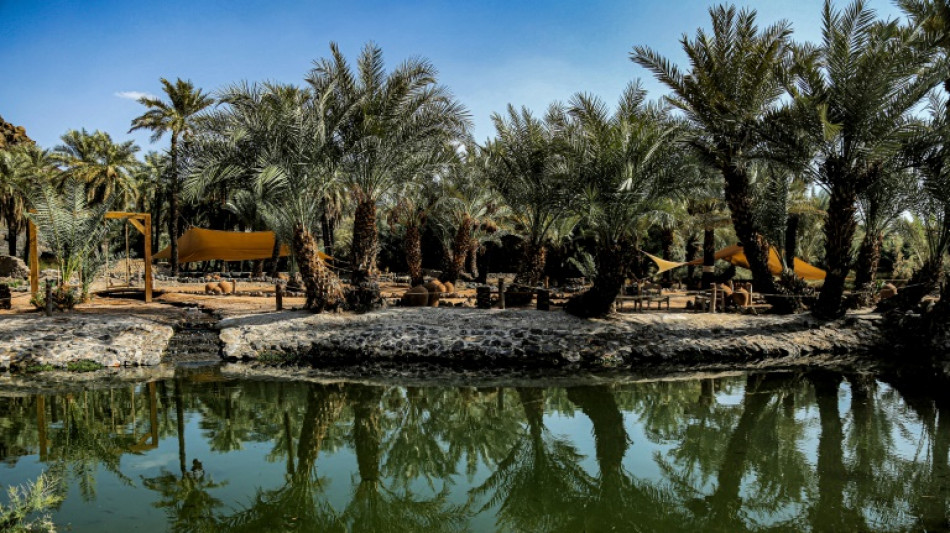
From battlefield to glampsite: the story of Saudi's Khaybar / Photo: © AFP

 Rams bounce back as Giants reel from Dart injury

 In Bangladesh, Pakistan's Jinnah photo stirs anger

 Two New Zealand naval ships transit Taiwan Strait

 Zidane gets down to work as France start new era
 Inside the Venezuelan prison meant to 'drive you insane'
 UK king braces as memoir by Diana's brother goes on sale
 No green light to lift EU sanctions on Russian oligarchs, talks to resume

 UK agrees support for Saudi in struggle with Houthis: reports

 EU foreign policy chief calls for continued sanctions on Russia

 Flights scrapped, evacuations urged as Typhoon Dujuan wallops Japan

 Fonseca to take break from tennis

 A Cuban zoo, and its animals, in epic battle for survival

 Infantino proposes consulting federations to reform FIFA

 El Nino weather pattern enters record territory: scientist
 OpenAI calls for US to lead global effort on AI standards
 South African ostriches plucked alive for luxury fashion: report

 US networks halt Trump coverage in revolt over White House ban

 Paramount settles with US states to clear Warner Bros. mega-merger

 Climate crisis a job for world leaders, not just activists: UK FM
 US networks halt Trump coverage over White House ban
 French singer accuses Miley Cyrus of plagiarism
 EU fines Google 403 mn euros for location data breach

 'Best is yet to come,' says De la Fuente after Spain extension

 Why diesel prices are rising more than crude oil

 COP31 host says AI's climate footprint to be a summit priority

A Saudi town best known for a fierce battle between the Prophet Mohammed and Jewish tribes is remodelling itself as an upscale tourist draw in line with the kingdom's rebranding efforts.
Situated in an oasis amid a volcanic field north of Medina, the settlement of Khaybar was once home to thousands of Jews, who were defeated in a decisive seventh-century battle with the Prophet's army as Islam expanded across the Arabian Peninsula.
The chant "Khaybar, Khaybar, o Jews, the army of Mohammed will return" can still sometimes be heard at present-day anti-Israel demonstrations, drawing objections from groups such as the Anti-Defamation League, which says it "can be perceived as a threat of armed violence".
Last month, Saudi Arabia inaugurated a new visitors' centre in Khaybar, which takes a longer view of the area's history by highlighting references in ancient texts to its conquest by Babylonian-era King Nabonidus.
At the centre, displays avoid mentioning the seventh-century battle and tourists can arrange hikes to nearby volcanoes, strolls through lush palm springs or helicopter tours over ancient tombs and desert kites, which are dry stone walls that served as animal traps.
The project is part of a broader push in the conservative Sunni Muslim country, which only began issuing tourism visas in 2019, to attract some 30 million foreign visitors annually by the end of the decade, up from four million last year.
Khaybar tour guide Enass al-Sharif said it was important to shine a light on features of the area that go beyond its significance to Islam.
"Khaybar has a strong relationship with religion and it has a close relationship with the Prophet," she told AFP.
However, "it also has a strong relationship with history and civilisation. All these things were collected in one place, which is why it is attracting many tourists."
- 'Quantum leap' -
Archaeologists believe Khaybar has been inhabited for over 200,000 years, and it once served as a vital stop along the so-called Incense Route that linked it to Medina to the south, and the desert city of Al-Ula to the north.
But in the 1970s, the Saudi government began pushing residents to leave the old settlements for new structures with modern plumbing and electricity.
"We wanted some civilisation and development... so we left," recalled Saifi al-Shilali, a Khaybar native who was in his early 20s when his family moved away.
Since then, the old settlements have been abandoned, and Shilali, now in his 60s, is among those who have been agitating for a revival.
The transformation of Khaybar into a potential tourism draw "is something we have been waiting for for a long time," he told AFP.
"With my interest in research in Khaybar and in tourism... we have been waiting for this moment, so we consider it a quantum leap."
Like other Saudi attractions such as Al-Ula, a budding arts hub located among ancient Nabataean tombs, Khaybar is largely geared toward well-heeled travellers.
The Khaybar Volcano Camp promises an "exclusive stay" that "takes glamping to another level", with 10 rooms surrounded by imposing mountains.
The focus lies squarely on the setting rather than the historical events that took place there.
The camp even features a reiki energy healing master named Chamuel who conducts sound meditation sessions, inviting guests to enter "your own magical garden, a place beyond time and space".
- Unsolved mysteries -
All the while, an archaeological survey and excavation project continues to unearth new details about human activity in the area as well as how its climate has evolved.
The project, backed by the French government and expected to last through the end of 2024, has already yielded a deeper understanding of neolithic campsites, canals and rock art.
Among the most intriguing finds are the "pendant tombs", rock formations that when viewed from above resemble a pendant hanging from a chain.
The story behind them "remains a mystery", according to the visitors' centre, though archaeologists believe they date back 5,000 years.
Khaybar residents like Shilali are eager to learn more about the people who constructed them as part of rounding out a picture of the region's past -- including the Prophet Mohammed's seventh-century victory, but also everything else.
"I think we are supposed to shed light on Khaybar as a historical region whose roots go back to prehistoric periods, including the Jewish period," he said.
"I believe that the history should be known in its true form, without any exaggerations."
T.Bondarenko--BTB