Runaway W. Antarctic ice sheet collapse not 'inevitable': study / Photo: © AFP/File

 Rams bounce back as Giants reel from Dart injury

 In Bangladesh, Pakistan's Jinnah photo stirs anger

 Two New Zealand naval ships transit Taiwan Strait

 Zidane gets down to work as France start new era

 Inside the Venezuelan prison meant to 'drive you insane'

 UK king braces as memoir by Diana's brother goes on sale

 No green light to lift EU sanctions on Russian oligarchs, talks to resume

 UK agrees support for Saudi in struggle with Houthis: reports

 EU foreign policy chief calls for continued sanctions on Russia

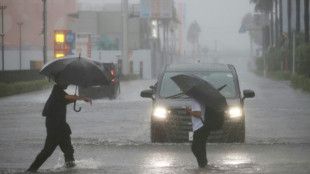 Flights scrapped, evacuations urged as Typhoon Dujuan wallops Japan

 Fonseca to take break from tennis

 A Cuban zoo, and its animals, in epic battle for survival

 Infantino proposes consulting federations to reform FIFA

 El Nino weather pattern enters record territory: scientist

 OpenAI calls for US to lead global effort on AI standards
 South African ostriches plucked alive for luxury fashion: report

 US networks halt Trump coverage in revolt over White House ban

 Paramount settles with US states to clear Warner Bros. mega-merger

 Climate crisis a job for world leaders, not just activists: UK FM

 US networks halt Trump coverage over White House ban

 French singer accuses Miley Cyrus of plagiarism

 EU fines Google 403 mn euros for location data breach

 'Best is yet to come,' says De la Fuente after Spain extension

 Why diesel prices are rising more than crude oil

 COP31 host says AI's climate footprint to be a summit priority

The runaway collapse of the West Antarctic Ice Sheet -- which would trigger catastrophic sea level rise -- is not "inevitable", scientists said Monday following research that tracked the region's recent response to climate change.
As global temperatures rise, there is mounting concern that warming could trigger so-called tipping points that set off irreversible melting of the world's massive ice sheets and ultimately lift oceans enough to drastically redraw the world map.
New research published Monday suggests a complex interaction of factors affecting the melting of the West Antarctic Ice Sheet, which is home to the enormous and unstable Pine Island and Thwaites glaciers -- nicknamed the "Doomsday glacier" -- that together could raise global sea levels by more than three metres (10 feet).
Using satellite imagery as well as ocean and climate records between 2003 and 2015, an international team of researchers found that while the West Antarctic Ice Sheet continued to retreat, the pace of ice loss slowed across a vulnerable region of the coastline.
Their study, published in the journal Nature Communications, concluded that this slowdown was caused by changes in ocean temperatures that were caused by offshore winds, with pronounced differences in the impact depending on the region.
Researchers said that this raises questions about how rising temperatures will affect the Antarctic, with ocean and atmospheric conditions playing a key role.
"That means that ice-sheet collapse is not inevitable," said co-author Professor Eric Steig from the University of Washington in Seattle.
"It depends on how climate changes over the next few decades, which we could influence in a positive way by reducing greenhouse gas emissions."
The researchers observed that while in one region, in the Bellingshausen Sea, the pace of ice retreat accelerated after 2003, it slowed in the Amundsen Sea.
- 'Blink of an eye' -
They concluded that this was down to changes in the strength and direction of offshore surface winds, which can change the ocean currents and disturb the layer of cold water around Antarctica and flush relatively warmer water towards the ice.
Both the North and South pole regions have warmed by roughly three degrees Celsius compared to late 19th-century levels, nearly three times the global average.
Scientists are increasingly concerned that the Pine Island and Thwaites glaciers have reached a "tipping point" that could see irreversible melting irrespective of cuts to greenhouse gas emissions.
Anders Levermann, a climate scientist at the Potsdam Institute for Climate Impact Research who was not connected to the latest study, welcomed the approach of bringing together multiple observations and records, although the study period was "the blink of an eye in ice terms".
"I think we still have to live and plan and do our sea level projections and coastal planning with a hypothesis that the West Antarctic Ice Sheet is destabilised and we will get three and a half meters of sea level rise just from this area of the planet alone," he said, adding however that this would happen "over centuries to millennia".
The United Nation's science advisory panel for climate change, the IPCC, has forecast that oceans will rise up to a metre by the end of the century, and even more after that.
Hundreds of millions of people live within a few metres of sea level.
While cutting planet-warming emissions is seen as the first and most important way to halt the melting of the West Antarctic ice sheet, scientists have also come up with an array of hi-tech suggestions for saving the gargantuan ice shelf and staving off.
Levermann has researched ideas including using snow cannons to pump trillions of tons of ice back on top of the frozen region.
Other suggestions have included constructing Eiffel Tower-sized columns on the seabed to prop it up from below, and a 100m-tall, 100-kilometre-long berm to block warm water flowing underneath.
D.Schneider--BTB