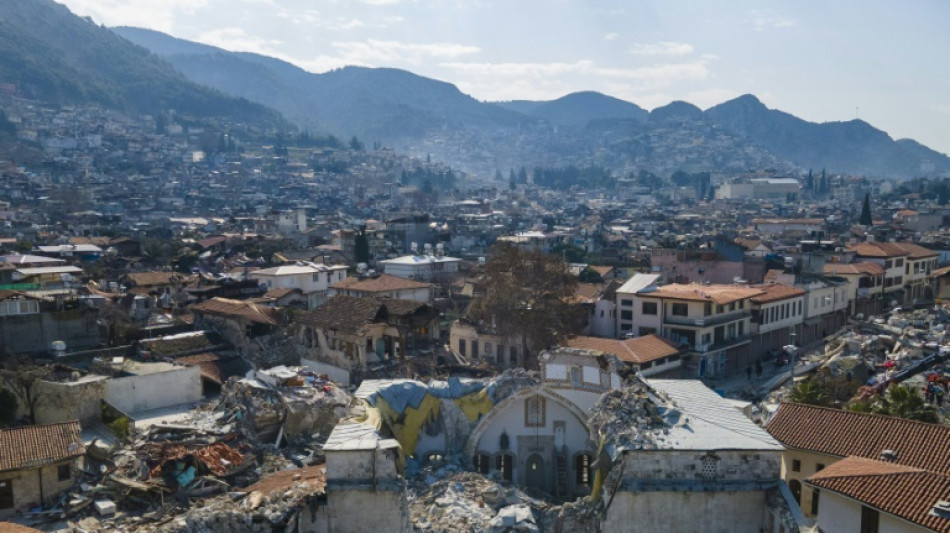
Once home to civilisations, fabled Antioch left in ruins / Photo: © AFP

 Typhoon Dujuan leaves four dead in Japan, 45,000 houses without power

 G7 leaders condemn Houthi strikes on Saudi Arabia

 Google data centre sparks protests in Austria

 Shin Ohashi: Junk food-loving teen and Japan's next big swimming hope

 Stocks rise on AI buzz, drop in oil prices
 China's robot dancers limber up for America's Got Talent final

 Despite military might, Saudi struggles to crush the Houthis

 Trump to tout deals, defend Iran war in UN speech

 Sri Lanka to issue verdict in landmark Easter attack trial

 No green light to lift EU sanctions on Russian oligarchs, talks to resume

 UK agrees support for Saudi in struggle with Houthis: reports

 EU foreign policy chief calls for continued sanctions on Russia

 Flights scrapped, evacuations urged as Typhoon Dujuan wallops Japan

 Fonseca to take break from tennis

 A Cuban zoo, and its animals, in epic battle for survival

 Infantino proposes consulting federations to reform FIFA

 El Nino weather pattern enters record territory: scientist

 OpenAI calls for US to lead global effort on AI standards
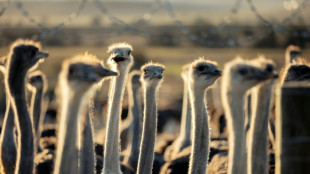 South African ostriches plucked alive for luxury fashion: report

 US networks halt Trump coverage in revolt over White House ban

 Paramount settles with US states to clear Warner Bros. mega-merger

 Climate crisis a job for world leaders, not just activists: UK FM

 US networks halt Trump coverage over White House ban

 French singer accuses Miley Cyrus of plagiarism

 EU fines Google 403 mn euros for location data breach

The smashed dome of the ancient mosque, considered to be Turkey's oldest, covers rubble that used to be a prayer hall.
Once a home to a myriad of civilisations, the southern city of Antakya lies in ruins after last Monday's 7.8-magnitude quake.
Fourteen centuries of history were ravaged in less than two minutes in Antakya, a fabled ancient Greek centre known throughout most of its history as Antioch.
Erected in AD 638, the Habib-i Neccar was "the first mosque built within modern-day Turkey's borders", according to the government's culture portal.
Only its walls have survived, leaving delicate yellow, red and blue paintings and calligraphy exposed to the winter sky.
"A bit of the Prophet Mohammed's beard was once preserved in a box" at the mosque, said Havva Pamukcu, a 50-year-old woman wearing a headscarf.
"I'm heartbroken," she said.
A few hundred metres away, a Greek Orthodox church erected in the 14th century -- and rebuilt in 1870 after another earthquake -- is also gone.
A white cross that once stood on its pointed roof now lies atop shattered walls and broken pieces of wood.
"All the walls have fallen. We're in despair," said Sertac Paul Bozkurt, a member of the council managing the church.
- 'Soil full of history' -
Antakya is in Hatay, a province tucked between the Mediterranean Sea and Turkey's border with Syria.
It was one of the worst affected by the earthquake and its aftershocks, which have claimed more than 35,000 lives across the region.
In the old city, several streets are still inaccessible, blocked by buildings flattened like pancakes and cars trapped under the debris.
Across more than two millennia, the city was home to Greek, Roman, Byzantine, Persian, Arab and Ottoman empires.
It was even placed under a French mandate between the end of the First World War and 1939, when the city became a part of modern-day Turkey.
A former general of Alexander the Great founded Antioch in 300 BC.
The city has suffered several earthquakes -- almost one every 100 years -- and is no stranger to rebuilding.
There were devastating quakes in 37 BC, 115 AD and 458 AD.
A quake in AD 526 is thought to have killed 250,000 people. In 1054, 10,000 are thought to have died.
"Antakya is the cradle of several historical events," said Hakan Mertkan, a doctoral student at the University of Bayreuth in Germany and author of a book on Antakya.
But it's also "a cradle of earthquakes, its soil full of history", he added.
- Crossroads of civilisations -
Turkey, like Syria, is on one of the world's most active fault lines.
But the region is also "at the centre of much of humanity's shared ancient history", said Aparna Tandon, senior programme leader at the International Centre for the Study of the Preservation and Restoration of Cultural Property.
The area impacted is home to six UNESCO World Heritage Sites.
Like Aleppo in Syria, Turkey's "crossroads of civilisations" was already "60 percent destroyed in 1822 after an earthquake", said Youmna Tabet, of the World Heritage Convention.
Fortunately, there does not seem to be as much damage at Turkey's other heritage sites, said Maria Liouliou, Tabet's colleague.
The fortress in Diyarbakir seems to have suffered only moderate damage, she said.
But the dangers are far from over now that the worst aftershocks have faded, experts warn.
What look like "simple cracks" to the "layman's eyes" can weaken a monument and cause it to collapse weeks later, said Samir Abdulac, who works at the International Council on Monuments and Sites, which seeks to protect historical places.
The experts AFP spoke to all insisted the "priority" was to save lives first. Safeguarding historical monuments must come later.
This was clear when AFP encountered a local official in Antakya, one of many families devastated by the disaster.
"I just lost my two brothers and a nephew. I am evacuating my wife and daughter today," said the official, who preferred to remain anonymous.
"I have no money, nothing. Frankly I have other priorities than cultural heritage."
H.Seidel--BTB