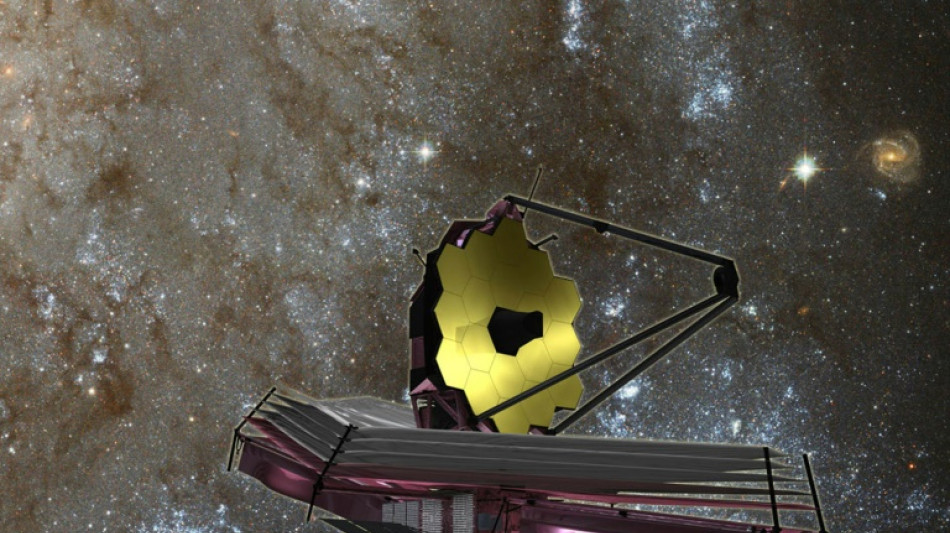
Webb spots surprisingly massive galaxies in early universe / Photo: © NASA/AFP/File

 Typhoon Dujuan leaves four dead in Japan, 45,000 houses without power

 G7 leaders condemn Houthi strikes on Saudi Arabia

 Google data centre sparks protests in Austria

 Shin Ohashi: Junk food-loving teen and Japan's next big swimming hope

 Stocks rise on AI buzz, drop in oil prices

 China's robot dancers limber up for America's Got Talent final

 Despite military might, Saudi struggles to crush the Houthis

 Trump to tout deals, defend Iran war in UN speech

 Sri Lanka to issue verdict in landmark Easter attack trial

 No green light to lift EU sanctions on Russian oligarchs, talks to resume

 UK agrees support for Saudi in struggle with Houthis: reports

 EU foreign policy chief calls for continued sanctions on Russia

 Flights scrapped, evacuations urged as Typhoon Dujuan wallops Japan

 Fonseca to take break from tennis

 A Cuban zoo, and its animals, in epic battle for survival

 Infantino proposes consulting federations to reform FIFA

 El Nino weather pattern enters record territory: scientist

 OpenAI calls for US to lead global effort on AI standards

 South African ostriches plucked alive for luxury fashion: report

 US networks halt Trump coverage in revolt over White House ban

 Paramount settles with US states to clear Warner Bros. mega-merger

 Climate crisis a job for world leaders, not just activists: UK FM

 US networks halt Trump coverage over White House ban

 French singer accuses Miley Cyrus of plagiarism

 EU fines Google 403 mn euros for location data breach

The James Webb Space Telescope has spotted six massive galaxies that emerged not long after the Big Bang, a study said Wednesday, surprising scientists by forming at a speed that contradicts our current understanding of the universe.
Since becoming operational last July, the Webb telescope has been peering farther than ever before into the universe's distant reaches -- which also means it is looking back in time.
For its latest discovery, the telescope spied galaxies from between 500 to 700 years million years after the Big Bang 13.8 billion years ago, meaning the universe was under five percent of its current age.
Webb's NIRCam instrument, which operates in the near infrared wavelength invisible to the naked eye, observed the six galaxies in a little-known region of the sky, according to a study published in the journal Nature.
Two of the galaxies had previously been spotted by the Hubble Space Telescope but were so faint in those images that they went unnoticed.
These six new "candidate galaxies", so-called because their discovery still needs to be confirmed by other measurements, contain many more stars than scientists expected.
One galaxy is even believed to have around 100 billion stars.
That would make it around the size of the Milky Way, which is "crazy," the study's first author Ivo Labbe told AFP.
- 'Off a cliff' -
It took our home galaxy the entire life of the universe for all its stars to assemble.
For this young galaxy to achieve the same growth in just 700 million years, it would have had to grow around 20 times faster than the Milky Way, said Labbe, a researcher at Australia's Swinburne University of Technology.
For there to be such massive galaxies so soon after the Big Bang goes against the current cosmological model which represents science's best understanding of how the universe works.
"According to theory, galaxies grow slowly from very small beginnings at early times," Labbe said, adding that such galaxies were expected to be between 10 to 100 times smaller.
But the size of these galaxies "really go off a cliff," he said.
What could be going on? One suspect is mysterious dark matter, which makes up a sizeable amount of the Universe.
While much about dark matter remains unknown, scientists believe it plays a key role in the formation of galaxies.
When dark matter "clumps" together into a halo, it attracts gas from the surrounding universe which in turn forms a galaxy and its stars, Labbe said.
But this process is supposed to take a long time, and "in the early universe, there's just not that many clumps of dark matter," he said.
- 'Model is cracking' -
The newly discovered galaxies could indicate that things sped up far faster in the early universe than previously thought, allowing stars to form "much more efficiently," said David Elbaz, an astrophysicist at the French Atomic Energy Commission not involved in the research.
This could be linked to recent signs that the universe itself is expanding faster than we once believed, he added.
This subject sparks fierce debate among cosmologists, making this latest discovery "all the more exciting, because it is one more indication that the model is cracking," Elbaz said.
Elbaz is one of many scientists working on the European Space Agency's Euclid space telescope, which is scheduled to launch in July to join Webb in space.
Euclid's mission is to uncover the secrets of dark matter and dark energy -- and it could also help solve this latest mystery, Elbaz said.
Labbe referred to the "black swan theory", under which just one unexpected event can overturn our previous understanding -- such as when Europeans saw the first black swans in Australia.
He called the galaxies "six black swans -- if even one of them turns out to be true, then it means we have to change our theories."
K.Thomson--BTB