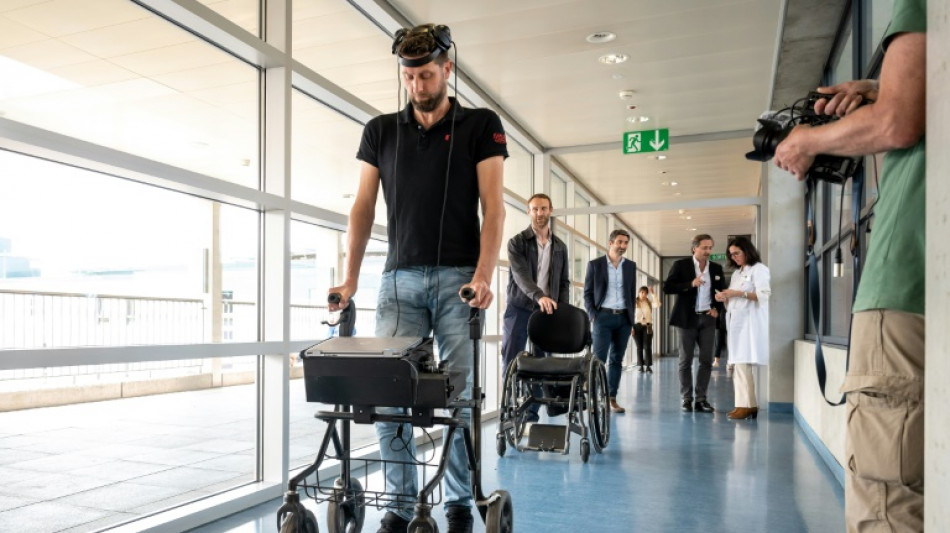
Paralysed man walks again via thought-controlled implants / Photo: © AFP

 Newcomers South Korea face holders Italy in Davis Cup finals

 Japan's Kojima sounds Marchand warning with Asian Games gold

 England rugby star Pollock signs new Northampton deal

 STARTRADER Expands Its Chinese Equity CFD Range with CXMT and Unitree Robotics

 MEXC Expands Opportunity Compass with Stock Trading Handbook to Help Crypto Users Build Investment Knowledge

 England paceman Wood retires from international cricket

 Magnificent Mandhana's 79 helps India to Asian Games cricket gold

 Marchand 'stressed' about racing Japanese rivals at LA Olympics

 Mobile boat clinics bring healthcare to India's remote islands

 Former India paceman Zaheer Khan named Chennai coach in IPL

 Six-year-old Chinese girl sets world record with Rubik's Cube

 Swimming prodigy Yu, 13, says 'interviews way harder than racing'

 Star coaches make their bows as Nations League returns

 Rams bounce back as Giants reel from Dart injury

 In Bangladesh, Pakistan's Jinnah photo stirs anger

 Two New Zealand naval ships transit Taiwan Strait

 Zidane gets down to work as France start new era

 Inside the Venezuelan prison meant to 'drive you insane'

 UK king braces as memoir by Diana's brother goes on sale

 Akkodis and Hamburg Public Transport Association Showcase hvv mia at InnoTrans 2026, Demonstrating the Future of AI-Powered Mobility

 Macron says talks with Trump on Red Sea, Ukraine 'constructive'

 Green policies just good politics, says UK minister

 Bardot auction in Paris fetches nearly one million euros

 No timeline on Daniels injury return, says Commanders coach

 British Columbia sues OpenAI in US court over Canada school shooting

A paralysed man has regained the ability to walk smoothly using only his thoughts for the first time, researchers said on Wednesday, thanks to two implants that restored communication between brain and spinal cord.
The patient Gert-Jan, who did not want to reveal his surname, said the breakthrough had given him "a freedom that I did not have" before.
The 40-year-old Dutchman has been paralysed in his legs for more than a decade after suffering a spinal cord injury during a bicycle accident.
But using a new system he can now walk "naturally", take on difficult terrain and even climb stairs, according to a study published in the journal Nature.
The advance is the result of more than a decade of work by a team of researchers in France and Switzerland.
Last year the team showed that a spinal cord implant -- which sends electrical pulses to stimulate movement in leg muscles -- had allowed three paralysed patients to walk again.
But they needed to press a button to move their legs each time.
Gert-Jan, who also has the spinal implant, said this made it difficult to get into the rhythm of taking a "natural step".
- 'Digital bridge' -
The latest research combines the spinal implant with new technology called a brain-computer interface, which is implanted above the part of the brain that controls leg movement.
The interface uses algorithms based on artificial intelligence methods to decode brain recordings in real time, the researchers said.
This allows the interface, which was designed by researchers at France's Atomic Energy Commission (CEA), to work out how the patient wants to move their legs at any moment.
The data is transmitted to the spinal cord implant via a portable device that fits in a walker or small backpack, allowing patients to get around without help from others.
The two implants build what the researchers call a "digital bridge" to cross the disconnect between the spinal cord and brain that was created during Gert-Jan's accident.
"Now I can just do what I want -- when I decide to make a step the stimulation will kick in as soon as I think about it," Gert-Jan said.
After undergoing invasive surgery twice to implant both devices, it has "been a long journey to get here," he told a press conference in the Swiss city of Lausanne.
But among other changes, he is now able to stand at a bar again with friends while having a beer.
"This simple pleasure represents a significant change in my life," he said in a statement.
- 'Radically different' -
Gregoire Courtine, a neuroscientist at Switzerland's Ecole Polytechnique Federale de Lausanne and a study co-author, said it was "radically different" from what had been accomplished before.
"Previous patients walked with a lot of effort -- now one just needs to think about walking to take a step," he told a press conference in the Swiss city of Lausanne.
There was another positive sign: following six months of training, Gert-Jan recovered some sensory perception and motor skills that he had lost in the accident.
He was even able to walk with crutches when the "digital bridge" was turned off.
Guillaume Charvet, a researcher at France's CEA, told AFP this suggests "that the establishment of a link between the brain and spinal cord would promote a reorganisation of the neuronal networks" at the site of the injury.
So when could this technology be available to paralysed people around the world? Charvet cautioned it will take "many more years of research" to get to that point.
But the team are already preparing a trial to study whether this technology can restore function in arms and hands.
They also hope it could apply to other problems such as paralysis caused by stroke.
J.Bergmann--BTB