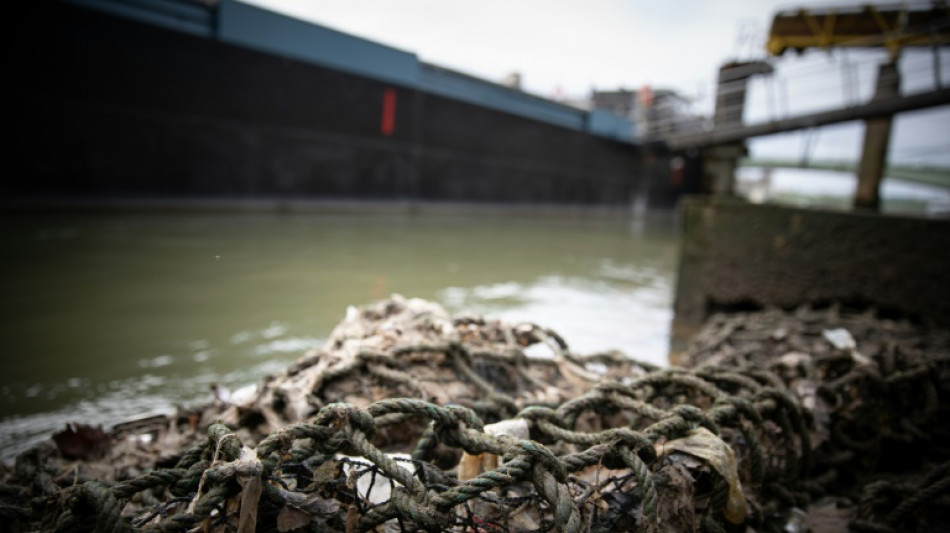
Meandering along the river Seine: France's roving plastic rubbish / Photo: © AFP/File

 Newcomers South Korea face holders Italy in Davis Cup finals

 Japan's Kojima sounds Marchand warning with Asian Games gold

 England rugby star Pollock signs new Northampton deal

 STARTRADER Expands Its Chinese Equity CFD Range with CXMT and Unitree Robotics

 MEXC Expands Opportunity Compass with Stock Trading Handbook to Help Crypto Users Build Investment Knowledge

 England paceman Wood retires from international cricket

 Magnificent Mandhana's 79 helps India to Asian Games cricket gold

 Marchand 'stressed' about racing Japanese rivals at LA Olympics

 Mobile boat clinics bring healthcare to India's remote islands
 Former India paceman Zaheer Khan named Chennai coach in IPL

 Six-year-old Chinese girl sets world record with Rubik's Cube
 Swimming prodigy Yu, 13, says 'interviews way harder than racing'

 Star coaches make their bows as Nations League returns
 Rams bounce back as Giants reel from Dart injury

 In Bangladesh, Pakistan's Jinnah photo stirs anger

 Two New Zealand naval ships transit Taiwan Strait

 Zidane gets down to work as France start new era

 Inside the Venezuelan prison meant to 'drive you insane'
 UK king braces as memoir by Diana's brother goes on sale

 Akkodis and Hamburg Public Transport Association Showcase hvv mia at InnoTrans 2026, Demonstrating the Future of AI-Powered Mobility

 Macron says talks with Trump on Red Sea, Ukraine 'constructive'

 Green policies just good politics, says UK minister

 Bardot auction in Paris fetches nearly one million euros
 No timeline on Daniels injury return, says Commanders coach

 British Columbia sues OpenAI in US court over Canada school shooting

The scrap of red plastic in among the waterside reeds in northern France could be any fragment of the throwaway consumerism piling up across the planet, flowing into rivers, choking animals, even seeping into our bloodstreams.
But this otherwise unremarkable litter caught in the foliage not far from the mouth of the river Seine has both a name -- EF56308 -- and a history.
It was tossed into the water on September 26, 2018, in Rouen, 70 kilometres upstream.
Romain Tramoy should know. He threw it.
Tramoy, a specialist in sediments, tours the riverbanks making an inventory of the plastic that now splashes garish colours in landscapes once beloved of impressionist painters.
Sometimes he marks the plastics with pink or fluorescent yellow paint so he can perhaps find them again one day, somewhere else on their journey towards the sea.
"No waste goes to the sea in a linear way," he told AFP, along a riverside strewn with litter.
They can hang around "for years", flowing from one bank to another, where they snare in the foliage.
The scientist, who works at the Water Environment and Urban Systems Laboratory, has spent years studying the life of plastics in the Seine, trying to trace the origins of the trash, how these items can make their way to the sea and how much there is.
The Seine River begins its life on the Langres plateau in eastern France before flowing to Paris, where it waters the feet of the Eiffel Tower before wending its way to the city of Rouen and ultimately spilling out into the English Channel.
With plastics tossed around by the currents over long periods, the estuary is "a machine for manufacturing microplastics", he said.
- Global scourge -
Concern is growing around the world about the potential impacts of this persistent rubbish on ecosystems, people and animals.
Microplastic fragments have now been found from the deepest oceans trenches to the top of Mount Everest. In humans, they have been detected in blood, breast milk and placentas.
Next week, France will host negotiators from nearly 200 countries for a new round of talks in Paris aimed at reaching a historic, legally binding agreement by next year to end plastic pollution.
Global production of the mainly fossil-fuel-based material has doubled in 20 years, according to the Organisation for Economic Cooperation and Development (OECD), which predicts production could triple again by 2060 without action.
France has an advantage over poorer countries when dealing with plastics, Tramoy said.
Refuse collection is highly organised and the sewage system is largely effective, other than when there are overflows linked to storms.
"We find much less plastic in the rivers than in countries without collections, and with steep gorges, like in South-East Asia for example," Tramoy said.
The Seine is also cleaned, notably by the Vinci Construction Maritime et Fluvial group, which collects floating waste. Other organisations focus on shoreline cleanup.
But still the plastic gets through.
- 'Everywhere' -
As a result of experiments between 2017 and 2020, Tramoy's team estimated that some 100 to 200 tonnes of plastic per year reach the sea along the Seine.
That was much fewer than his initial assumptions but it is still enough to keep him busy.
Tramoy has placed nets at the exit of storm overflow pipes, which can disgorge into the river after heavy rains.
The contents are washed, dried, weighed and listed in his laboratory.
This yields an array of plastics -- drinks bottles and cigarette butts thrown onto the streets and washed into the sewage system, as well as items flushed directly into toilets.
Like an archaeologist of the Anthropocene, the researcher uses certain common products to date the flows of rubbish.
One is the small plastic applicator for the single-dose laxative "microlax". Enough people flush them down their toilets to make these abundant in the river rubbish and they are each marked with a telltale expiry date.
One day in February this year, Tramoy showed AFP some of his earlier finds on a stony bank on the river’s edge, tossed up by the tides among driftwood and branches.
Detergent bottles, cans, yoghurt pots, sweet wrappers, lids, sandals. The items are an inventory of modern consumption.
Macro plastics, microplastics, even nanoplastics.
"We find them everywhere," he said.
C.Kovalenko--BTB