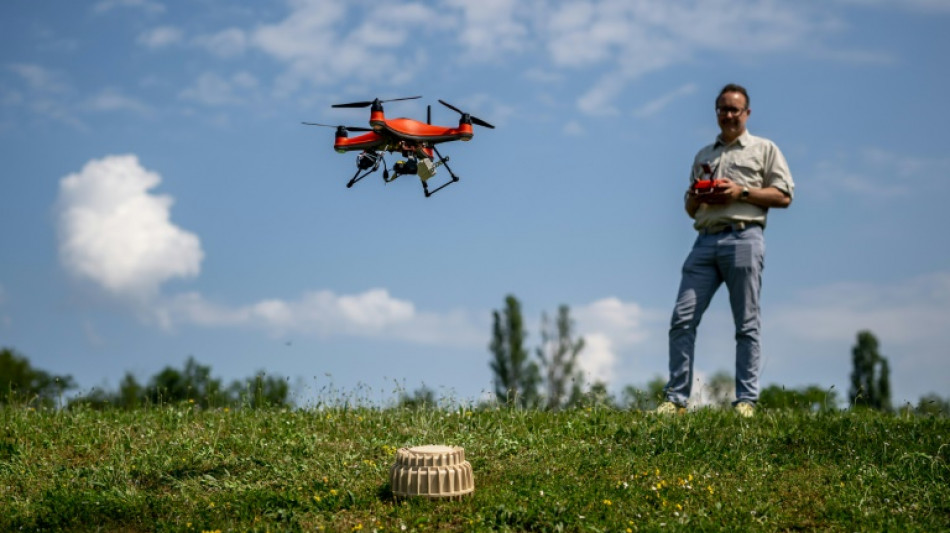
Ukraine dam's destruction increases mines threat: Red Cross / Photo: © AFP

 Newcomers South Korea face holders Italy in Davis Cup finals

 Japan's Kojima sounds Marchand warning with Asian Games gold

 England rugby star Pollock signs new Northampton deal

 STARTRADER Expands Its Chinese Equity CFD Range with CXMT and Unitree Robotics

 MEXC Expands Opportunity Compass with Stock Trading Handbook to Help Crypto Users Build Investment Knowledge

 England paceman Wood retires from international cricket

 Magnificent Mandhana's 79 helps India to Asian Games cricket gold

 Marchand 'stressed' about racing Japanese rivals at LA Olympics
 Mobile boat clinics bring healthcare to India's remote islands
 Former India paceman Zaheer Khan named Chennai coach in IPL

 Six-year-old Chinese girl sets world record with Rubik's Cube

 Swimming prodigy Yu, 13, says 'interviews way harder than racing'

 Star coaches make their bows as Nations League returns

 Rams bounce back as Giants reel from Dart injury

 In Bangladesh, Pakistan's Jinnah photo stirs anger

 Two New Zealand naval ships transit Taiwan Strait

 Zidane gets down to work as France start new era

 Inside the Venezuelan prison meant to 'drive you insane'

 UK king braces as memoir by Diana's brother goes on sale

 Akkodis and Hamburg Public Transport Association Showcase hvv mia at InnoTrans 2026, Demonstrating the Future of AI-Powered Mobility

 Macron says talks with Trump on Red Sea, Ukraine 'constructive'

 Green policies just good politics, says UK minister

 Bardot auction in Paris fetches nearly one million euros

 No timeline on Daniels injury return, says Commanders coach

 British Columbia sues OpenAI in US court over Canada school shooting

The destruction of the Kakhovka dam in Ukraine will have a catastrophic effect on locating landmines in the affected region, the Red Cross warned Wednesday.
"We knew where the hazards were," said Erik Tollefsen, head of the Weapon Contamination Unit at the International Committee of the Red Cross. "Now we don't know.
"All we know is that they are somewhere downstream."
"This is a major concern because it will affect not just the population, but also all of those that are coming in to help," he added.
Tollefsen was speaking as the ICRC presented a new drone that uses artificial intelligence to locate mines and other explosive remnants of war from the heat they emit.
It could one day be used in Ukraine.
The ICRC had spent several months helping mine clearance operations in Ukraine, mapping and marking minefields and providing training and equipment, said Tollefsen.
"Now all of that has been washed away."
Anti-personnel and anti-tank mines such as the TM-57 will now have been dispersed into unknown locations, he said.
Ukraine's Kakhovka dam in Russian-held territory was destroyed on Tuesday, flooding dozens of villages and parts of a nearby city, and sparking fears of a humanitarian disaster.
- Mine numbers 'massive' -
Already on Tuesday the United Nations warned of the risks associated with the mines, which are numerous in Ukraine.
The ICRC noted that the floodwaters would not damage or deactivate these explosive devices, which means they could pose a threat for decades to come.
Downstream from the dam in the Kherson region "there has been a lot of what we call defensive minefields put up by parties to the conflict", said Norwegian specialist Tollefsen.
Normally, these are "very, very populated with both anti-personnel mines and anti-vehicle mines", he added.
The ICRC does not know how many mines might have been submerged or washed away by the floodwaters.
"The parties to conflict haven't declared any kind of numbers of mines that have been laid," said Tollefsen.
"We just know that the numbers are massive."
Moscow and Kyiv have blamed each other for the destruction of the 1950s Soviet-era dam on the Dnipro River.
The flooding has forced several thousand civilians to leave their homes.
- New drone 'a step forward' -
ICRC president Mirjana Spoljaric Egger said the destruction of the dam was "symbolic for the need to comply with international humanitarian law.
"The damage is already massive and I feel very concerned about how much more damage will be caused by this incident," she told reporters at the unveiling of the mine-hunting drone.
The new drone can cover in a day the same surface area a demining dog would in six months, has so far only been used in testing in Jordan.
The Geneva-based ICRC hopes to use it for the first time this year around the city of Aleppo in northwest Syria.
The drone if eventually used in Ukraine, could help trace the large numbers of mines laid there since Russia's full-scale invasion in February last year.
It will not remove mines itself but should accelerate their detection thanks to its cameras, heat detector and artificial intelligence software, which the ICRC intends to share.
"It is a step forward because it covers large areas at a much higher speed," said ICRC weapons specialist Martin Jebens.
Spoljaric Egger added: "Typically in mine clearance operations the average figure per day per deminer is 50 square metres.
"With this new technology being put together by the ICRC and its partners, conservative estimates suggest we will be able to survey and process 100,000 square metres a day for more efficient demining."
P.Anderson--BTB