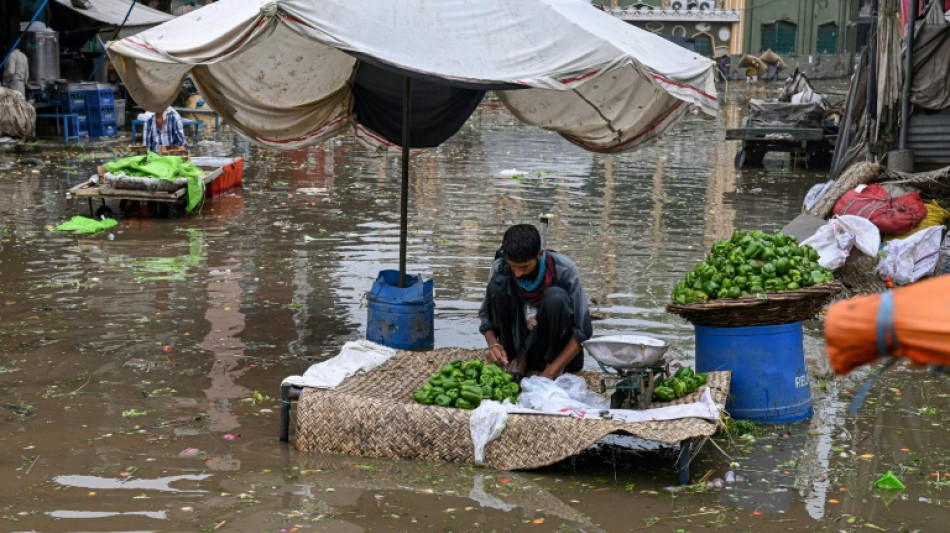
Every 1C of warming means 15% more extreme rain, researchers say / Photo: © AFP/File

 Newcomers South Korea face holders Italy in Davis Cup finals

 Japan's Kojima sounds Marchand warning with Asian Games gold

 England rugby star Pollock signs new Northampton deal

 STARTRADER Expands Its Chinese Equity CFD Range with CXMT and Unitree Robotics

 MEXC Expands Opportunity Compass with Stock Trading Handbook to Help Crypto Users Build Investment Knowledge

 England paceman Wood retires from international cricket

 Magnificent Mandhana's 79 helps India to Asian Games cricket gold

 Marchand 'stressed' about racing Japanese rivals at LA Olympics

 Mobile boat clinics bring healthcare to India's remote islands

 Former India paceman Zaheer Khan named Chennai coach in IPL

 Six-year-old Chinese girl sets world record with Rubik's Cube
 Swimming prodigy Yu, 13, says 'interviews way harder than racing'

 Star coaches make their bows as Nations League returns

 Rams bounce back as Giants reel from Dart injury

 In Bangladesh, Pakistan's Jinnah photo stirs anger

 Two New Zealand naval ships transit Taiwan Strait

 Zidane gets down to work as France start new era

 Inside the Venezuelan prison meant to 'drive you insane'

 UK king braces as memoir by Diana's brother goes on sale

 Akkodis and Hamburg Public Transport Association Showcase hvv mia at InnoTrans 2026, Demonstrating the Future of AI-Powered Mobility

 Macron says talks with Trump on Red Sea, Ukraine 'constructive'

 Green policies just good politics, says UK minister

 Bardot auction in Paris fetches nearly one million euros

 No timeline on Daniels injury return, says Commanders coach

 British Columbia sues OpenAI in US court over Canada school shooting

Global heating incrementally boosts the intensity of extreme rainfall at higher altitudes, putting two billion people living in or downstream from mountains at greater risk of floods and landslides, researchers said Wednesday.
Every degree Celsius of warming increases the density of major downpours by 15 percent at elevations above 2,000 metres, they reported in the journal Nature.
On top of that, each additional 1,000 metres of altitude adds another one percent of rainfall.
A world, in other words, 3C hotter than preindustrial levels will see the likelihood of potentially devastating deluges multiply by nearly half.
The findings underscore the vulnerability of infrastructure not designed to withstand extreme flooding events, the authors warned.
Earth's surface has already warmed 1.2C, enough to amplify record-breaking downpours that put huge swathes of Pakistan under water last summer, and parts of California earlier this year.
On current policy trends, the planet will warm 2.8C by century's end, according to the UN's IPCC climate science advisory panel.
The new study -- based on data covering the last 70 years, and climate-model projections -- found two main drivers behind the upsurge in extreme rainfall events at altitude in a warming world.
The first is simply more water: scientists have long known that every 1C increase boosts the amount of moisture in the atmosphere by seven percent.
- From snow to rain -
Since the 1950s, heavy rainfall has become more frequent and intense across most parts of the world, according to the World Weather Attribution (WWA) consortium, which teases out the impact of climate change on specific extreme weather events, including heatwaves, droughts and tropical storms.
Extreme rainfall is more common and intense because of human-caused climate change in Europe, most of Asia, central and eastern North America, and parts of South America, Africa and Australia, the WWA has found.
The second factor uncovered by researchers was more surprising.
"This is first time that anyone has looked at whether those intense precipitation events fall as rain or snow," lead author Mohammed Ombadi, a researcher at Lawrence Berkeley National Laboratory in California, told AFP.
"Unlike snowfall, rainfall triggers runoff more rapidly, leading to a higher risk of flooding, landslide hazards and soil erosion."
Ombadi speculated that a higher rate of snow-turned-to-rain observed between 2,500 and 3,000 metres was due to precipitation at that altitude occurring a just below freezing.
The mountainous regions and adjacent flood plains likely to experience the biggest impacts from extreme rainfall events are in and around the Himalayas and North America's Pacific mountain ranges, according to the study.
The findings focused only on the northern hemisphere due to a lack of observational data from below the equator.
The regions most affected should prepare "robust climate adaptation plans," the authors said.
"We need to consider this increase in rainfall extremes in the design and building of dams, highways, railroads and other infrastructure if we want to make sure they will remain sustainable in a warmer climate," said Ombadi.
High-risk areas will either need to be avoided altogether, or built up with engineering solutions that can protect the communities living there, he added.
J.Horn--BTB