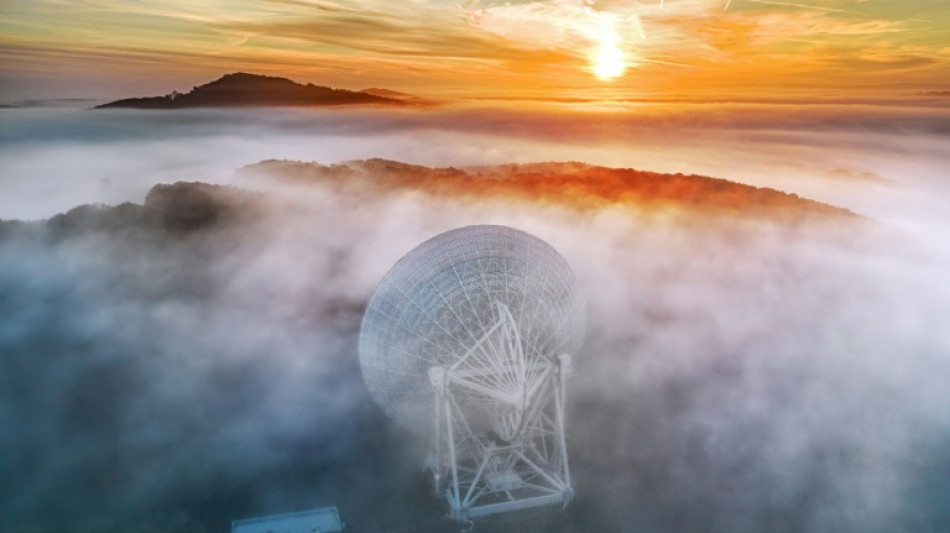
Europe's space telescope to target universe's dark mysteries / Photo: © Max Planck Institute for Radio Astronomy/AFP

 Newcomers South Korea face holders Italy in Davis Cup finals

 Japan's Kojima sounds Marchand warning with Asian Games gold

 England rugby star Pollock signs new Northampton deal

 STARTRADER Expands Its Chinese Equity CFD Range with CXMT and Unitree Robotics

 MEXC Expands Opportunity Compass with Stock Trading Handbook to Help Crypto Users Build Investment Knowledge

 England paceman Wood retires from international cricket

 Magnificent Mandhana's 79 helps India to Asian Games cricket gold

 Marchand 'stressed' about racing Japanese rivals at LA Olympics

 Mobile boat clinics bring healthcare to India's remote islands

 Former India paceman Zaheer Khan named Chennai coach in IPL

 Six-year-old Chinese girl sets world record with Rubik's Cube

 Swimming prodigy Yu, 13, says 'interviews way harder than racing'

 Star coaches make their bows as Nations League returns

 Rams bounce back as Giants reel from Dart injury

 In Bangladesh, Pakistan's Jinnah photo stirs anger

 Two New Zealand naval ships transit Taiwan Strait

 Zidane gets down to work as France start new era

 Inside the Venezuelan prison meant to 'drive you insane'

 UK king braces as memoir by Diana's brother goes on sale

 Akkodis and Hamburg Public Transport Association Showcase hvv mia at InnoTrans 2026, Demonstrating the Future of AI-Powered Mobility

 Macron says talks with Trump on Red Sea, Ukraine 'constructive'

 Green policies just good politics, says UK minister

 Bardot auction in Paris fetches nearly one million euros

 No timeline on Daniels injury return, says Commanders coach

 British Columbia sues OpenAI in US court over Canada school shooting

Europe's Euclid space telescope is scheduled to blast off Saturday on the first-ever mission aiming to shed light on two of the universe's greatest mysteries: dark energy and dark matter.
The launch is planned from Cape Canaveral in Florida at 11:11 am local time (1511 GMT) on a Falcon 9 rocket of the US company SpaceX.
The European Space Agency was forced to turn to the rival firm of billionaire Elon Musk to launch the mission after Russia pulled its Soyuz rockets in response to sanctions over the war in Ukraine.
After a month-long journey through space, Euclid will join its fellow space telescope James Webb at a stable hovering spot around 1.5 million kilometres (more than 930,000 miles) from Earth called the second Lagrangian Point.
From there, Euclid will chart the largest-ever map of the universe, encompassing up to two billion galaxies across more than a third of the sky.
By capturing light that has taken 10 billion years to reach Earth, the map will also offer a new view of the 13.8-billion-year-old universe's history.
Scientists hope to use this information to address what the Euclid project manager Giuseppe Racca calls a "cosmic embarrassment": that 95 percent of the universe remains unknown to humanity.
Around 70 percent is thought to be dark energy, the name given to the unknown force that is causing the universe to expand at an accelerated rate.
And 25 percent is dark matter, thought to bind the universe together and make up around 80 percent of its mass.
- 'Dark detective' -
Euclid consortium member Guadalupe Canas told a press conference that the two-tonne space telescope was a "dark detective" which can reveal more about both elements.
Euclid, which is 4.7 metres (15 feet) tall and 3.5 metres (11 feet) wide, will use two scientific instruments to map the sky.
Its visible light camera will let it measure the shape of galaxies, while its near infrared spectrometer and photometer will allow it to measure how far away they are.
So how will Euclid try to spot things that cannot be seen? By searching for their absence.
The light coming from billions of light years away is slightly distorted by the mass of visible and dark matter along the way, a phenomenon known as weak gravitational lensing.
"By subtracting the visible matter, we can calculate the presence of the dark matter which is in between," Racca told AFP.
While this may not reveal the true nature of dark matter, scientists hope it will throw up new clues that will help track it down in the future.
For dark energy, French astrophysicist David Elbaz compared the expansion of the universe to blowing up a balloon with lines drawn on it.
By "seeing how fast it inflates," scientists hope to measure the breath -- or dark energy -- making it expand.
- 'Goldmine' -
A major difference between Euclid and other space telescopes is its wide field of view, which takes in an area equivalent to two full moons.
Project scientist Rene Laureijs said that this wider view means Euclid will be able to "surf the sky and find exotic objects" like black holes that the Webb telescope can then investigate in greater detail.
Beyond dark energy and matter, Euclid's map of the universe is expected to be a "goldmine for the whole field of astronomy," said Yannick Mellier, head of the Euclid consortium.
Scientists hope that Euclid's data will help them learn more about the evolution of galaxies, black holes and more.
The first images are expected once scientific operations start in October, with major data releases planned for 2025, 2027 and 2030.
The 1.4-billion-euro ($1.5-billion) mission is intended to run until 2029, but could last a little longer if all goes well.
The launch comes as Europe finds itself with few ways to independently send its missions into space, due to Russia ending cooperation last year and long delays to the next-generation Ariane 6 rocket.
Y.Bouchard--BTB