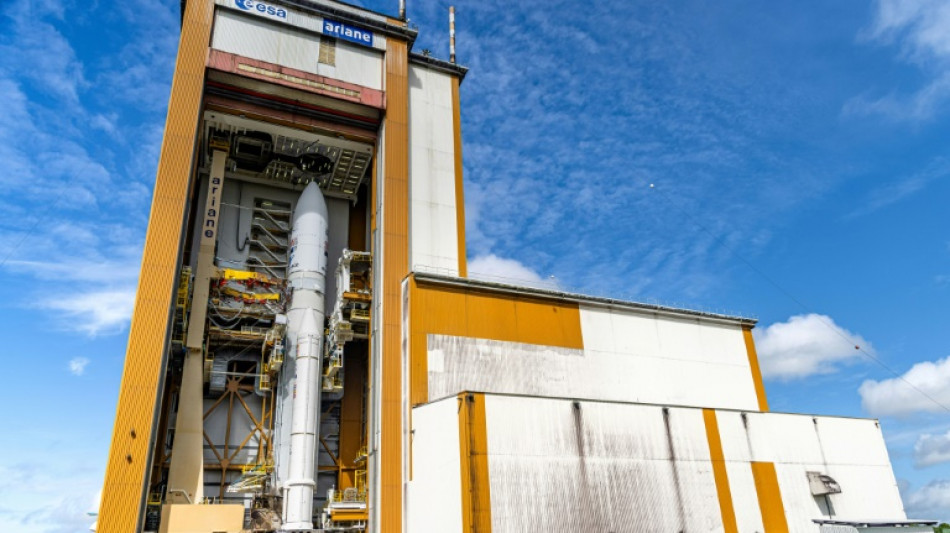
Final Ariane 5 blasts off amid Europe rocket crisis / Photo: © AFP

 Republican senator seeks probe of Trump Jr Russian-funded wedding

 Memoir by Diana's brother goes on sale after rocking UK monarchy
 Newcomers South Korea face holders Italy in Davis Cup finals

 Japan's Kojima sounds Marchand warning with Asian Games gold

 England rugby star Pollock signs new Northampton deal
 STARTRADER Expands Its Chinese Equity CFD Range with CXMT and Unitree Robotics

 MEXC Expands Opportunity Compass with Stock Trading Handbook to Help Crypto Users Build Investment Knowledge

 England paceman Wood retires from international cricket

 Magnificent Mandhana's 79 helps India to Asian Games cricket gold

 Marchand 'stressed' about racing Japanese rivals at LA Olympics

 Mobile boat clinics bring healthcare to India's remote islands

 Former India paceman Zaheer Khan named Chennai coach in IPL

 Six-year-old Chinese girl sets world record with Rubik's Cube

 Swimming prodigy Yu, 13, says 'interviews way harder than racing'

 Star coaches make their bows as Nations League returns

 Rams bounce back as Giants reel from Dart injury

 In Bangladesh, Pakistan's Jinnah photo stirs anger

 Two New Zealand naval ships transit Taiwan Strait

 Zidane gets down to work as France start new era

 Inside the Venezuelan prison meant to 'drive you insane'

 UK king braces as memoir by Diana's brother goes on sale

 Akkodis and Hamburg Public Transport Association Showcase hvv mia at InnoTrans 2026, Demonstrating the Future of AI-Powered Mobility

 No green light to lift EU sanctions on Russian oligarchs, talks to resume

 UK agrees support for Saudi in struggle with Houthis: reports

 EU foreign policy chief calls for continued sanctions on Russia

Europe's workhorse Ariane 5 rocket blasted off for a final time on Wednesday, with its farewell flight after 27 years of launches coming at a difficult time for European space efforts.
Faced with soaring global competition, the continent has unexpectedly found itself without a way to independently launch heavy missions into space due to delays to the next-generation Ariane 6 and Russia withdrawing its rockets.
The 117th and final flight of an Ariane 5 rockettook place at around 2200 GMT on Wednesdayfrom Europe's spaceport in Kourou, French Guiana.
The launch had been postponed twice. It was originally scheduled on June 16, but was called off because of problems with pyrotechnical lines in the rocket's booster, which have since been replaced.
Another launch planned for Tuesday was delayed by a day due to bad weather.
The final payload on an Ariane 5 is a French military communications satellite and a German communications satellite.
Marie-Anne Clair, the director of the Guiana Space Centre, told AFP that the final flight of an Ariane 5, whose launches have punctuated life in Kourou for nearly three decades, was "charged with emotion" for the teams there.
Though it would become a reliable rocket, Ariane 5 had a rocky start. Its maiden flight exploded moments after liftoff in 1996. Its only other such failure came in 2002.
Herve Gilibert, an engineer who was working on Ariane 5 at the time, said the 2002 explosion was a "traumatic experience" that "left a deep impression on us".
But the rocket would embark on what was ultimately a long string of successful launches.
The initial stumbles had "the positive effect of keeping us absolutely vigilant," Gilibert said.
- Webb and Juice -
Ariane 5 earned such a reputation for reliability that NASA trusted it to launch the $10 billion James Webb Space Telescope in late 2021.
The rocket's second-last launch was in April this year, blasting the European Space Agency's Juice spacecraft on its way to find out whether Jupiter's icy moons can host alien life.
Daniel Neuenschwander, the ESA's head of space transportation, said that in commercial terms, Ariane 5 had been "the spearhead of Europe's space activities".
The rocket was able to carry a far bigger load than its predecessor Ariane 4, giving Europe a competitive advantage and allowing the continent to establish itself in the communication satellite market.
While waiting for Ariane 6, whose first launch was initially scheduled for 2020, Europe had been relying on Russia's Soyuz rockets to get heavy-load missions into space.
But Russia withdrew space cooperation with Europe in response to sanctions imposed over Moscow's invasion of Ukraine in February 2022.
The number of launches from Kourou fell from 15 in 2021 to six last year.
Another blow came in December, when the first commercial flight of the next-generation Vega C light launcher failed. Last week, another problem was detected in the Vega C's engine, likely pushing its return further into the future.
- 'Difficult times' -
The launcher market has been increasingly dominated by billionaire Elon Musk's US firm SpaceX, whose rockets are now blasting off once a week.
Lacking other options, the ESA was forced to turn to rival SpaceX's Falcon 9 for the successful launch of its Euclid space telescope on Saturday.
The ESA will also use a SpaceX rocket to launch satellites for the EarthCARE observation mission.
It remains unclear how the agency will launch the next round of satellites for the European Union's Galileo global navigation system.
At the Paris Air Show earlier this month, ESA chief Josef Aschbacher acknowledged that these were "difficult times," adding that everyone was "working intensely" to get Ariane 6 and Vega-C ready.
Ariane 6 was unveiled on a launch pad in Kourou earlier this month ahead of an ignition test of its Vulcain 2.1 rocket engine.
Because the new rocket requires less staffing and maintenance, 190 out of 1,600 positions are being cut at the Kourou spaceport.
O.Krause--BTB