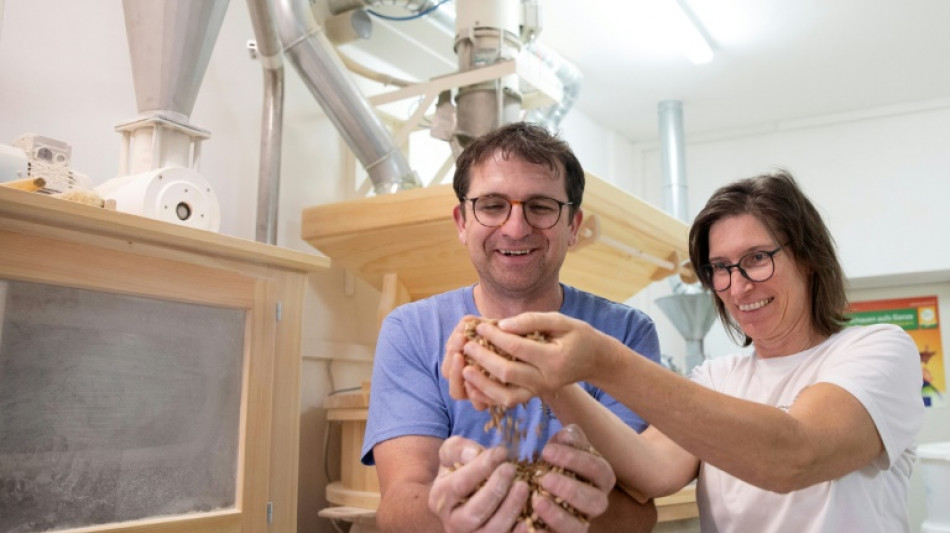
Austria farmers up in arms over Brussels GMO plans / Photo: © AFP

 Republican senator seeks probe of Trump Jr Russian-funded wedding

 Memoir by Diana's brother goes on sale after rocking UK monarchy
 Newcomers South Korea face holders Italy in Davis Cup finals

 Japan's Kojima sounds Marchand warning with Asian Games gold

 England rugby star Pollock signs new Northampton deal

 STARTRADER Expands Its Chinese Equity CFD Range with CXMT and Unitree Robotics

 MEXC Expands Opportunity Compass with Stock Trading Handbook to Help Crypto Users Build Investment Knowledge

 England paceman Wood retires from international cricket

 Magnificent Mandhana's 79 helps India to Asian Games cricket gold

 Marchand 'stressed' about racing Japanese rivals at LA Olympics

 Mobile boat clinics bring healthcare to India's remote islands
 Former India paceman Zaheer Khan named Chennai coach in IPL

 Six-year-old Chinese girl sets world record with Rubik's Cube

 Swimming prodigy Yu, 13, says 'interviews way harder than racing'

 Star coaches make their bows as Nations League returns
 Rams bounce back as Giants reel from Dart injury

 In Bangladesh, Pakistan's Jinnah photo stirs anger

 Two New Zealand naval ships transit Taiwan Strait

 Zidane gets down to work as France start new era

 Inside the Venezuelan prison meant to 'drive you insane'

 UK king braces as memoir by Diana's brother goes on sale

 Akkodis and Hamburg Public Transport Association Showcase hvv mia at InnoTrans 2026, Demonstrating the Future of AI-Powered Mobility
 No green light to lift EU sanctions on Russian oligarchs, talks to resume

 UK agrees support for Saudi in struggle with Houthis: reports

 EU foreign policy chief calls for continued sanctions on Russia

The European Commission's proposal to ease current restrictions on genetically modified crops has riled up EU organic farming leader Austria and its farmers.
"I think it's outrageous... They have a nerve even considering this," organic farmer Beate Brenner told AFP on her farm in a small village surrounded by grain and sunflower fields some 100 kilometres (60 miles) northwest of Vienna.
With about a fourth of all agricultural land certified as organic in Austria, the government has said it would lobby to block Brussels' proposal.
Under the plan, the commission wants to allow gene editing with a plant's existing DNA to escape the tough restrictions that apply to plants which have been modified using genes from another organism (genetically modified organisms or GMOs) in terms of authorisations, labelling and monitoring.
- 'Danger' -
"The Commission's proposal is a danger for the Austrian way of agriculture and also takes away consumers' freedom of choice," three Austrian ministers said in a statement last month, just after the commission put forward its plan.
"We are doing everything we can in Brussels to ensure that strict rules for genetically modified plants and food continue to apply," they added.
The commission says the rules need to be relaxed to grow crops that require fewer pesticides, are better adapted to climate change and need less water.
The text of the project calls for the existing GMO rules to not apply to genetically edited crops where the modifications could have come about naturally or through traditional cross-breeding procedures.
EU agriculture ministers began discussing the proposal last week in Brussels.
Though no produce coming from these new genomic techniques (NGT) will be able to carry the "bio" label, Austria -- known for its small-sized farms -- worries that even organic produce could be "contaminated" under the new rules.
This could happen when genetically edited crops are planted next to organic ones or livestock is inadvertently fed with them, the government says.
Hungary and Slovenia have also expressed some reluctance.
Spain, which currently holds the EU's rotating presidency, hopes to conclude an agreement by the end of its term in December.
This would be followed by final discussions with MEPs to try to finalise the text before the European elections in June 2024.
Grain farmer Brenner said Brussels should find better ways to address the challenges posed by climate change -- with extreme weather threatening harvests.
She actively tries to explain Brussels' proposal to her customers, who buy her bread, flour and other produce directly at her farm, online or in a few partner shops.
"They can count on knowing what happens here," said the 47-year-old, who together with her husband took over his parent's farm in 2002, starting to grow grain organically on 60 hectares (150 acres) and milling it directly at the farm.
- 'Make noise' -
Brenner's customers say it is important for them that farmers work without chemical fertilisers -- and above all without gene editing.
"It's about our health... I hope we can stop it (Brussels' proposal) if we make enough noise," care worker Susi Pofi, 64, told AFP.
Powerful agri-groups have been calling for simplified rules to speed up sales of their products, with some EU member countries and lawmakers in the European Parliament's centre-right EPP grouping backing that stance.
As of early July, Brussels had received 90 authorisation requests for NGT crops, a third of which are in advanced research stages.
A few have reached the level of testing in open fields, such as corn in Belgium and potatoes in Sweden.
Leftwing lawmakers and environmental groups, including Greenpeace, are against a "GMO deregulation" with lawmakers demanding a systematic risk analysis, compulsory labelling, and the means to detect and trace such products.
Bio Austria, which describes itself as Europe's biggest network of organic farmers, has slammed the commission's proposal as "a bow to the genetic engineering and seed companies and... a massive step backwards in the area of food transparency".
J.Horn--BTB