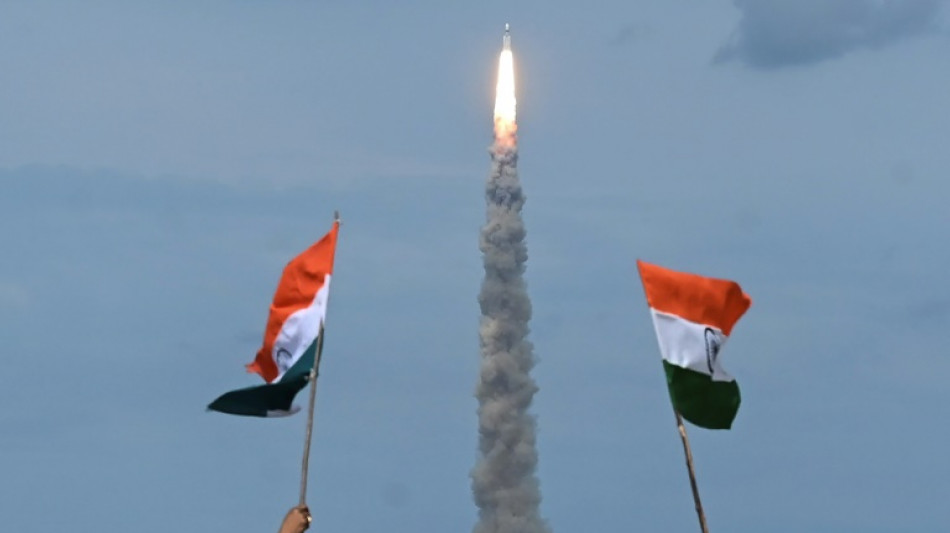
Indian lunar landing mission enters Moon's orbit / Photo: © AFP

 Republican senator seeks probe of Trump Jr Russian-funded wedding

 Memoir by Diana's brother goes on sale after rocking UK monarchy

 Newcomers South Korea face holders Italy in Davis Cup finals

 Japan's Kojima sounds Marchand warning with Asian Games gold

 England rugby star Pollock signs new Northampton deal

 STARTRADER Expands Its Chinese Equity CFD Range with CXMT and Unitree Robotics

 MEXC Expands Opportunity Compass with Stock Trading Handbook to Help Crypto Users Build Investment Knowledge

 England paceman Wood retires from international cricket

 Magnificent Mandhana's 79 helps India to Asian Games cricket gold

 Marchand 'stressed' about racing Japanese rivals at LA Olympics
 Mobile boat clinics bring healthcare to India's remote islands

 Former India paceman Zaheer Khan named Chennai coach in IPL

 Six-year-old Chinese girl sets world record with Rubik's Cube

 Swimming prodigy Yu, 13, says 'interviews way harder than racing'

 Star coaches make their bows as Nations League returns

 Rams bounce back as Giants reel from Dart injury

 In Bangladesh, Pakistan's Jinnah photo stirs anger

 Two New Zealand naval ships transit Taiwan Strait

 Zidane gets down to work as France start new era

 Inside the Venezuelan prison meant to 'drive you insane'

 UK king braces as memoir by Diana's brother goes on sale

 Akkodis and Hamburg Public Transport Association Showcase hvv mia at InnoTrans 2026, Demonstrating the Future of AI-Powered Mobility

 No green light to lift EU sanctions on Russian oligarchs, talks to resume

 UK agrees support for Saudi in struggle with Houthis: reports

 EU foreign policy chief calls for continued sanctions on Russia

India's latest space mission entered the Moon's orbit on Saturday ahead of the country's second attempted lunar landing, as its cut-price space programme seeks to reach new heights.
The world's most populous nation has a comparatively low-budget aerospace programme that is rapidly closing in on the milestones set by global space powers.
Only Russia, the United States and China have previously achieved a controlled landing on the lunar surface.
The Indian Space Research Organisation (ISRO) confirmed that Chandrayaan-3, which means "Mooncraft" in Sanskrit, had been "successfully inserted into the lunar orbit", more than three weeks after its launch.
If the rest of the current mission goes to plan, the mission will safely touch down near the Moon's little-explored south pole between August 23 and 24.
India's last attempt to do so ended in failure four years ago, when ground control lost contact moments before landing.
Developed by ISRO, Chandrayaan-3 includes a lander module named Vikram, which means "valour" in Sanskrit, and a rover named Pragyan, the Sanskrit word for wisdom.
The mission comes with a price tag of $74.6 million -- far smaller than those of other countries, and a testament to India's frugal space engineering.
Experts say India can keep costs low by copying and adapting existing space technology, and thanks to an abundance of highly skilled engineers who earn a fraction of their foreign counterparts' wages.
- 'A moment of glory' -
The Chandrayaan-3 spacecraft has taken much longer to reach the Moon than the manned Apollo missions of the 1960s and 1970s, which arrived in a matter of days.
The Indian rocket used is much less powerful than the United States' Saturn V and instead the probe orbited the earth five or six times elliptically to gain speed, before being sent on a month-long lunar trajectory.
If the landing is successful the rover will roll off Vikram and explore the nearby lunar area, gathering images to be sent back to Earth for analysis.
The rover has a mission life of one lunar day or 14 Earth days.
ISRO chief S. Somanath has said his engineers carefully studied data from the last failed mission and tried their best to fix the glitches.
India's space programme has grown considerably in size and momentum since it first sent a probe to orbit the Moon in 2008.
In 2014, it became the first Asian nation to put a satellite into orbit around Mars, and three years later, the ISRO launched 104 satellites in a single mission.
The ISRO's Gaganyaan ("Skycraft") programme is slated to launch a three-day manned mission into Earth's orbit by next year.
India is also working to boost its two percent share of the global commercial space market by sending private payloads into orbit for a fraction of the cost of competitors.
G.Schulte--BTB