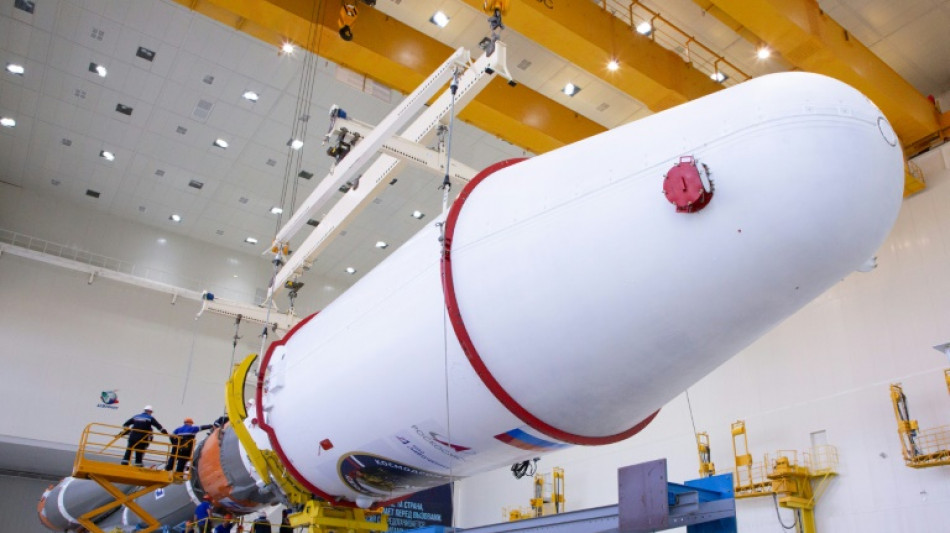
Russia to launch lunar mission Friday, first in nearly 50 years / Photo: © Russian Space Agency Roscosmos/AFP

 Republican senator seeks probe of Trump Jr Russian-funded wedding

 Memoir by Diana's brother goes on sale after rocking UK monarchy

 Newcomers South Korea face holders Italy in Davis Cup finals

 Japan's Kojima sounds Marchand warning with Asian Games gold

 England rugby star Pollock signs new Northampton deal
 STARTRADER Expands Its Chinese Equity CFD Range with CXMT and Unitree Robotics

 MEXC Expands Opportunity Compass with Stock Trading Handbook to Help Crypto Users Build Investment Knowledge

 England paceman Wood retires from international cricket

 Magnificent Mandhana's 79 helps India to Asian Games cricket gold

 Marchand 'stressed' about racing Japanese rivals at LA Olympics
 Mobile boat clinics bring healthcare to India's remote islands

 Former India paceman Zaheer Khan named Chennai coach in IPL

 Six-year-old Chinese girl sets world record with Rubik's Cube
 Swimming prodigy Yu, 13, says 'interviews way harder than racing'

 Star coaches make their bows as Nations League returns

 Rams bounce back as Giants reel from Dart injury

 In Bangladesh, Pakistan's Jinnah photo stirs anger

 Two New Zealand naval ships transit Taiwan Strait

 Zidane gets down to work as France start new era

 Inside the Venezuelan prison meant to 'drive you insane'

 UK king braces as memoir by Diana's brother goes on sale

 Akkodis and Hamburg Public Transport Association Showcase hvv mia at InnoTrans 2026, Demonstrating the Future of AI-Powered Mobility

 No green light to lift EU sanctions on Russian oligarchs, talks to resume

 UK agrees support for Saudi in struggle with Houthis: reports

 EU foreign policy chief calls for continued sanctions on Russia

Russia said Monday it plans to launch a lunar lander this week after multiple delays, hoping to return to the Moon for the first time in nearly fifty years.
Russian space agency Roscosmos said it had scheduled the launch of the Luna-25 lander for the early hours of Friday.
With the lunar mission, Russia's first since 1976, Moscow is seeking to restart and build on the Soviet Union's pioneering space programme.
The launch is the first mission of Moscow's new lunar project and comes as President Vladimir Putin looks to strengthen cooperation in space with China after ties with the West broke down following the start of Moscow's offensive in Ukraine last year.
Engineers have assembled a Soyuz rocket at the Vostochny cosmodrome in the Russian Far East for the launch of the lander, Roscosmos said.
"The Luna-25 will have to practise soft landing, take and analyse soil samples and conduct long-term scientific research," Roscosmos said in a statement.
The four-legged lander, which weighs around 800 kilograms (1,750 pounds) , is expected to touch down in the region of the lunar south pole. By contrast, most previous Moon landings have occurred near the lunar equator.
The spacecraft is expected to reach the Moon around five days after launch.
- 'Total sanctions' -
After Putin sent troops to Ukraine last year, the European Space Agency (ESA) said it would not cooperate with Moscow on the upcoming Luna-25 launch as well as future 26 and 27 missions.
Despite the pullout, Moscow said it would go ahead with its lunar plans and replace ESA equipment with Russian-made scientific instruments.
Speaking at the Vostochny cosmodrome last year, Putin said the Soviet Union put the first man into space in 1961 despite "total" sanctions.
The Kremlin chief insisted Moscow would similarly continue to develop its lunar programme despite current Western sanctions in response to the assault in Ukraine.
"We are guided by the ambition of our ancestors to move forward, despite any difficulties and any attempts to prevent us in this movement from the outside," Putin said.
In June, the head of Russia's space agency Roscosmos, Yuri Borisov, described the upcoming launch as high-risk.
"This mission involves landing at the south pole. No one in the world has ever done such things," he said during a meeting with Putin.
"The probability of successful completion of such missions is estimated at around 70 percent."
- Evacuation -
Ahead of Friday's launch, local authorities said that residents would be evacuated from the village of Shakhtinsky in the far-eastern region of Khabarovsk, where the rocket's boosters are expected to fall.
During the last Soviet Moon mission in 1976, the Luna-24 brough back samples of lunar soil.
With Sputnik, the Soviet Union launched the first man-made satellite into space in 1957 and later sent into orbit the first animal, a dog named Laika, the first man, Yuri Gagarin, and the first woman, Valentina Tereshkova.
But compared with the Soviet era, modern Russia has struggled to innovate and its space industry is fighting to secure state funding while the Kremlin prioritises military spending.
Russia's space agency is still reliant on Soviet-designed technology and has faced a number of setbacks, including corruption scandals and botched launches.
Moscow is also falling behind in the global space race, facing tough competition from the United States and China.
H.Seidel--BTB