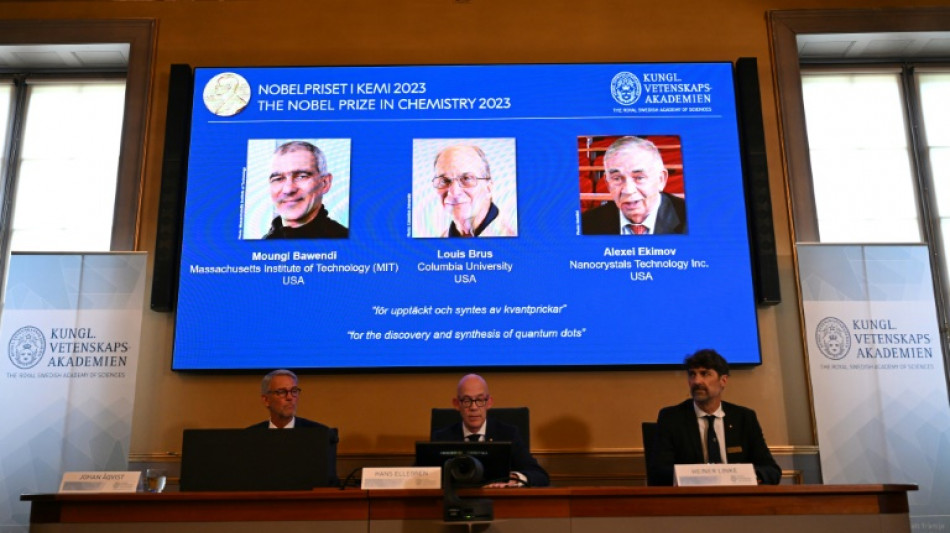
Three giants of chemistry connected by the quantum realm / Photo: © AFP

 Trump renames AI "super intelligence," rejects international oversight
 Trump rejects international regulation of AI
 How is the EU approaching record fuel prices?

 Sri Lanka's Colombage strikes on debut as England dismissed for 265 in first ODI
 Hurricane Polo strengthens to top category 5 off Mexico
 11 hurt as teen opens fire outside school in western Turkey

 UN chief says 'Big Oil' treats atmosphere as open sewer

 Tunisia says 2026 summer hottest on record

 England's Rashid out of Sri Lanka ODIs with hand injury

 Houthis accuse Saudi Arabia of deadly strikes as thousands flee

 Stocks climb as oil slides, AI buzz returns
 India cricketers win in style as Afghan savours 'special' Games silver

 La Liga president hits out at Real Madrid refereeing 'conspiracy' claims

 MEXC Launches “Real Stocks, Real Friends” with Rewards for Bringing Friends to Wall Street

 Mbappe continues media push for Ballon d'Or recognition

 Stocks rise on AI buzz, oil prices cool

 India narrowly survive huge scare against minnows Japan
 Missing F-35 fighter parts 'not sensitive', says Australia minister

 Cambodia showcases scams crackdown with global conference
 Afghan cyclist who disguised herself as man wins Asian Games silver

 Typhoon Dujuan leaves four dead in Japan, 45,000 houses without power

 G7 leaders condemn Houthi strikes on Saudi Arabia

 Google data centre sparks protests in Austria

 Shin Ohashi: Junk food-loving teen and Japan's next big swimming hope

 Stocks rise on AI buzz, drop in oil prices

This year's Nobel Chemistry winners are pioneers in the nanoworld.
During the 1980s, Alexi Ekimov, 78, and Louis Brus, 80, working independently and on opposite sides of the Iron Curtain, succeeding in creating "quantum dots" -- nanoparticles that are found today in next generation TV screens and are being used to illuminate tumors in the body.
A decade later, 62-year-old Moungi Bawendi revolutionized methods to manufacture them with precision and at scale, paving the way for their applications.
Here's the rundown on the 2023 Nobel Prize in Chemistry winners.
- Perseverance -
Bawendi was born in 1961 in Paris, France to a Tunisian father and French mother.
His family emigrated to the United States when he was 10 years old, and though he excelled at science in high school, he flunked his very first college chemistry class at Harvard.
"It could easily have destroyed me, my first experience with an F, the lowest grade in my class by far," he told reporters.
But he persevered, earning his undergraduate degree and later his PhD at the University of Chicago. He would later join Brus at Bell Laboratories, then finally the Massachusetts Institute of Technology (MIT), where he remains today as a professor.
"I'm especially honored to share this with Louis Brus, who was my postdoctoral mentor... I tried to emulate his scholarship and mentoring style as a professor myself," he said.
Bawendi built upon the work of his co-laureates and in 1993 succeeded in vastly improving the methods to create quantum dots, finding just the right solvent and temperature to grow nanocrystals to specific sizes.
- Colored glass experiments -
Ekimov and Brus grew up in the post-war era. Ekimov was born in 1945 in the former USSR, and graduated from Leningrad State University.
Ekimov was fascinated by colored glass and the fact that a single substance could yield many colors. By experimenting with temperatures and heating times of molten glass, he found he was able to vary the size of the particles produced and that the smaller the particles were, the bluer the light they emitted.
He published his findings in a Soviet science journal 1981, and was the first person to intentionally create quantum dots -- particles predicted by physics theory in the early 20th century but not until then demonstrated in reality.
At the same time, Brus worked at the legendary Bell Laboratories in the United States -- then a hotbed for scientific discovery -- on experiments that involved chopping up particles to provide a larger surface area and faster chemical reactions.
During his work, he noticed that the particles' optical and other properties shifted the smaller they became, something that could only be explained by quantum mechanics.
- Sputnik generation -
"I am a member of the Sputnik generation, raised after WWII as the United States dramatically expanded science and technology in response to the Cold War" he wrote in an autobiographical account after receiving the 2008 Kavli Prize.
Gifted from an early age in mathematics and science, he grew up in the suburbs of Kansas City, where he says he "developed an affinity for tools and machines by working after school and on weekends in the local hardware store."
He initially thought he would follow his father into business. But after receiving his doctorate in 1969 from Columbia University in New York, he served in the United States Navy, and became a researcher in a laboratory in Washington.
Then, in 1972, he began working for Bell Labs, where he remained for 23 years.
He is now a professor at Columbia University and a firm believer in the power of science.
"Scientists struggle daily with their experiments, and tend to lose sight of the enormous collective progress of science and technology over the decades," he wrote.
"Science has created a far better existence for mankind despite war, economic collapse and natural disaster."
M.Odermatt--BTB