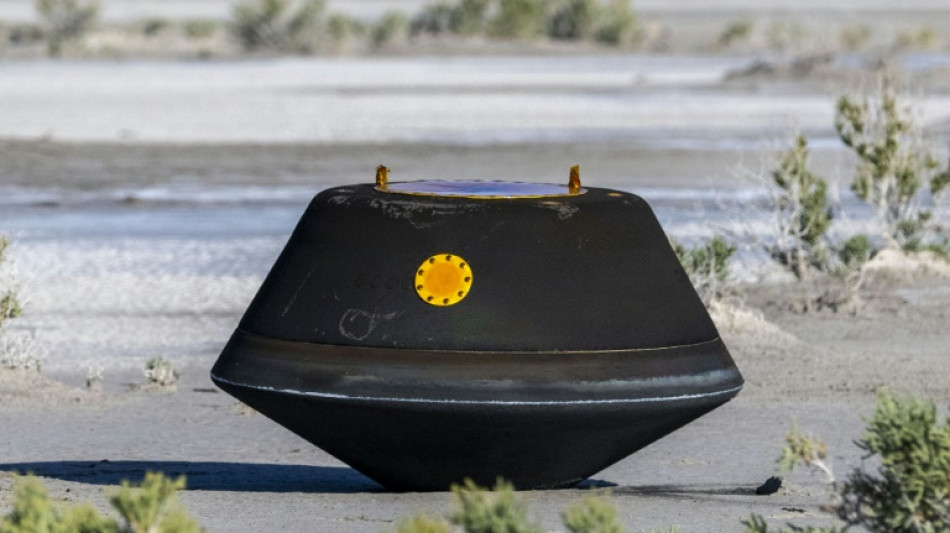
NASA asteroid sample contains life-critical water and carbon / Photo: © NASA/AFP/File

 Trump renames AI "super intelligence," rejects international oversight

 Trump rejects international regulation of AI

 How is the EU approaching record fuel prices?

 Sri Lanka's Colombage strikes on debut as England dismissed for 265 in first ODI

 Hurricane Polo strengthens to top category 5 off Mexico

 11 hurt as teen opens fire outside school in western Turkey

 UN chief says 'Big Oil' treats atmosphere as open sewer

 Tunisia says 2026 summer hottest on record

 England's Rashid out of Sri Lanka ODIs with hand injury

 Houthis accuse Saudi Arabia of deadly strikes as thousands flee

 Stocks climb as oil slides, AI buzz returns

 India cricketers win in style as Afghan savours 'special' Games silver

 La Liga president hits out at Real Madrid refereeing 'conspiracy' claims

 MEXC Launches “Real Stocks, Real Friends” with Rewards for Bringing Friends to Wall Street

 Mbappe continues media push for Ballon d'Or recognition

 Stocks rise on AI buzz, oil prices cool

 India narrowly survive huge scare against minnows Japan

 Missing F-35 fighter parts 'not sensitive', says Australia minister

 Cambodia showcases scams crackdown with global conference

 Afghan cyclist who disguised herself as man wins Asian Games silver

 Typhoon Dujuan leaves four dead in Japan, 45,000 houses without power

 G7 leaders condemn Houthi strikes on Saudi Arabia

 Google data centre sparks protests in Austria

 Shin Ohashi: Junk food-loving teen and Japan's next big swimming hope

 Stocks rise on AI buzz, drop in oil prices

A sample collected from the 4.5-billion-year-old asteroid Bennu contains abundant water and carbon, both vital materials for the formation of our planet, NASA revealed on Wednesday.
The finding offers yet more evidence for the theory that the foundations for life on Earth were seeded from outer space.
"The first analysis shows samples that contain abundant water in the form of hydrated clay minerals," Bill Nelson said in a press event.
"This is the biggest carbon rich asteroid sample ever returned to Earth," he said, with the carbon contained in the form of both minerals and organic molecules.
The OSIRIS-REx mission collected rock and dust from Bennu in 2020, and a capsule containing the precious cargo successfully returned to Earth a little over two weeks ago, landing in the Utah desert.
It is now being painstakingly analyzed in a specialized clean room at NASA's Johnson Space Center in Houston.
OSIRIS-REx wasn't the first mission to rendezvous with an asteroid and bring back samples for study -- Japan succeeded in the feat twice, returning bits of space pebbles in 2010 and 2020.
But the substantial amount of material -- an estimated 250 grams (half a pound) -- as opposed to the 5.4 grams returned by Japan's Hayabusa2 -- is a key difference.
NASA chose Bennu because they think similar asteroids could have delivered organic building blocks to Earth along with water through collisions billions of years ago.
Bennu's orbit, which intersects that of our planet, also made the roundtrip journey easier than going to the Asteroid Belt, which lies between Mars and Jupiter.
Researchers have so far focused their efforts not on the main sample itself but on "bonus particles," described as black dust and debris coating the sample collector.
Back in October 2020, when OSIRIS-REx probe shot nitrogen gas at Bennu to collect its sample, a flap meant to seal it got wedged open with a piece of rock, allowing some of the finer material to flow out of the collector without escaping altogether.
"The very best 'problem' to have is that there is so much material, it's taking longer than we expected to collect it," said deputy OSIRIS-REx curation lead Christopher Snead, in a statement.
An inspection of the remainder of the sample will follow later.
It's thought that Bennu formed from pieces of a larger asteroid in the asteroid belt, following a massive collision between one and two billion years ago.
Data gathered by the spacecraft revealed the particles making up its exterior were so loosely packed that if a person were to step onto the surface, they might sink in, much like stepping into a pit of plastic balls.
In addition to scientific insights, better understanding of Bennu's composition could prove useful if humanity ever needs to steer it away.
While it has no chance of hitting Earth through the mid 2100s, the chances rise to around 1 in 1750 between then and the year 2300, NASA says.
C.Kovalenko--BTB