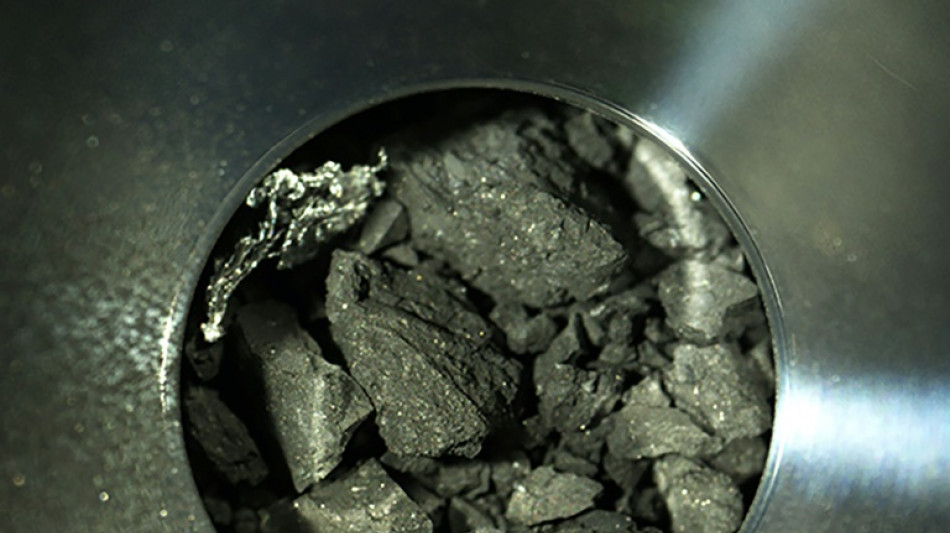
Asteroid samples contain 'clues to origin of life': Japan scientists / Photo: © JAXA/AFP/File

 Drones hit Moscow as Russians go to the polls

 New England boss Fleming says 'wrong' to ask Stokes to end retirement

 Germans vote in elections threatening fresh blow to Merz

 US fears rapid escalation in Mideast after Houthis attack Riyadh

 Japan triathlete Hojo wins first gold of Asian Games
 IOC president impressed by 'beautiful' Asian Games wooden huts

 First Asian Games gold goes to Japan as China's 13-year-old Yu lights up pool

 Data centre command hub keeps AI up and running

 Pope Leo in France: the issues on the table

 Packing for a pope: behind the scenes on foreign trips

 Republicans find transgender issues a powerful political weapon in midterm campaigning

 German state elections threaten new shock waves for Merz

 Chile's Bachelet quits race to be next UN chief

 Raphinha treble fires perfect Barca to win at Sevilla

 Thiam makes winning heptathlon return at Decastar meet

 Czechs beat USA to qualify for Davis Cup finals

 Dortmund sink Stuttgart to climb to Bundesliga summit

 Trump says will not tolerate attempts to slow AI growth

 'It has to stop': runners protest women's murders in S.Africa district

 Fire erupts near Riyadh airport as Houthis claim strikes

 Cuba works to restore power after another blackout

 England thrash Sri Lanka again to return to top of T20 rankings

 Arsenal thrashed by Brighton, sorry Spurs lose again

 South Korea, Austria qualify for Davis Cup finals

 Seare shocks Ingebrigtsen to win world 5km gold

Asteroid dust collected by a Japanese space probe contains organic material that shows some of the building blocks of life on Earth may have been formed in space, scientists said Friday.
Pristine material from the asteroid Ryugu was brought back to Earth in 2020 after a six-year mission to the celestial body around 300 million kilometres away.
But scientists are only just beginning to discover its secrets in the first studies on small portions of the 5.4 grams (0.2 ounces) of dust and dark, tiny rocks.
In one paper published Friday, a group of researchers led by Okayama University in western Japan said they had discovered "amino acids and other organic matter that could give clues to the origin of life on Earth".
"The discovery of protein-forming amino acids is important, because Ryugu has not been exposed to the Earth's biosphere, like meteorites, and as such their detection proves that at least some of the building blocks of life on Earth could have been formed in space environments," the study said.
The team said they found 23 different types of amino acid while examining the sample collected by Japan's Hayabusa-2 probe in 2019.
The dust and rocks were stirred up when the fridge-sized spacecraft fired an "impactor" into the asteroid.
"The Ryugu sample has the most primitive characteristics of any natural sample available to mankind, including meteorites," the Japan Aerospace Exploration Agency (JAXA) said in a statement.
It is believed that part of the material was created about five million years after the birth of the solar system and has not been heated above 100 degrees Celsius (210 degrees Fahrenheit).
Another study published in the US-based journal "Science" said the material has "a chemical composition that more closely resembles the Sun's photosphere than other natural samples".
Kensei Kobayashi, an astrobiology expert and professor emeritus at Yokohama National University, hailed the discovery.
"Scientists have been questioning how organic matter -- including amino acids -- was created or where it came from, and the fact that amino acids were discovered in the sample offers a reason to think that amino acids were brought to Earth from outer space," he told AFP.
Another mainstream theory about the origin of amino acids is that they were created in Earth's primitive atmosphere through lightning strikes, for example, after Earth cooled down.
F.Müller--BTB