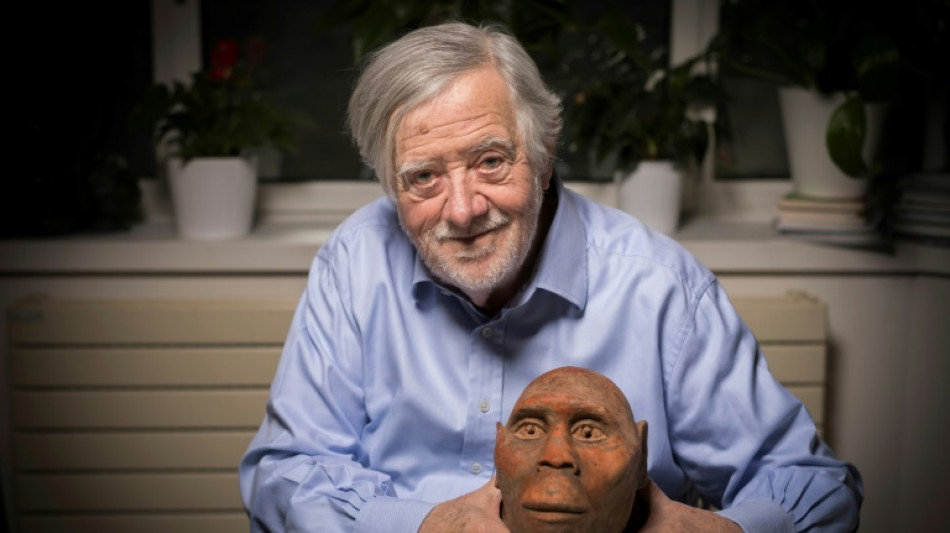
French co-discoverer of 'Lucy' dies at 87 / Photo: © AFP/File

 US warns of rapid escalation in Mideast war

 Iran 'put hearts on the court' to win Asian Games basketball bronze

 School girl Yu helps China dominate in Asian Games swimming openers

 Myanmar win first Asian Games teqball gold as Spain great Puyol watches

 China's 13-year-old Yu scorches to first major gold at Asian Games

 Russians vote on last day of parliamentary elections

 Hong Kong pays final respects to former city leader Tung

 Typhoon put people off Asian Games opening ceremony, official says

 China's 13-year-old Yu cruises as Asian Games swimming begins

 AI 'warning shots' focus Beijing on national security risks

 Philippine tribe in limbo over US-led tech hub

 Leo XIV, first US pope transcends his restrained style

 Singer Ed Sheeran says Gaza situation 'unjustifiable' following controversy

 In 'Tenzing', a Sherpa mountaineer gets his due

 Ed Sheeran set to return to stage after Palestinian controversy
 Toulouse edge Vannes, Lyon beat Pau to take Top 14 summit

 Germans arrested for Louvre stunt in Mona Lisa hall

 Saudi-led coalition says Houthis fired ballistic missile at Riyadh

 France's debt climbs to highest since 1978: ministry

 McIlroy two shots off the lead at Wentworth after eagle on 18

 Martinez brace saves Inter in Serie A top-two clash with Roma

 Rosenior abused but guides Paris FC past old club Strasbourg

 Seven-try Lyon beat Pau, climb to Top 14 summit

 Brighton defeat a 'big lesson' against complacency for Arsenal, says Arteta

 Thousands protest inaction over climate crisis in Switzerland

French palaeontologist Yves Coppens, credited with the co-discovery of the famous fossil find known as "Lucy", died on Wednesday aged 87 after a long illness, his publisher said.
"France has lost one of its great men," publisher Odile Jacob tweeted, adding that beyond his science skills, Coppens had also been "a talented writer, storyteller and non-fiction author".
He was, with Maurice Taieb and Donald Johanson, part of the team that found the most complete remnants of an Australopithecus afarensis ever discovered, in 1974 in Hadar, Ethiopia.
The team nicknamed the 3.2- million-year-old female hominid "Lucy" after the Beatles song "Lucy in the Sky with Diamonds" which they listened to while labelling the fossils.
Based on the large part of Lucy they found, 40 percent of her skeleton, the scientists were able to determine her height (one metre, 3.5 feet) and show that she was muscular and able to climb trees as well as walk upright.
Coppens, who was born in Britanny and was the son of a nuclear physicist father, co-signed six hominid discoveries over his career.
"At six or seven years old I already wanted to become an archaeologist," Coppens told AFP in 2016. "All my holiday time was spent at digs," he added.
Coppens was admitted to France's prestigious CNRS scientific centre in 1956 when he was still only 22.
He began travelling to Africa from the 1960s, starting with Algeria and Chad.
His first major discovery came in 1967, a 2.6-million-year-old fossil in the Omo valley in Ethiopia.
Then in 1974 came the international expedition in Ethiopia's Afar triangle that was to make Coppens, his friend and fellow Frenchman Taieb and Donald Johanson, an American, world famous for the discovery of Lucy.
Coppens often referred to himself as one of Lucy's "daddies" ("papas" in French).
For a long time after the find, which comprised 52 bone fragments, scientists believed that she was a direct ancestor of humanity.
But this claim is no longer widely believed, and Coppens as well as other palaeontologists came instead to view Lucy as a distant cousin of mankind.
Later Coppens ran digs in Mauritania, the Philippines, Indonesia, Siberia, China and Mongolia.
Back home, he became director of the Musee de l'Homme (Museum of Mankind) in Paris, was given the palaeontology chair in the prestigious College de France, and joined France's Academy of Science.
He also won several prizes, served as an advisor on environmental questions to the French government, and wrote several books and more than a million scientific articles.
Besides the discovery of Lucy, Coppens once told AFP, he was particularly proud to have "made an irrefutable link between the emergence of man and climate change".
As forests gave place to savannas, man stopped climbing trees, began to walk upright and needed to develop brain power to keep carnivores at bay, he said.
burs-jh/har
R.Adler--BTB