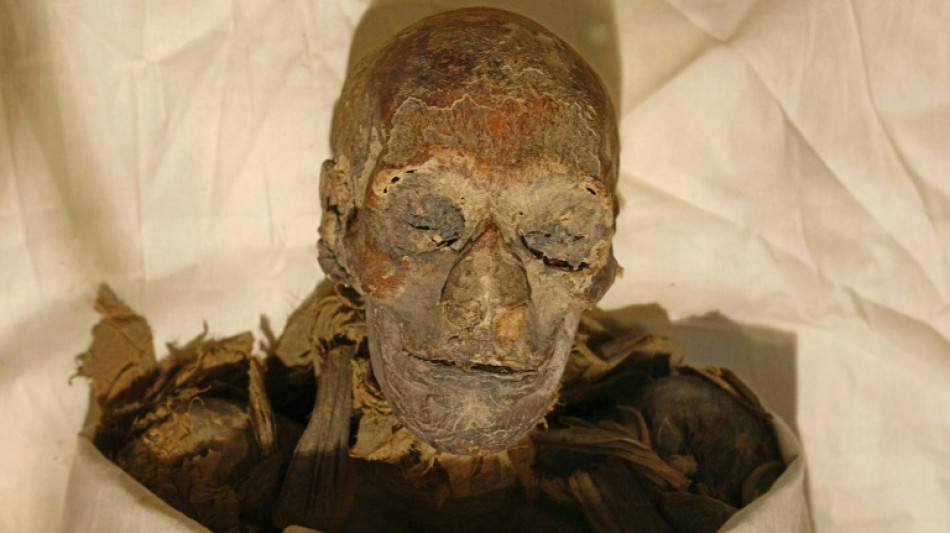
Gender not main factor in attacks on Egyptian woman pharaoh: study / Photo: © AFP

 Newcomers South Korea face holders Italy in Davis Cup finals

 Japan's Kojima sounds Marchand warning with Asian Games gold

 England rugby star Pollock signs new Northampton deal

 STARTRADER Expands Its Chinese Equity CFD Range with CXMT and Unitree Robotics

 MEXC Expands Opportunity Compass with Stock Trading Handbook to Help Crypto Users Build Investment Knowledge

 England paceman Wood retires from international cricket

 Magnificent Mandhana's 79 helps India to Asian Games cricket gold

 Marchand 'stressed' about racing Japanese rivals at LA Olympics

 Mobile boat clinics bring healthcare to India's remote islands

 Former India paceman Zaheer Khan named Chennai coach in IPL

 Six-year-old Chinese girl sets world record with Rubik's Cube

 Swimming prodigy Yu, 13, says 'interviews way harder than racing'

 Star coaches make their bows as Nations League returns

 Rams bounce back as Giants reel from Dart injury

 In Bangladesh, Pakistan's Jinnah photo stirs anger

 Two New Zealand naval ships transit Taiwan Strait

 Zidane gets down to work as France start new era

 Inside the Venezuelan prison meant to 'drive you insane'

 UK king braces as memoir by Diana's brother goes on sale

 Akkodis and Hamburg Public Transport Association Showcase hvv mia at InnoTrans 2026, Demonstrating the Future of AI-Powered Mobility

 Macron says talks with Trump on Red Sea, Ukraine 'constructive'

 Green policies just good politics, says UK minister

 Bardot auction in Paris fetches nearly one million euros

 No timeline on Daniels injury return, says Commanders coach

 British Columbia sues OpenAI in US court over Canada school shooting

She was one of ancient Egypt's most successful rulers, a rare female pharaoh who preceded Cleopatra by 1,500 years, but Queen Hatshepsut's legacy was systematically erased by her stepson successor after her death.
The question of why her impressive reign was so methodically scrubbed has attracted significant debate, but in new research published Monday, University of Toronto scholar Jun Wong argues far too much emphasis has been placed on her gender.
"It's quite a romantic question: why was this pharaoh attacked after her death?" Wong told AFP, explaining his interest in a monarch who steered ancient Egypt through a period of extraordinary prosperity.
Earlier scholars believed Queen Hatshepsut's stepson Thutmose III unleashed a posthumous campaign of defilement against her out of revenge and hatred, including because he wanted to purge any notion that a woman could successfully rule.
"The way in which (Hatshepsut's) reign has been understood has always been colored by her gender," Wong said, referencing beliefs that Thutmose III may have viewed her as "a kind of an evil stepmother."
His research, which builds on other recent scholarship and is being published in the journal Antiquity, argues Thutmose III's motivations were far more nuanced, casting further doubt on the theory of backlash against a woman in charge.
Hatshepsut ruled Egypt roughly 3,500 years ago, taking over following the death of her husband Thutmose II.
She first served as regent to her stepson, the king-in-waiting, but successfully consolidated power in her own right, establishing herself as a female pharaoh.
Experts say she expanded trade routes and commissioned extraordinary structures, including an unparallelled mortuary in the Valley of the Kings on the Nile's west bank.
Wong reassessed a range of material from damaged statues uncovered during excavations from 1922 to 1928.
He said there is no doubt Thutmose III worked to eliminate evidence of Hatshepsut's achievements, but his efforts were "perhaps driven by ritual necessity rather than outright antipathy," Wong said.
Thutmose III may have been trying to neutralize the power of his predecessor in a practical and common way, not out of malice.
He also found that some of the statues depicting Hatshepsut were likely damaged because later generations wanted to reuse them as building materials.
"For a long time, it has been assumed that Hatshepsut's statuary sustained a vindictive attack," Wong said, arguing that a fresh look at the archives suggests "this is not the case."
J.Bergmann--BTB