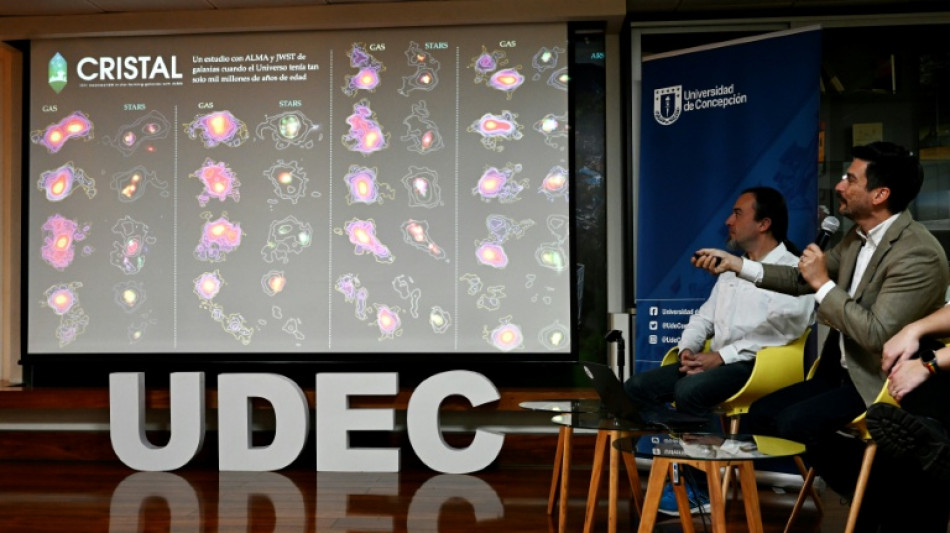
ALMA lets astronomers see building blocks of early galaxies / Photo: © AFP

 Newcomers South Korea face holders Italy in Davis Cup finals

 Japan's Kojima sounds Marchand warning with Asian Games gold

 England rugby star Pollock signs new Northampton deal

 STARTRADER Expands Its Chinese Equity CFD Range with CXMT and Unitree Robotics

 MEXC Expands Opportunity Compass with Stock Trading Handbook to Help Crypto Users Build Investment Knowledge

 England paceman Wood retires from international cricket

 Magnificent Mandhana's 79 helps India to Asian Games cricket gold

 Marchand 'stressed' about racing Japanese rivals at LA Olympics
 Mobile boat clinics bring healthcare to India's remote islands

 Former India paceman Zaheer Khan named Chennai coach in IPL

 Six-year-old Chinese girl sets world record with Rubik's Cube

 Swimming prodigy Yu, 13, says 'interviews way harder than racing'

 Star coaches make their bows as Nations League returns

 Rams bounce back as Giants reel from Dart injury

 In Bangladesh, Pakistan's Jinnah photo stirs anger

 Two New Zealand naval ships transit Taiwan Strait

 Zidane gets down to work as France start new era

 Inside the Venezuelan prison meant to 'drive you insane'

 UK king braces as memoir by Diana's brother goes on sale

 Akkodis and Hamburg Public Transport Association Showcase hvv mia at InnoTrans 2026, Demonstrating the Future of AI-Powered Mobility

 Macron says talks with Trump on Red Sea, Ukraine 'constructive'

 Green policies just good politics, says UK minister

 Bardot auction in Paris fetches nearly one million euros

 No timeline on Daniels injury return, says Commanders coach

 British Columbia sues OpenAI in US court over Canada school shooting

Chile's ALMA observatory, which houses some of the world's most powerful telescopes, has captured its most detailed images to date of the building blocks of the early universe -- primarily cold gases, dust and stellar light in 39 galaxies.
"We've never achieved so much detail and depth in galaxies from the early universe," Sergio Martin, head of Scientific Operations at ALMA, told AFP during a presentation of the research at University of Concepcion in Santiago.
Due to its dark skies and clear air, Chile hosts the telescopes of more than 30 countries, including the Atacama Large Millimeter/submillimeter Array (ALMA) that was used in the findings.
The research was led by Rodrigo Herrera-Camus, director of the Millennium Nucleus of Galaxies (MINGAL) of Chile, who told AFP the new images provide "the opportunity to study how stars are born."
The survey also found that stars emerged in "giant clumps," Herrera-Camus said.
By combining ALMA's findings with images from the James Webb and Hubble telescopes, researchers were able to learn more about how galaxies evolve, interact, and form stars.
The ALMA telescope was developed by the European Southern Observatory, the US National Radio Astronomy Observatory and the National Astronomical Observatory of Japan.
R.Adler--BTB