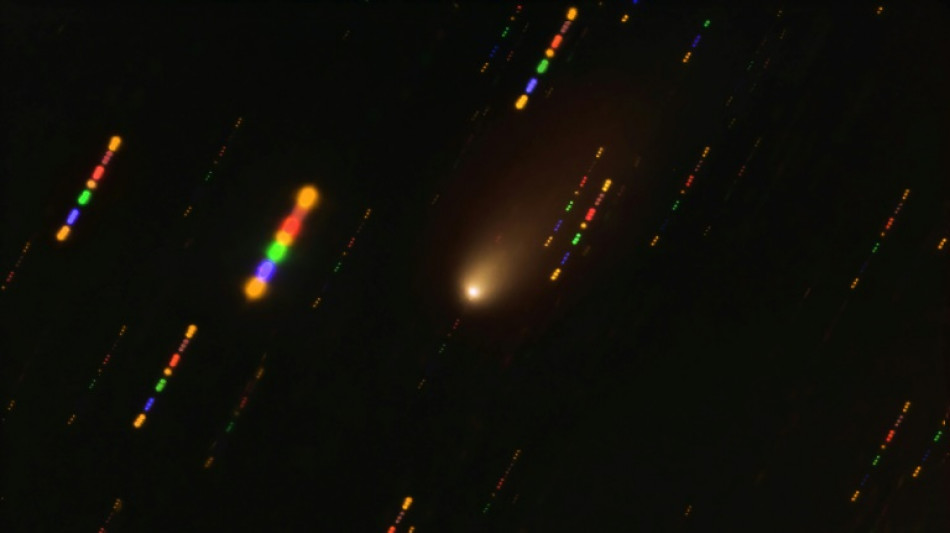
Possible interstellar object spotted zooming through Solar System / Photo: © EUROPEAN SOUTHERN OBSERVATORY/AFP/File

 Newcomers South Korea face holders Italy in Davis Cup finals

 Japan's Kojima sounds Marchand warning with Asian Games gold

 England rugby star Pollock signs new Northampton deal

 STARTRADER Expands Its Chinese Equity CFD Range with CXMT and Unitree Robotics

 MEXC Expands Opportunity Compass with Stock Trading Handbook to Help Crypto Users Build Investment Knowledge

 England paceman Wood retires from international cricket

 Magnificent Mandhana's 79 helps India to Asian Games cricket gold

 Marchand 'stressed' about racing Japanese rivals at LA Olympics

 Mobile boat clinics bring healthcare to India's remote islands

 Former India paceman Zaheer Khan named Chennai coach in IPL

 Six-year-old Chinese girl sets world record with Rubik's Cube

 Swimming prodigy Yu, 13, says 'interviews way harder than racing'

 Star coaches make their bows as Nations League returns

 Rams bounce back as Giants reel from Dart injury

 In Bangladesh, Pakistan's Jinnah photo stirs anger

 Two New Zealand naval ships transit Taiwan Strait

 Zidane gets down to work as France start new era

 Inside the Venezuelan prison meant to 'drive you insane'

 UK king braces as memoir by Diana's brother goes on sale

 Akkodis and Hamburg Public Transport Association Showcase hvv mia at InnoTrans 2026, Demonstrating the Future of AI-Powered Mobility

 Macron says talks with Trump on Red Sea, Ukraine 'constructive'

 Green policies just good politics, says UK minister

 Bardot auction in Paris fetches nearly one million euros

 No timeline on Daniels injury return, says Commanders coach

 British Columbia sues OpenAI in US court over Canada school shooting

An object that appears to be from beyond our Solar System has been spotted hurtling towards the Sun, which if confirmed would be the third visitor from the stars ever detected, the European Space Agency said Wednesday.
The object, which is currently being referred to as A11pl3Z, poses no threat to Earth, the ESA's planetary defence head Richard Moissl told AFP.
"It will fly deep through the Solar System, passing just inside the orbit of Mars," but will not hit our neighbouring planet, he said.
Excited astronomers are still refining their calculations, but the object appears to be zooming more than 60 kilometres (37 miles) a second.
This would mean it is not bound by the Sun's orbit, unlike comets and asteroids, which all originate from within the Solar System.
Its trajectory also "means it's not orbiting our star, but coming from interstellar space and flying off to there again," Moissl said.
"We are not 100 percent certain at the moment, but anything else would be a surprise," he added.
Official confirmation is expected to come from the International Astronomical Union's Minor Planet Center, which has recorded more than 100 observations of the object so far.
The NASA-funded ATLAS survey in Hawaii first discovered the object on Tuesday, US astronomer David Rankin wrote on the social media platform Bluesky.
Professional and amateur astronomers across the world then searched through past telescope data, tracing its trajectory back to at least June 14.
The object is currently estimated to be roughly 10-20 kilometres wide, Moissl said. But the object could be smaller if it is made out of ice, which reflects more light.
"It will get brighter and closer to the Sun until late October and then still be observable (by telescope) until next year," Moissl said.
- Our third visitor -
It would be the third time humanity has detected something coming from the stars.
The first, 'Oumuamua, was discovered in 2017. It was so strange that at least one prominent scientist became convinced it was an alien vessel -- though this has since been dismissed by further research.
Our second interstellar visitor, 2I/Borisov, was spotted in 2019.
Mark Norris, an astronomer at the UK's University of Central Lancashire, told AFP that the new object appears to be "moving considerably faster than the other two extra-solar objects that we previously discovered."
The object is currently roughly around the distance from Jupiter away from Earth, Norris said.
He lamented that he would not be able to observe the object on his telescope on Wednesday night, because it is currently only visible in the Southern Hemisphere.
Norris pointed to modelling estimating that there could be as many 10,000 interstellar objects drifting through the Solar System at any given time, though most would be smaller than the newly discovered object.
If true, this suggests that the newly online Vera C. Rubin Observatory in Chile could soon be finding these dim interstellar visitors every month, Norris said.
Moissl said it is not feasible to send a mission into space to intercept the new object.
Still, these visitors offer scientists a rare chance to study something outside of our Solar System.
For example, if we detected precursors of life such as amino acids on such an object, it would give us "a lot more confidence that the conditions for life exist in other star systems," Norris said.
L.Dubois--BTB