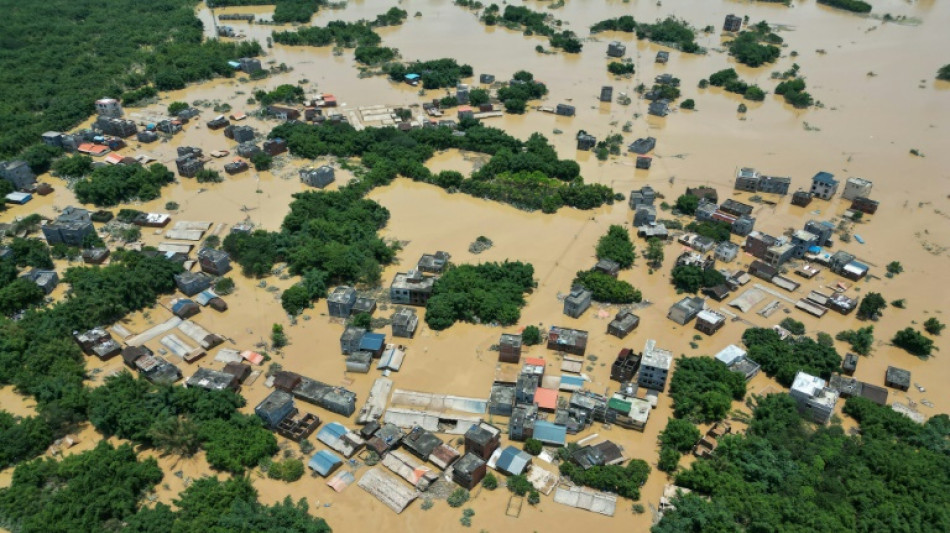
What is causing record floods and heatwaves in China? / Photo: © AFP/File

 US warns of rapid escalation in Mideast war

 Iran 'put hearts on the court' to win Asian Games basketball bronze

 School girl Yu helps China dominate in Asian Games swimming openers

 Myanmar win first Asian Games teqball gold as Spain great Puyol watches

 China's 13-year-old Yu scorches to first major gold at Asian Games

 Russians vote on last day of parliamentary elections

 Hong Kong pays final respects to former city leader Tung

 Typhoon put people off Asian Games opening ceremony, official says
 China's 13-year-old Yu cruises as Asian Games swimming begins

 AI 'warning shots' focus Beijing on national security risks

 Philippine tribe in limbo over US-led tech hub

 Leo XIV, first US pope transcends his restrained style

 Singer Ed Sheeran says Gaza situation 'unjustifiable' following controversy

 In 'Tenzing', a Sherpa mountaineer gets his due

 Ed Sheeran set to return to stage after Palestinian controversy

 Toulouse edge Vannes, Lyon beat Pau to take Top 14 summit

 Germans arrested for Louvre stunt in Mona Lisa hall

 Saudi-led coalition says Houthis fired ballistic missile at Riyadh

 France's debt climbs to highest since 1978: ministry

 McIlroy two shots off the lead at Wentworth after eagle on 18

 Martinez brace saves Inter in Serie A top-two clash with Roma

 Rosenior abused but guides Paris FC past old club Strasbourg

 Seven-try Lyon beat Pau, climb to Top 14 summit

 Brighton defeat a 'big lesson' against complacency for Arsenal, says Arteta

 Thousands protest inaction over climate crisis in Switzerland

Record floods in southern China this month displaced more than half a million people, while searing heat buckled roads in other parts of the country.
Authorities have issued extreme weather warnings in multiple regions, while experts warned that these phenomena were more evidence of the impact of climate change.
- How bad are the floods? -
Summer floods are common in China, especially in the low-lying Pearl River delta region in the south.
This year, however, the National Climate Center forecast that flooding will be "relatively worse" and "more extreme" than before.
Water levels at one location in Guangdong province "surpassed historical records" this week, according to the ministry of water resources, while parts of neighbouring Fujian province and Guangxi region also reported record rainfall.
More than half a million people were evacuated this month because of the flood threat.
In the cities of Guangzhou and Shaoguan in Guangdong province, heavy rainfall turned roads into rivers and people had to be taken to safety in lifeboats.
Authorities in the province estimated the economic damage from the floods to be more than a quarter of a billion dollars.
- What about the heatwave? -
Seven provinces in northern and central China Wednesday warned millions of residents not to go outdoors as temperatures hit 40 degrees Celsius (104 degrees Fahrenheit).
State broadcaster CCTV this week showed footage of cement roads cracked under extreme heat in central Henan province.
Meanwhile, power demand surged to record levels in several cities in the north this week as residents cranked up the air conditioning to beat the heat.
In China's second-most populous province Shandong, home to more than 100 million people, electricity use topped 93 million kilowatts on Tuesday, beating the 2020 high of 90 million kilowatts, CCTV said.
- What is the economic cost? -
China's central economic planner estimates that extreme weather will shave off one to three percent of the country's GDP every year.
The floods in China last year cost $25 billion -- the world's second-worst flood-related loss after Europe, a study published in April by reinsurer Swiss Re showed.
Chinese Premier Li Keqiang warned Wednesday that floods and heatwaves will affect the production of staple grains, vegetables and pork and push up inflation.
- Why is this happening? -
"Extreme weather and climate events in the country have become more frequent, severe and widespread," China Meteorological Administration said Wednesday.
It followed a warning in March from Xiao Chan, deputy director of the National Climate Center: "Global warming and La Nina events are contributing to abnormally high temperatures and extreme rain in China."
As the Earth's atmosphere gets warmer, it holds more moisture, making downpours more intense.
La Nina refers to the large-scale cooling of surface temperatures in the central and eastern equatorial Pacific Ocean, causing devastating floods in South China, India and Bangladesh.
- What is China doing about it? -
China has built a network of massive dams and "sponge cities" with permeable pavements to try and limit the devastation during the annual flood season.
"But the most damaging recent floods have occurred in areas historically less at risk," said Scott Moore, a researcher at the University of Pennsylvania focusing on China's environmental policy.
"This is a classic climate change effect: increased extreme weather in different regions and at different times of year than the historical average."
China is the world's biggest coal-burning nation and top emitter of greenhouse gases that lead to climate change.
It aims to become carbon neutral by 2060, but local governments have pushed up investments in both renewables and coal in recent months.
Beijing has also not yet outlined precisely how it intends to achieve its emissions targets.
Environmentalists have warned that without specifying the size of the peak or setting an absolute cap, China can essentially keep increasing emissions until 2030.
- Focus on forecasting? -
A new roadmap for climate change adaptation published by the Chinese government last week says the focus should now shift to predicting extreme weather more accurately using sensors and satellites.
"The usefulness of weather forecasts caps out around 10 days, beyond which their accuracy rapidly drops to that of a coin flip," think tank Trivium China said in a research note.
"Climate monitoring and forecasting is a whole different ballgame", helping to predict severe floods and droughts at least a month in advance.
K.Brown--BTB