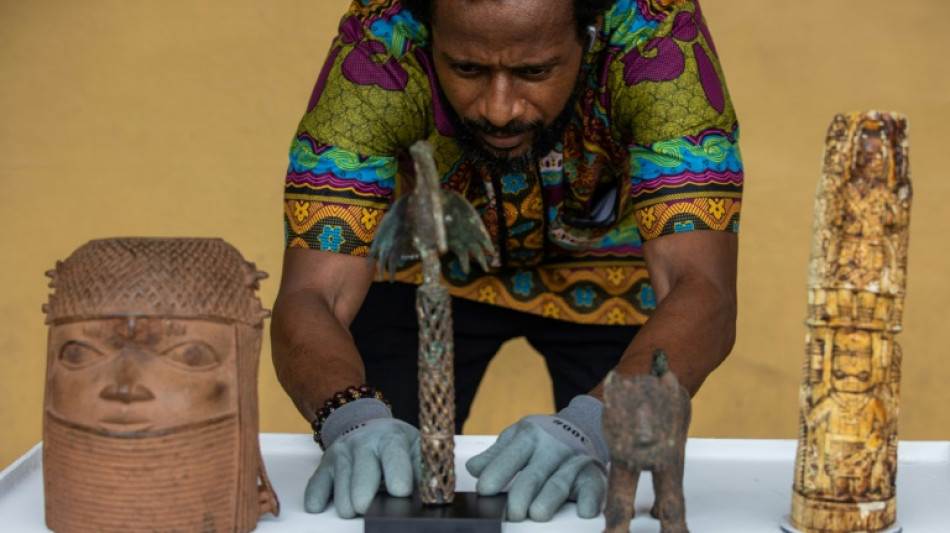
Looted art: the battle for looted treasures / Photo: © AFP

 Newcomers South Korea face holders Italy in Davis Cup finals

 Japan's Kojima sounds Marchand warning with Asian Games gold

 England rugby star Pollock signs new Northampton deal
 STARTRADER Expands Its Chinese Equity CFD Range with CXMT and Unitree Robotics

 MEXC Expands Opportunity Compass with Stock Trading Handbook to Help Crypto Users Build Investment Knowledge

 England paceman Wood retires from international cricket

 Magnificent Mandhana's 79 helps India to Asian Games cricket gold

 Marchand 'stressed' about racing Japanese rivals at LA Olympics

 Mobile boat clinics bring healthcare to India's remote islands

 Former India paceman Zaheer Khan named Chennai coach in IPL

 Six-year-old Chinese girl sets world record with Rubik's Cube

 Swimming prodigy Yu, 13, says 'interviews way harder than racing'

 Star coaches make their bows as Nations League returns

 Rams bounce back as Giants reel from Dart injury

 In Bangladesh, Pakistan's Jinnah photo stirs anger

 Two New Zealand naval ships transit Taiwan Strait

 Zidane gets down to work as France start new era

 Inside the Venezuelan prison meant to 'drive you insane'

 UK king braces as memoir by Diana's brother goes on sale

 Akkodis and Hamburg Public Transport Association Showcase hvv mia at InnoTrans 2026, Demonstrating the Future of AI-Powered Mobility

 Macron says talks with Trump on Red Sea, Ukraine 'constructive'

 Green policies just good politics, says UK minister

 Bardot auction in Paris fetches nearly one million euros

 No timeline on Daniels injury return, says Commanders coach

 British Columbia sues OpenAI in US court over Canada school shooting

After the French parliament voted on Monday to return to Ivory Coast a "talking drum" that colonial troops took from the Ebrie tribe in 1916, here is a recap of other disputes over artefacts looted from Europe's former colonies.
- France: tens of thousands of pieces -
The Djidji Ayokwe, the beloved "talking drum" is one of tens of thousands of artworks and other prized artefacts that France looted from its colonial empire from the 16th century to the first half of the 20th century.
Three metres long and weighing 430 kilogrammes, it was seized by French troops in 1916 and sent to France in 1929.
President Emmanuel Macron in 2021 promised to return the drum, used as a communication tool to transmit messages between different areas, and other artefacts to the west African country.
Ivory Coast, Senegal and Benin have all asked for the repatriation of their treasures.
In late 2020, the French parliament adopted a law providing for the permanent return to Benin of 26 artefacts from the royal treasures of Dahomey.
- Britain: refuses to budge -
The Parthenon Marbles, the object of a long-running dispute between the United Kingdom and Greece, are the most high profile of contested treasures.
Athens has for decades demanded the return of the sculptures from the British Museum, saying they were looted in 1802 by Lord Elgin, the then-British ambassador to the Ottoman Empire.
The current government of Prime Minister Kyriakos Mitsotakis has escalated its efforts to secure the repatriation of the Marbles, holding official and unofficial meetings with the government of Keith Starmer last autumn.
The British Museum has also refused to return any of the sacred sculptures and carvings known as the "Benin Bronzes" taken during a British military expedition in the former kingdom of Benin in southern Nigeria in 1897.
It has the biggest collection of the Benin Bronzes which are held in museums across the United States and Europe.
The British Museum is also standing firm on the 11 Ethiopian tabots, or sacred tablets, that it holds.
- Germany: agrees to return Bronzes -
The German government agreed in 2022 to hand 1,100 Benin Bronzes back to Nigeria. The first 22 were sent back in December 2022.
- Netherlands too -
The Netherlands in June 2025 officially handed back to Nigeria 119 Benin Bronzes sculptures with a ceremony held at the National Museum in Lagos, showcasing four of them in the museum's courtyard.
- Egyptian antiquities -
Many artworks and artefacts have over the centuries been looted from Egypt, the cradle of an ancient civilisation that has long fascinated Europeans.
Among the most high profile cases are the Nefertiti bust, the Rosetta Stone and the Dendera Zodiac, which are on show in top museums in Germany, the United Kingdom and France.
The bust of Nefertiti, the wife of the Pharaoh Akhenaten, was sculpted around 1340 BC but was taken to Germany by a Prussian archaeologist and was later given to the Neues Museum in Berlin.
The Rosetta Stone, a basalt slab dating from 196 BC, has been housed in the British Museum since 1802, inscribed with the legend "Captured in Egypt by the British Army in 1801".
It bore extracts of a decree written in Ancient Greek, an ancient Egyptian vernacular script called Demotic and hieroglyphics.
The Dendera Zodiac, a celestial map, was blasted out of the Hathor Temple in Qena in southern Egypt in 1820 by a French official.
Thought to date from around 50 BC, it has been suspended on a ceiling in the Louvre museum in Paris since 1922.
E.Schubert--BTB