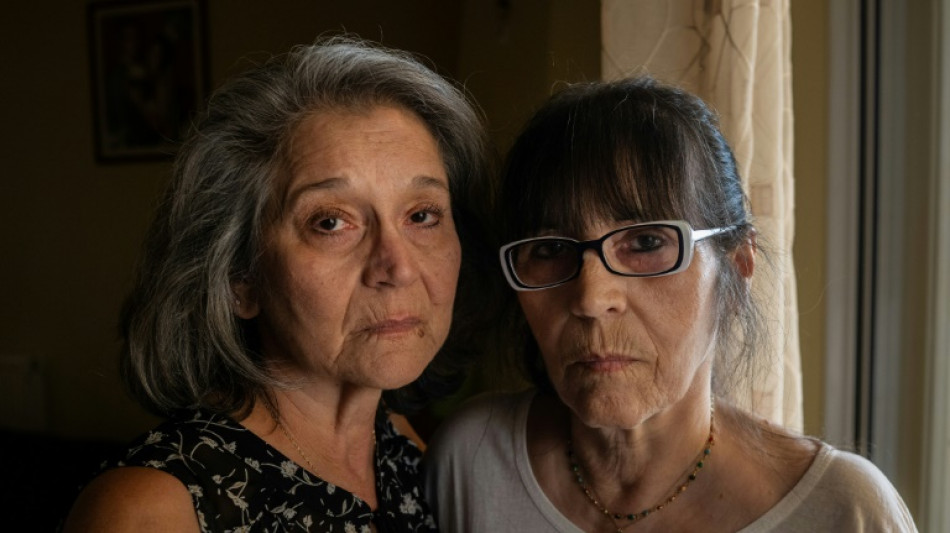
Adopted in US, Greek Cold War kids find long-lost families / Photo: © AFP

 Newcomers South Korea face holders Italy in Davis Cup finals

 Japan's Kojima sounds Marchand warning with Asian Games gold
 England rugby star Pollock signs new Northampton deal

 STARTRADER Expands Its Chinese Equity CFD Range with CXMT and Unitree Robotics

 MEXC Expands Opportunity Compass with Stock Trading Handbook to Help Crypto Users Build Investment Knowledge

 England paceman Wood retires from international cricket

 Magnificent Mandhana's 79 helps India to Asian Games cricket gold
 Marchand 'stressed' about racing Japanese rivals at LA Olympics
 Mobile boat clinics bring healthcare to India's remote islands
 Former India paceman Zaheer Khan named Chennai coach in IPL

 Six-year-old Chinese girl sets world record with Rubik's Cube
 Swimming prodigy Yu, 13, says 'interviews way harder than racing'
 Star coaches make their bows as Nations League returns
 Rams bounce back as Giants reel from Dart injury
 In Bangladesh, Pakistan's Jinnah photo stirs anger

 Two New Zealand naval ships transit Taiwan Strait

 Zidane gets down to work as France start new era
 Inside the Venezuelan prison meant to 'drive you insane'

 UK king braces as memoir by Diana's brother goes on sale

 Akkodis and Hamburg Public Transport Association Showcase hvv mia at InnoTrans 2026, Demonstrating the Future of AI-Powered Mobility

 Macron says talks with Trump on Red Sea, Ukraine 'constructive'

 Green policies just good politics, says UK minister

 Bardot auction in Paris fetches nearly one million euros

 No timeline on Daniels injury return, says Commanders coach

 British Columbia sues OpenAI in US court over Canada school shooting

Robyn Bedell Zalewa grew up and spent all her adult life in the United States, but is part of a little-known chapter of Greek history -- the adoption of some 4,000 infants during the Cold War.
Always knowing she came from Greece, she rediscovered her long-lost sister Sophia, who lives in the Athens area, and regained her Greek nationality two years ago.
Connecticut-based Robyn goes by the name of Joanna when in Greece.
There's just one snag.
Her sister Sophia only speaks Greek, so the siblings communicate through an online translator tool.
"What hurts me the most is not being able to have a conversation with Sophia," the 68-year-old told AFP.
At the close of the Second World War and a brutal occupation by Nazi Germany, Greece was consumed by civil strife between royalists and communists that saw fighting continue until 1949.
With thousands of Greek families plunged into disaster and poverty, an adoption movement gained momentum in the 1950s and 1960s, which saw babies and children sent abroad for adoption, mainly in the United States.
Gonda Van Steen, director of the Centre for Hellenic Studies at King's College London, told AFP that Greece "was the main country of origin of children adopted in the US in the early 1950s".
"American childless couples were willing to pay any price for a healthy white newborn," said Van Steen, who has conducted extensive research and authored a book on the subject.
Greek-American Mary Cardaras campaigned for years so that children born in Greece, who are now in their sixties or seventies, could retrieve their birth nationality.
"What followed (the first adoptions in Greece) was a tsunami of international adoptions," she said, citing in particular China, Vietnam, Russia and especially South Korea, where at least 140,000 children were adopted by foreign parents between 1955 and 1999.
- 'A better life' -
In Greece, the biological mothers of adopted children were often impoverished widows, some of whom had been raped, or faced social stigmatisation for having a child out of wedlock.
"They saw no other solution than to give the child away for him or her to have 'a better life'," Van Steen said.
Greece simplified in May the process of obtaining birth documents to specifically enable individuals adopted until 1976 to regain Greek nationality.
On the terrace of an Athens café, Bedell Zalewa proudly pulls her Greek passport and identity card from her handbag.
Even though she had her adoption certificate -- not all children did -- she began the process well before new regulations were implemented and had to wait a long time before regaining Greek citizenship.
"I always knew I had been adopted in Greece," said the pensioner who was born in Messini, in the Peloponnese region, before being adopted in Texas.
"What I've wanted my entire life is to find my family," said Bedell Zalewa, her eyes welling up.
Her story is one of a tenacious search for one's roots.
Bedell Zalewa found her brothers and sister and even met her biological mother before she passed away.
As the youngest of five, she was apparently given up for adoption because her widowed mother was too poor to raise her.
The ties she has forged in Greece encourage her to stay there whenever she can.
Cardaras, the retired journalist who was adopted in the Chicago area and lived for a long time in California, also always knew that she was of Greek origin.
She kept her Greek birth passport, which was originally revoked when she left the country as a baby.
- Faces on the street -
When she returned to her native country for the first time on a summer vacation in 1972, she remembers looking "at every woman's face" on the street.
"I wondered... if she was my mother," she said.
Everything felt familiar to her: "The smells, the atmosphere, I was completely at home."
"But it was only when my (adoptive) parents died that I really began to question the first months and years of my life," Cardaras said.
Now settled in Athens, she is taking Greek classes and is making progress in understanding her native language.
Better access to Greek nationality constitutes a deeply emotional breakthrough for adoptees with fragmented backgrounds.
One of them recently shared their experience on social media.
"At 12:47 PM Greek time, I received a message announcing that I am now reinstated as a Greek citizen! I am overwhelmed with emotion, thrilled, and on cloud nine!" Stephanie Pazoles wrote on Facebook.
B.Shevchenko--BTB