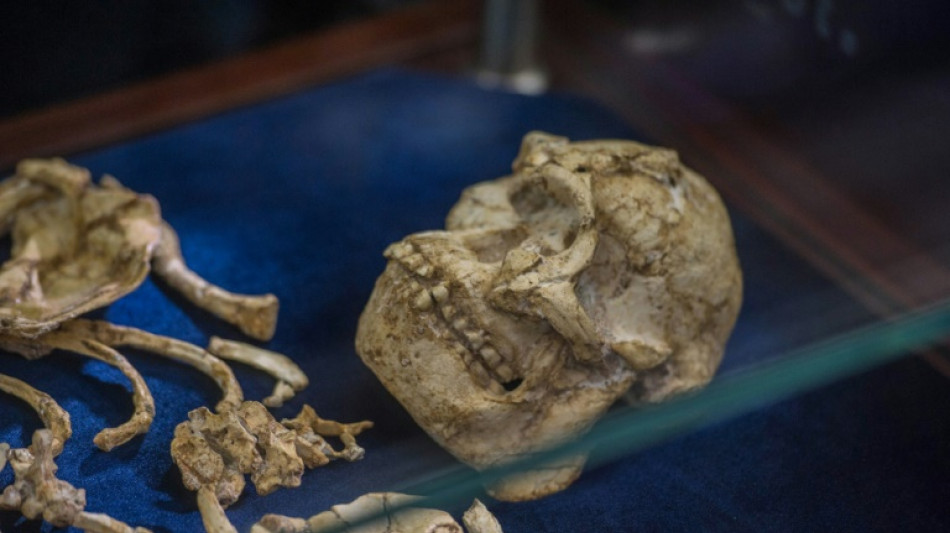
Early human ancestors one million years older than thought / Photo: © AFP/File

 US warns of rapid escalation in Mideast war

 Iran 'put hearts on the court' to win Asian Games basketball bronze

 School girl Yu helps China dominate in Asian Games swimming openers

 Myanmar win first Asian Games teqball gold as Spain great Puyol watches

 China's 13-year-old Yu scorches to first major gold at Asian Games

 Russians vote on last day of parliamentary elections

 Hong Kong pays final respects to former city leader Tung

 Typhoon put people off Asian Games opening ceremony, official says

 China's 13-year-old Yu cruises as Asian Games swimming begins

 AI 'warning shots' focus Beijing on national security risks

 Philippine tribe in limbo over US-led tech hub

 Leo XIV, first US pope transcends his restrained style

 Singer Ed Sheeran says Gaza situation 'unjustifiable' following controversy

 In 'Tenzing', a Sherpa mountaineer gets his due

 Ed Sheeran set to return to stage after Palestinian controversy

 Toulouse edge Vannes, Lyon beat Pau to take Top 14 summit

 Germans arrested for Louvre stunt in Mona Lisa hall

 Saudi-led coalition says Houthis fired ballistic missile at Riyadh

 France's debt climbs to highest since 1978: ministry

 McIlroy two shots off the lead at Wentworth after eagle on 18

 Martinez brace saves Inter in Serie A top-two clash with Roma

 Rosenior abused but guides Paris FC past old club Strasbourg

 Seven-try Lyon beat Pau, climb to Top 14 summit

 Brighton defeat a 'big lesson' against complacency for Arsenal, says Arteta

 Thousands protest inaction over climate crisis in Switzerland

The fossils of our earliest ancestors found in South Africa are a million years older than previously thought, meaning they walked the Earth around the same time as their East African relatives like the famous "Lucy", according to new research.
The Sterkfontein caves at the Cradle of Humankind world heritage site southwest of Johannesburg have yielded more Australopithecus fossils than any other site in the world.
Among them was "Mrs Ples", the most complete skull of an Australopithecus africanus found in South Africa in 1947.
Based on previous measurements, Mrs Ples and other fossils found at a similar depth of the cave were estimated to be between 2.1 and 2.6 million years old.
But "chronologically that didn't fit," said French scientist Laurent Bruxelles, one of the authors of a study published Monday in the PNAS science journal.
"It was bizarre to see some Australopithecus lasting for such a long time," the geologist told AFP.
Around 2.2 million years ago the Homo habilis -- the earliest species of the Homo genus that includes Homo sapiens -- was already roaming the region.
But there were no signs of Homo habilis at the depth of the cave where Mrs Ples was found.
- 'Contemporaries' -
Also casting doubt on Mrs Ples's age was recent research showing that the almost-complete skeleton of an Australopithecus known as "Little Foot" was 3.67 million years old.
Such a big gap in ages between Mrs Ples and Little Foot seemed unlikely given they were separated by so few sedimentary layers.
Because the fossils are too old and fragile to test, scientists analyse the sediment near where they were found.
The previous dates underestimated the age of the fossils because they measured calcite flowstone mineral deposits, which were younger than the rest of that cave section, the study said.
For the latest study, the researchers used a technique called cosmogenic nuclide dating, which looked at levels of rare isotopes created when rocks containing quartz were hit by high-speed particles that arrived from outer space.
"Their radioactive decay dates when the rocks were buried in the cave when they fell in the entrance together with the fossils," said the study's lead author, Darryl Granger of Purdue University in the US.
The researchers found that Mrs Ples and other fossils near her were between 3.4 and 3.7 million years old.
This means that members of Australopithecus africanus like Mrs Ples were "contemporaries" of East Africa's Australopithecus afarensis, including 3.2-million-year-old Lucy who was found in Ethiopia, said Dominic Stratford, director of research at the caves and one of study's authors.
- Our family tree 'more like a bush' -
It could also possibly alter our understanding of our ancestral history.
The South African Australopithecus had previously been considered "too young" to be the ancestor of the Homo genus, Stratford said. That meant that Lucy's home of East Africa was thought to be the more likely place where the Homo genus evolved.
But the new research shows that the South African Australopithecus had almost a million years to evolve into our Homo ancestor.
Or they could have worked on it together.
"Over a timeframe of millions of years, at only 4,000 kilometres (2,500 miles) away, these species had plenty of time to travel, to breed with each other... so we can largely imagine a common evolution across Africa," Bruxelles said.
The research showed that the history of hominids was "more complex than linear evolution", he added.
Our family tree is in fact "more like a bush, to use the words of our late friend Yves Coppens," Bruxelles said, referring to the French palaeontologist credited with co-discovering Lucy. Coppens died last week.
"He had long understood the pan-African nature of evolution," Bruxelles said.
A.Gasser--BTB