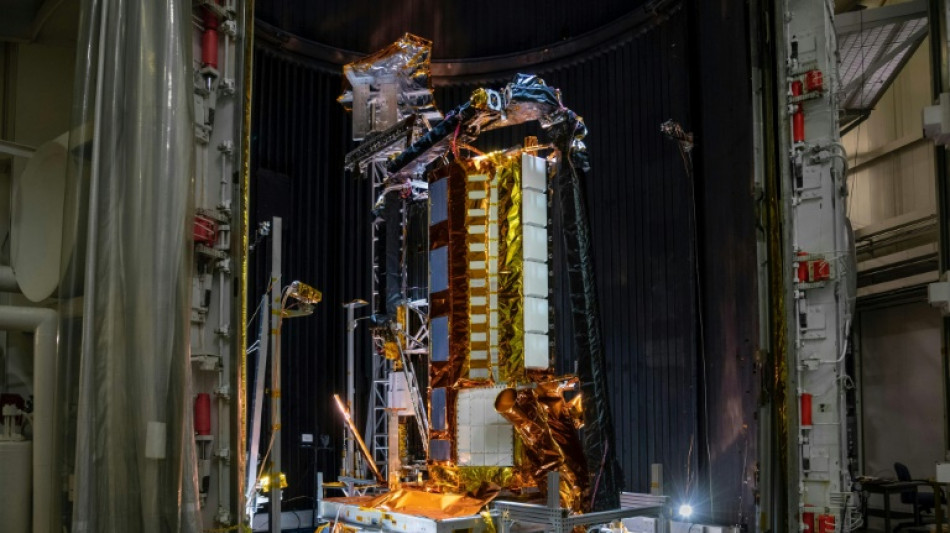
US, India to launch powerful Earth-monitoring satellite / Photo: © NASA/AFP

 Antonio Sabato Jr. Calls for Compassion After Son's Fatal Hit-and-Run Arrest

 Ohio Rep.-Elect Don Leonard Alleges Threats From Senior Democrats Over Speaker Vote
 एलेक्स बोडी और SCANDIC PAY: Mastercard और VISA कार्ड — भुगतान की नई पीढ़ी

 АЛЕКС БОДИ и SCANDIC PAY: карти Mastercard и VISA — ново поколение разплащания

 أليكس بودي وSCANDIC PAY: بطاقات Mastercard وVISA — جيل جديد من المدفوعات

 ALEX BODI 與 SCANDIC PAY:Mastercard 與 VISA 卡——新一代支付方式

 ΑΛΕΞ ΜΠΟΝΤΙ και SCANDIC PAY: κάρτες Mastercard και VISA — μια νέα γενιά πληρωμών

 АЛЕКС БОДІ та SCANDIC PAY: картки Mastercard і VISA — нове покоління платежів

 ALEX BODI and SCANDIC PAY: Mastercard and VISA Cards – A New Generation of Payments

 Heir to £50m Estate Convicted of Grievous Bodily Harm in Pub Assault

 Vodacom Targets Late 2027 Launch for Satellite-to-Phone Service in South Africa
 Rutgers Defeats NJIT 101-64 Behind Francis and Mark Scores
A formidable new radar satellite jointly developed by the United States and India is set to launch Wednesday, designed to track subtle changes in Earth's land and ice surfaces and help predict both natural and human-caused hazards.
Dubbed NISAR (NASA-ISRO Synthetic Aperture Radar), the pickup truck-sized spacecraft is scheduled to lift off at 5:40 pm (1210 GMT) from the Satish Dhawan Space Centre on India's southeastern coast, riding an ISRO Geosynchronous Satellite Launch Vehicle rocket.
Highly anticipated by scientists, the mission has also been hailed as a milestone in growing US-India cooperation between President Donald Trump and Prime Minister Narendra Modi.
"Our planet surface undergoes constant and meaningful change," Karen St Germain, director of NASA's Earth Science division, told reporters.
"Some change happens slowly. Some happens abruptly. Some changes are large, while some are subtle."
By picking up on tiny changes in the vertical movement of the Earth's surface -- as little as one centimeter (0.4 inches) -- scientists will be able to detect the precusors for natural and human-caused disasters, from earthquakes, landsides and volcanoes to aging infrastructure like dams and bridges.
"We'll see land substance and swelling, movement, deformation and melting of mountain glaciers and ice sheets covering both Greenland and Antarctica, and of course, we'll see wildfires," added St Germain, calling NISAR "the most sophisticated radar we've ever built."
Equipped with a 12-meter dish that will unfold in space, NISAR will record nearly all of Earth's land and ice twice every 12 days from an altitude of 464 miles (747 kilometers).
- Microwave frequencies -
As it orbits, the satellite will continuously transmit microwaves and receive echoes from the surface.
Because the spacecraft is moving, the returning signals are distorted -- but computer processing will reassemble them to produce detailed, high-resolution images.
Achieving similar results with traditional radar would require an impractically large 12-mile-wide dish.
NISAR will operate on two radar frequencies: L-band and S-band. The L-band is ideal for sensing taller vegetation like trees, while the S-band enables more accurate readings of shorter plants such as bushes and shrubs.
NASA's Jet Propulsion Laboratory and India's ISRO shared the workload, each building components on opposite sides of the planet before integrating and testing the spacecraft at ISRO's Satellite Integration & Testing Establishment in the southern Indian city of Bengaluru.
NASA's contribution came to just under $1.2 billion, while ISRO's costs were around $90 million.
India's space program has made major strides in recent years, including placing a probe in Mars orbit in 2014 and landing a robot and rover on the Moon in 2023.
Shubhanshu Shukla, a test pilot with the Indian Air Force, recently became the second Indian to travel to space and the first to reach the International Space Station -- a key step toward India's own indigenous crewed mission planned for 2027 under the Gaganyaan ("sky craft") program.
I.Meyer--BTB


