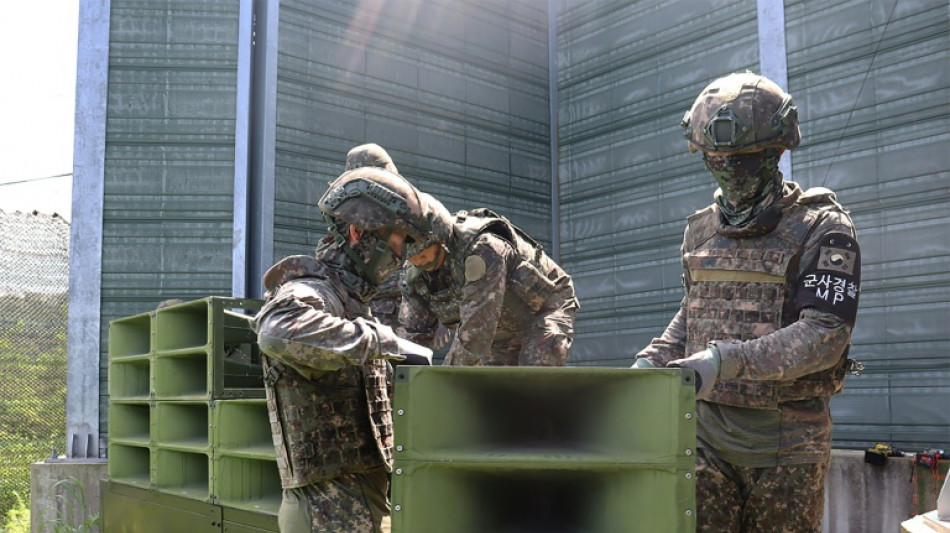
South Korea removing loudspeakers on border with North / Photo: © South Korean Defence Ministry/AFP

 ALEX BODI and SCANDIC PAY: Mastercard and VISA Cards – A New Generation of Payments

 Heir to £50m Estate Convicted of Grievous Bodily Harm in Pub Assault

 Vodacom Targets Late 2027 Launch for Satellite-to-Phone Service in South Africa

 Rutgers Defeats NJIT 101-64 Behind Francis and Mark Scores

South Korea said Monday it was removing loudspeakers used to blare K-pop and news reports to the North, as the new administration in Seoul tries to ease tensions with its bellicose neighbour.
The nations, still technically at war, had already halted propaganda broadcasts along the demilitarised zone, Seoul's military said in June after the election of President Lee Jae Myung.
It said in June that Pyongyang stopped transmitting bizarre, unsettling noises along the border that had become a major nuisance for South Korean locals, a day after the South's loudspeakers fell silent.
"Starting today, the military has begun removing the loudspeakers," Lee Kyung-ho, spokesman of the South's defence ministry, told reporters on Monday.
"It is a practical measure aimed at helping ease tensions with the North, provided that such actions do not compromise the military's state of readiness."
All loudspeakers set up along the border will be dismantled by the end of the week, he added.
He did not disclose the number to be removed, but a Yonhap news agency report -- which the defence ministry declined to verify -- said it was about 20.
Handout photos released by the ministry show soldiers wearing body armour unloading sets of speakers as part of the process.
Newly elected President Lee ordered the military to stop the broadcasts in a bid to "restore trust".
Relations between the two Koreas had been at one of their lowest points in years, with Seoul taking a hard line towards Pyongyang, which has drawn ever closer to Moscow in the wake of Russia's invasion of Ukraine.
-Overture-
Last year, the two Koreas were in a tit-for-tat propaganda war, as the North sent thousands of trash-filled balloons southwards, saying they were retaliation for propaganda balloons launched by South Korean activists.
In response, South's then-president Yoon Suk Yeol ordered to turn on border loudspeaker broadcasts -- including K-pop tunes and international news.
Shortly afterwards, North Korea started transmitting strange sounds along the frontier, unsettling South Korean residents.
Lee has taken a different approach in dealing with the North since his June election, including requesting civic groups to stop sending anti-North propaganda leaflets.
"We have strongly urged civic groups to halt leaflet activities in order to foster peace and ensure the safety of residents in border areas," Koo Byung-sam, spokesman of the Unification Ministry, said at a press briefing on Monday.
Lee has said he would seek talks with the North without preconditions, following a deep freeze under his predecessor.
Despite his diplomatic overtures, the North has rejected pursuing dialogue with its neighbour.
"If the ROK... expected that it could reverse all the results it had made with a few sentimental words, nothing is more serious miscalculation than it," Kim Yo Jong, sister of North Korean leader Kim Jong Un, said last week using the South's official name.
The two countries technically remain at war because the 1950-53 Korean War ended in an armistice, not a peace treaty.
M.Ouellet--BTB


