
NASA races to put nuclear reactors on Moon and Mars / Photo: © GETTY IMAGES NORTH AMERICA/AFP/File

 Stocks rise on AI buzz, oil prices cool

 India narrowly survive huge scare against minnows Japan

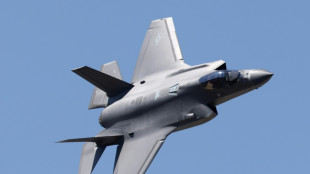 Missing F-35 fighter parts 'not sensitive', says Australia minister

 Cambodia showcases scams crackdown with global conference

 Afghan cyclist who disguised herself as man wins Asian Games silver

 Typhoon Dujuan leaves four dead in Japan, 45,000 houses without power

 G7 leaders condemn Houthi strikes on Saudi Arabia

 Google data centre sparks protests in Austria

 Shin Ohashi: Junk food-loving teen and Japan's next big swimming hope

 Stocks rise on AI buzz, drop in oil prices

 China's robot dancers limber up for America's Got Talent final

 Despite military might, Saudi struggles to crush the Houthis

 Trump to tout deals, defend Iran war in UN speech

 Sri Lanka to issue verdict in landmark Easter attack trial

 No green light to lift EU sanctions on Russian oligarchs, talks to resume

 UK agrees support for Saudi in struggle with Houthis: reports

 EU foreign policy chief calls for continued sanctions on Russia

 Flights scrapped, evacuations urged as Typhoon Dujuan wallops Japan

 Fonseca to take break from tennis

 A Cuban zoo, and its animals, in epic battle for survival

 Infantino proposes consulting federations to reform FIFA

 El Nino weather pattern enters record territory: scientist

 OpenAI calls for US to lead global effort on AI standards

 South African ostriches plucked alive for luxury fashion: report

 US networks halt Trump coverage in revolt over White House ban

The United States is rushing to put nuclear power reactors on the Moon and Mars, and hopes to launch the first system by the end of the decade.
A new NASA directive -- first reported by Politico and seen by AFP on Tuesday -- calls for the appointment of a nuclear power czar to select two commercial proposals within six months, framing the push as crucial to outpacing a joint Chinese-Russian effort.
Signed by acting NASA chief Sean Duffy, who is also US transportation secretary, the July 31 memo is the latest sign of the agency's shift towards prioritizing human space exploration over scientific research under President Donald Trump's second term.
"Since March 2024, China and Russia have announced on at least three occasions a joint effort to place a reactor on the Moon by the mid-2030s," it says.
"The first country to do so could potentially declare a keep-out zone which would significantly inhibit the United States from establishing a planned Artemis presence if not there first."
The idea of using nuclear energy off-planet is not new.
Since 2000, NASA has invested $200 million towards developing small, lightweight fission power systems, though none have progressed towards flight readiness, according to the directive.
The most recent effort came in 2023 with the completion of three $5 million industry study contracts that focused on generating 40 kilowatts of power, enough to continuously run 30 households for ten years.
Unlike solar power, fission systems can operate around the clock -- invaluable during the weeks-long lunar nights or Martian dust storms.
Advances in technology have made such systems increasingly compact and lightweight.
NASA formally committed to using nuclear power on Mars in December 2024 -- the first of seven key decisions necessary for human exploration of the Red Planet.
Based on feedback by industry, surface power needs should be at least 100 kilowatts to support "long-term human operations including in-situ resource utilization," meaning things like life support, communications, and mining equipment to collect surface ice.
It assumes the use of a "heavy class lander" that carries up to 15 metric tons of mass, and targets a "readiness to launch by the first quarter of FY30," meaning late 2029.
NASA's Artemis program to return to the Moon and establish a lasting presence near the south pole has faced repeated delays.
The timeline for Artemis 3, the first planned crewed landing, has slipped to 2027, a date few see as realistic given the planned lander, SpaceX's Starship, is far from ready.
China meanwhile is targeting 2030 for its first crewed mission and has proven more adept at meeting its deadlines in recent years.
O.Bulka--BTB