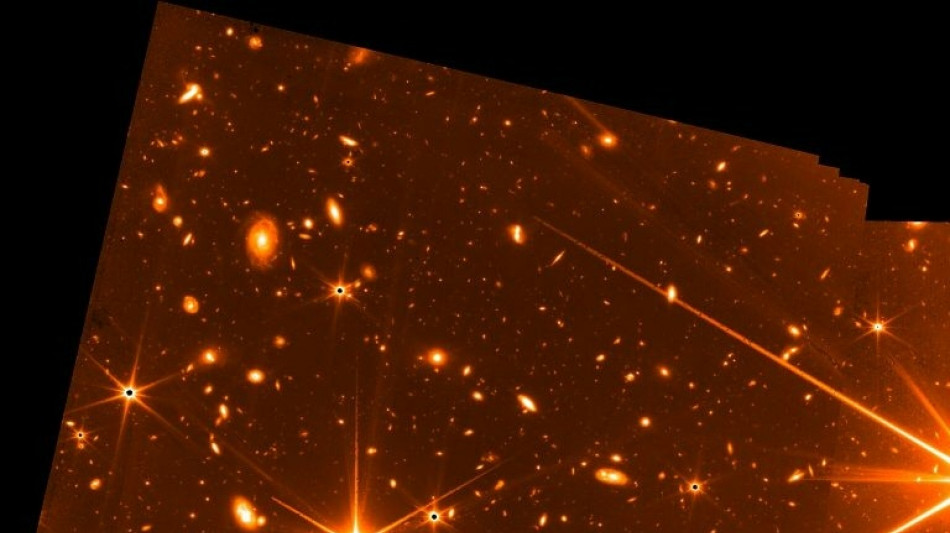
NASA releases James Webb telescope 'teaser' picture / Photo: © NASA/AFP

 US warns of rapid escalation in Mideast war
 Iran 'put hearts on the court' to win Asian Games basketball bronze
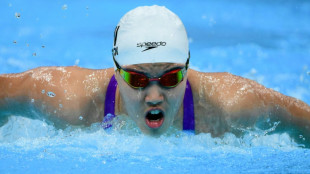
 School girl Yu helps China dominate in Asian Games swimming openers
 Myanmar win first Asian Games teqball gold as Spain great Puyol watches
 China's 13-year-old Yu scorches to first major gold at Asian Games

 Russians vote on last day of parliamentary elections

 Hong Kong pays final respects to former city leader Tung
 Typhoon put people off Asian Games opening ceremony, official says
 China's 13-year-old Yu cruises as Asian Games swimming begins
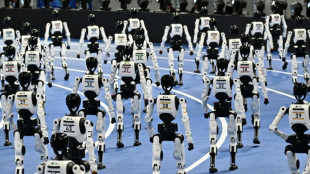 AI 'warning shots' focus Beijing on national security risks
 Philippine tribe in limbo over US-led tech hub
 Leo XIV, first US pope transcends his restrained style
 Singer Ed Sheeran says Gaza situation 'unjustifiable' following controversy

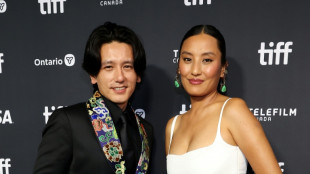 In 'Tenzing', a Sherpa mountaineer gets his due

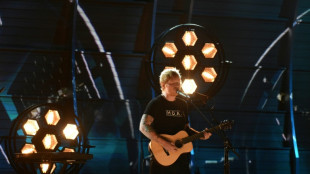 Ed Sheeran set to return to stage after Palestinian controversy
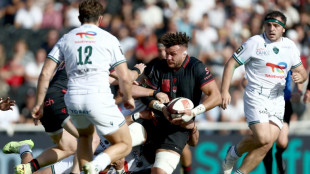 Toulouse edge Vannes, Lyon beat Pau to take Top 14 summit
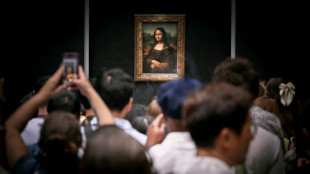 Germans arrested for Louvre stunt in Mona Lisa hall
 Saudi-led coalition says Houthis fired ballistic missile at Riyadh

 France's debt climbs to highest since 1978: ministry

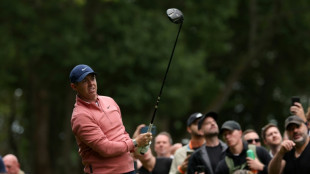 McIlroy two shots off the lead at Wentworth after eagle on 18

 Martinez brace saves Inter in Serie A top-two clash with Roma

 Rosenior abused but guides Paris FC past old club Strasbourg

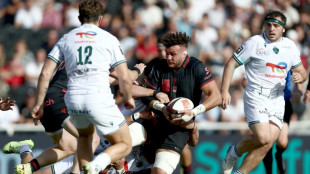 Seven-try Lyon beat Pau, climb to Top 14 summit
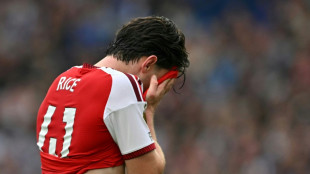 Brighton defeat a 'big lesson' against complacency for Arsenal, says Arteta
 Thousands protest inaction over climate crisis in Switzerland
NASA has a provided a tantalizing teaser photo ahead of the highly-anticipated release next week of the first deep-space images from the James Webb Telescope –- an instrument so powerful it can peer back into the origins of the universe.
The $10 billion observatory -- launched in December last year and now orbiting the Sun a million miles (1.5 million kilometers) away from Earth –- can look where no telescope has looked before thanks to its enormous primary mirror and instruments that focus on infrared, allowing it to peer through dust and gas.
The first fully formed pictures are set for release on July 12, but NASA provided an engineering test photo on Wednesday -- the result of 72 exposures over 32 hours that shows a set of distant stars and galaxies.
The image has some "rough-around-the-edges" qualities, NASA said in a statement, but is still "among the deepest images of the universe ever taken" and offers a "tantalizing glimpse" at what will be revealed in the coming weeks, months, and years.
"When this image was taken, I was thrilled to clearly see all the detailed structure in these faint galaxies," said Neil Rowlands, program scientist for Webb's Fine Guidance Sensor at Honeywell Aerospace.
Jane Rigby, Webb's operations scientist at NASA's Goddard Space Flight Center, said the "faintest blobs in this image are exactly the types of faint galaxies that Webb will study in its first year of science operations."
NASA administrator Bill Nelson said last week that Webb is able to gaze further into the cosmos than any telescope before it.
"It's going to explore objects in the solar system and atmospheres of exoplanets orbiting other stars, giving us clues as to whether potentially their atmospheres are similar to our own," he said.
"It may answer some questions that we have: Where do we come from? What more is out there? Who are we? And of course, it's going to answer some questions that we don't even know what the questions are."
Webb's infrared capabilities allow it to see back in time to the Big Bang, which happened 13.8 billion years ago.
Because the Universe is expanding, light from the earliest stars shifts from the ultraviolet and visible wavelengths it was emitted in, to longer infrared wavelengths -- which Webb is equipped to detect at an unprecedented resolution.
At present, the earliest cosmological observations date to within 330 million years of the Big Bang, but with Webb's capacities, astronomers believe they will easily break the record.
E.Schubert--BTB