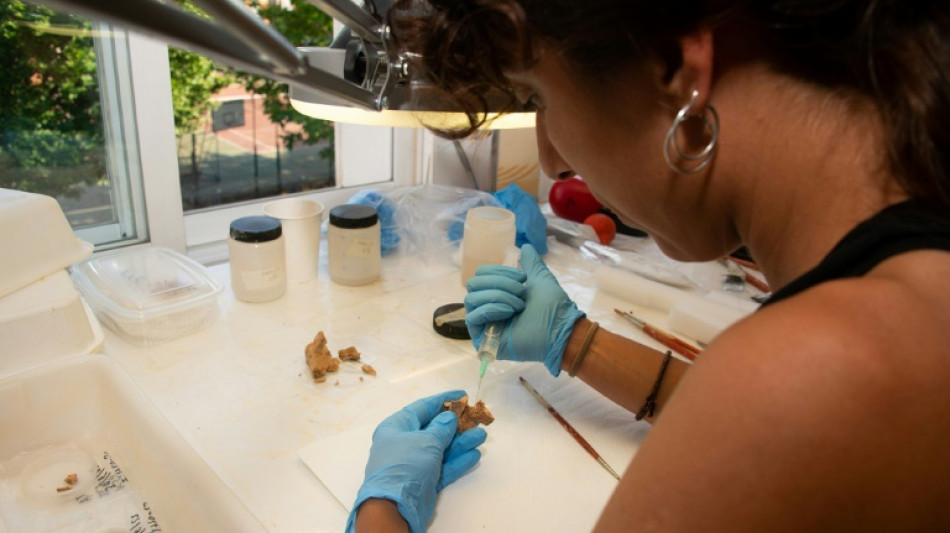
Oldest European human fossil possibly found in Spain / Photo: © Equipo de Investigacion de Atapuerca/AFP

 US warns of rapid escalation in Mideast war

 Iran 'put hearts on the court' to win Asian Games basketball bronze

 School girl Yu helps China dominate in Asian Games swimming openers

 Myanmar win first Asian Games teqball gold as Spain great Puyol watches

 China's 13-year-old Yu scorches to first major gold at Asian Games

 Russians vote on last day of parliamentary elections

 Hong Kong pays final respects to former city leader Tung

 Typhoon put people off Asian Games opening ceremony, official says

 China's 13-year-old Yu cruises as Asian Games swimming begins

 AI 'warning shots' focus Beijing on national security risks

 Philippine tribe in limbo over US-led tech hub

 Leo XIV, first US pope transcends his restrained style

 Singer Ed Sheeran says Gaza situation 'unjustifiable' following controversy

 In 'Tenzing', a Sherpa mountaineer gets his due

 Ed Sheeran set to return to stage after Palestinian controversy

 Toulouse edge Vannes, Lyon beat Pau to take Top 14 summit

 Germans arrested for Louvre stunt in Mona Lisa hall

 Saudi-led coalition says Houthis fired ballistic missile at Riyadh

 France's debt climbs to highest since 1978: ministry

 McIlroy two shots off the lead at Wentworth after eagle on 18

 Martinez brace saves Inter in Serie A top-two clash with Roma

 Rosenior abused but guides Paris FC past old club Strasbourg

 Seven-try Lyon beat Pau, climb to Top 14 summit

 Brighton defeat a 'big lesson' against complacency for Arsenal, says Arteta

 Thousands protest inaction over climate crisis in Switzerland

A jawbone fragment discovered in northern Spain last month could be the oldest known fossil of a human ancestor found to date in Europe, Spanish paleontologists said Friday.
The researchers said the fossil found at an archaeological site on June 30 in northern Spain's Atapuerca mountain range is around 1.4 million years old.
Until now, the oldest hominid fossil found in Europe was a jawbone found at the same site in 2007 which was determined to be 1.2 million years old.
Atapuerca contains one of the richest records of prehistoric human occupation in Europe.
Researchers will now have to "complete" their first estimate for the age of the jawbone fragment using scientific dating techniques, palaeoanthropologist Jose-Maria Bermudez de Castro, the co-director of the Atapuerca research project, said during a news conference.
But since the jawbone fragment was found some two metres below the layer of earth where the jawbone in 2007 was found, "it is logical and reasonable to think it is older," he added.
The scientific dating of the jawbone fragment will be carried out at the National Centre for Research on Human Evolution in Burgos, a city located about 10 kilometres (six miles) from Atapuerca.
The process should take between six to eight months to complete, Bermudez de Castro said.
The analysis could help identify which hominid species the jawbone fragment belongs to and better understand the human beings evolved on the European continent.
Scientists have so far been unable to determine with certainty which species the jawbone discovered in 2007 belonged to.
The fossil could correspond to the species called Homo antecessor, discovered in the 1990s.
The Atapuerca Foundation which runs the archaeological site said in a statement that is "very likely" that the jawbone fragment "belongs to one of the first populations that colonised Europe".
The archaeological site of Atapuerca was in 2000 included on UNESCO's list of world heritage sites, giving it access to United Nations conservation funding.
It contains thousands of hominid fossils and tools including a flint discovered in 2013 that is 1.4 million years old.
M.Ouellet--BTB