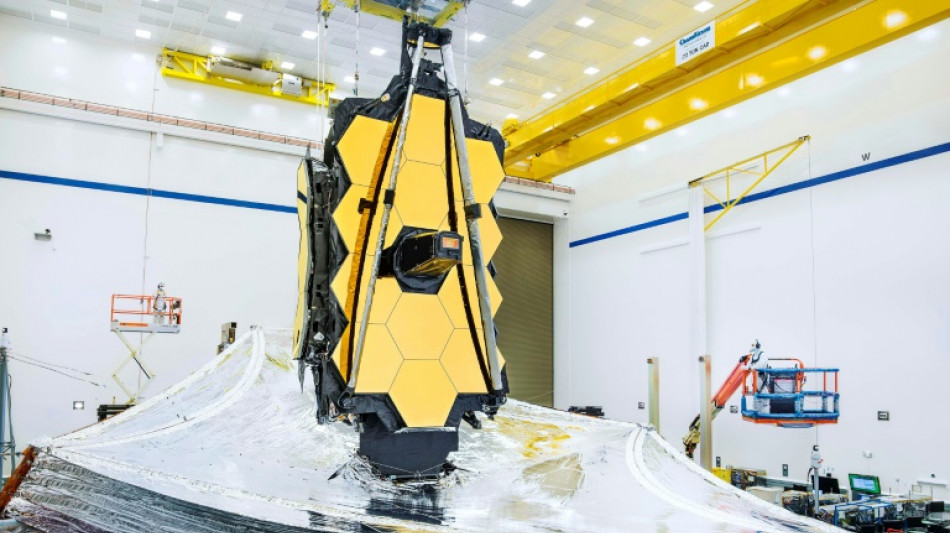
The James Webb Space Telescope, by the numbers / Photo: © NASA/AFP/File

 US warns of rapid escalation in Mideast war

 Iran 'put hearts on the court' to win Asian Games basketball bronze

 School girl Yu helps China dominate in Asian Games swimming openers

 Myanmar win first Asian Games teqball gold as Spain great Puyol watches

 China's 13-year-old Yu scorches to first major gold at Asian Games

 Russians vote on last day of parliamentary elections

 Hong Kong pays final respects to former city leader Tung

 Typhoon put people off Asian Games opening ceremony, official says
 China's 13-year-old Yu cruises as Asian Games swimming begins

 AI 'warning shots' focus Beijing on national security risks
 Philippine tribe in limbo over US-led tech hub
 Leo XIV, first US pope transcends his restrained style

 Singer Ed Sheeran says Gaza situation 'unjustifiable' following controversy

 In 'Tenzing', a Sherpa mountaineer gets his due

 Ed Sheeran set to return to stage after Palestinian controversy

 Toulouse edge Vannes, Lyon beat Pau to take Top 14 summit

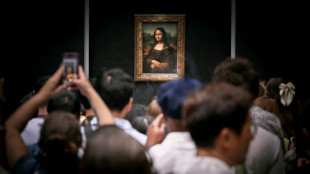 Germans arrested for Louvre stunt in Mona Lisa hall

 Saudi-led coalition says Houthis fired ballistic missile at Riyadh

 France's debt climbs to highest since 1978: ministry

 McIlroy two shots off the lead at Wentworth after eagle on 18

 Martinez brace saves Inter in Serie A top-two clash with Roma

 Rosenior abused but guides Paris FC past old club Strasbourg

 Seven-try Lyon beat Pau, climb to Top 14 summit

 Brighton defeat a 'big lesson' against complacency for Arsenal, says Arteta

 Thousands protest inaction over climate crisis in Switzerland

The most powerful space telescope ever built, James Webb is set to deliver its first full-color scientific images to the world Tuesday.
Here is an overview of this feat of human ingenuity, in five key figures.
- More than 21 feet -
The centerpiece of the observatory is its huge main mirror, measuring more than 21 feet (6.5 meters) in diameter and made up of 18 smaller, hexagonal-shaped mirrors.
The observatory also has four scientific instruments: cameras to take pictures of the cosmos, and spectrographs, which break down light to study which elements and molecules make up objects.
The mirror and the instruments are protected from the light of our Sun by a tennis-court sized thermal shield, made up of five superimposed layers.
Each layer is hair thin, and together they ensure the telescope operates in the darkness needed to capture faint glimmers from the far reaches of the Universe.
- Million miles away -
Unlike the Hubble telescope which revolves around the Earth, Webb orbits around the Sun, nearly a million miles (1.6 million kilometers) from us, or four times the distance from our planet to the Moon.
It took the spacecraft almost a month to reach this region, called Lagrange Point two, where it remains in a fixed position behind the Earth and Sun to give it a clear view of the cosmos.
Here, the gravity from the sun and Earth balance the centrifugal motion of a satellite, meaning it needs minimal fuel for course correction.
- 13.8 billion years -
In astronomy, the farther out you see, the deeper back in time you're looking.
Webb's infrared capabilities are what make it uniquely powerful -- allowing it to detect light from the earliest stars, which has been stretched into infrared wavelengths as the Universe expanded.
This lets it peer further back in time than any previous telescope, to within a few hundred million years after the Big Bang, 13.8 billion years ago.
- Three-decade wait -
The project was first conceived in the 1990s, but construction did not begin until 2004.
Then Webb's launch date was repeatedly postponed. Initially set for 2007, it finally took place on December 25, 2021, aboard an Ariane 5 rocket, from French Guiana.
- $10 billion -
Webb is an international collaboration between US space agency NASA, the European Space Agency (ESA), and the Canadian Space Agency (CSA), involving more than 10,000 people.
The lifetime cost to NASA alone will be approximately $9.7 billion, according to an analysis by the Planetary Society, or $10.8 billion adjusted for inflation to 2020 dollars.
M.Odermatt--BTB