Archaeologists unearth clues on French colonial massacre in Senegal cemetery / Photo: © AFP

 Rams bounce back as Giants reel from Dart injury

 In Bangladesh, Pakistan's Jinnah photo stirs anger

 Two New Zealand naval ships transit Taiwan Strait

 Zidane gets down to work as France start new era

 Inside the Venezuelan prison meant to 'drive you insane'

 UK king braces as memoir by Diana's brother goes on sale

 No green light to lift EU sanctions on Russian oligarchs, talks to resume

 UK agrees support for Saudi in struggle with Houthis: reports

 EU foreign policy chief calls for continued sanctions on Russia

 Flights scrapped, evacuations urged as Typhoon Dujuan wallops Japan

 Fonseca to take break from tennis

 A Cuban zoo, and its animals, in epic battle for survival

 Infantino proposes consulting federations to reform FIFA
 El Nino weather pattern enters record territory: scientist
 OpenAI calls for US to lead global effort on AI standards
 South African ostriches plucked alive for luxury fashion: report
 US networks halt Trump coverage in revolt over White House ban
 Paramount settles with US states to clear Warner Bros. mega-merger

 Climate crisis a job for world leaders, not just activists: UK FM
 US networks halt Trump coverage over White House ban
 French singer accuses Miley Cyrus of plagiarism

 EU fines Google 403 mn euros for location data breach

 'Best is yet to come,' says De la Fuente after Spain extension

 Why diesel prices are rising more than crude oil

 COP31 host says AI's climate footprint to be a summit priority

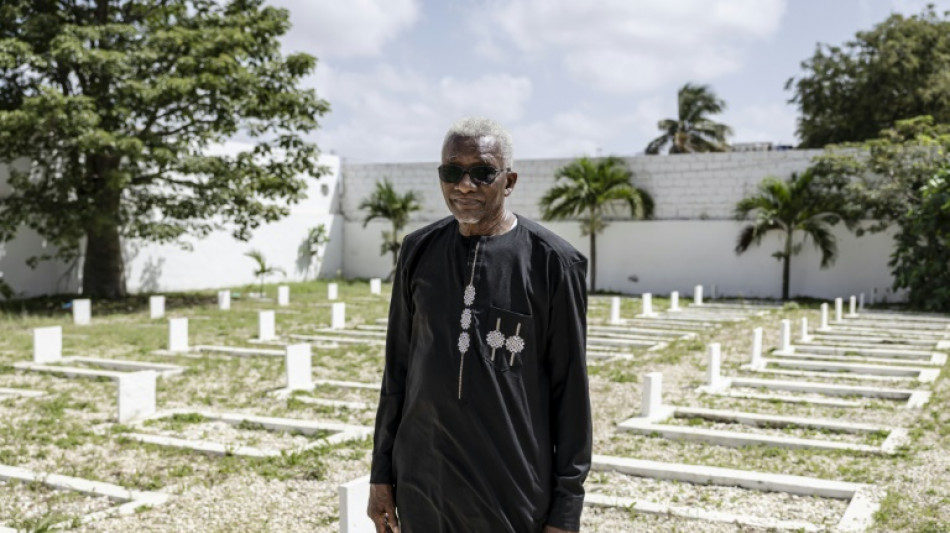
Holes in the ground, clods of earth next to headstones, dislocated concrete outlines: the Thiaroye military cemetery near Dakar bears the marks of recent excavations meant to unearth the truth behind a WWII-era massacre by French colonial forces.
In November 1944 around 1,600 soldiers from several west African countries were sent to the Thiaroye camp after being captured by Germany while fighting for France.
Discontent soon mounted over unpaid back pay and unmet demands that they be treated on a par with white soldiers.
On December 1, French forces opened fire on them.
The circumstances surrounding the massacre, the number of riflemen killed and their place of burial all remain unclear.
An AFP team recently visited the camp's cemetery, where archaeologists are conducting landmark excavations to find and examine the remains of those interred there.
Rows of 202 graves, marked with white headstones and cement demarcations, are covered with shells.
It is not known who exactly is in all the graves, or if there are even bodies at each marker. The researchers have so far only been able to excavate a very small percentage of them.
The cemetery was created in 1926 by colonial France to bury African soldiers. Some researchers believe that riflemen killed in the Thiaroye massacre were buried there.
Unearthed burial containers, since covered in blue plastic, bear testament to the archaeologists' work.
Senegal alleges it was difficult to access the French colonial archives to study the massacre in full.
This is why Colonel Saliou Ngom, the director of the Senegalese army's archives and historical heritage, believes it was necessary to "make the underground" speak.
The archaeologists have so far carried out their initial excavations under one of two large baobabs, enormous trees that can indicate the site of buried bodies.
The baobab is "a calcareous tree, that is one that likes limestone", history and geography professor Mamadou Kone, technical adviser to the Armed Forces Museum, told AFP.
"Where there are bones, there are often baobabs", he said.
- Clues on violence -
The researchers submitted an official report on October 16 to Senegalese President Bassirou Diomaye Faye describing the massacre as "premeditated" and covered up, with a death toll that had been grossly underestimated.
The French colonial authorities at the time of the massacre said up to 70 World War II riflemen were killed.
But the researchers said the most credible estimates put the figure closer to 300 to 400, with some of the men buried in the Thiaroye cemetery.
One of the archaeologists who led the dig, Moustapha Sall, explained that seven graves were excavated out of a first group of 34.
"Archaeologists found seven skeletons. This is a very important step in the search for historical truth," Colonel Ngom said.
According to Sall, "one skeleton contains a bullet in its left side in the location of the heart."
"Others lack a spine, ribs or skull. Some individuals are buried with iron chains on their shins," he added.
"This means they suffered violence."
The graves where the bodies are located are more recent than the remains themselves, Sall added.
"One hypothesis is that the graves were made after the (initial) burials or that it was staged to make is appear they had been properly buried," Sall said.
- Genetic, ballistic studies -
The next key step, Sall explained, will be taking DNA samples to help determine the individuals' origins.
"The preliminary results do not allow us to answer all the questions," he said.
Ballistics experts will additionally provide information on the military equipment, he added.
Meanwhile the Senegalese government has ordered ground-penetrating radar (GPR) to better explore the depths of the cemetery's subsoil.
"We have been searching for the historical truth for 81 years", Colonel Ngom said. "If the subsoil provides us with (this truth) there is nothing more significant".
President Faye, who has committed to preserving the soldiers' memory, has announced he has approved "the continuation of archaeological excavations at all sites likely to contain mass graves".
In November 2024, as the atrocity's 80th anniversary approached, French President Emmanuel Macron acknowledged that French colonial forces had committed a "massacre" in Thiaroye.
L.Dubois--BTB