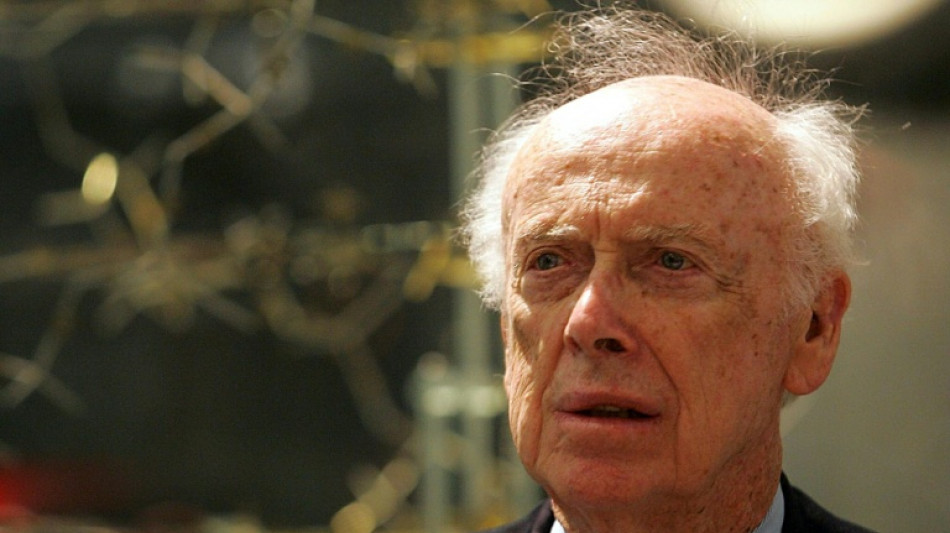
James Watson, Nobel prize-winning DNA pioneer, dead at 97 / Photo: © AFP

 Rams bounce back as Giants reel from Dart injury

 In Bangladesh, Pakistan's Jinnah photo stirs anger

 Two New Zealand naval ships transit Taiwan Strait

 Zidane gets down to work as France start new era

 Inside the Venezuelan prison meant to 'drive you insane'

 UK king braces as memoir by Diana's brother goes on sale

 No green light to lift EU sanctions on Russian oligarchs, talks to resume

 UK agrees support for Saudi in struggle with Houthis: reports

 EU foreign policy chief calls for continued sanctions on Russia

 Flights scrapped, evacuations urged as Typhoon Dujuan wallops Japan

 Fonseca to take break from tennis

 A Cuban zoo, and its animals, in epic battle for survival

 Infantino proposes consulting federations to reform FIFA

 El Nino weather pattern enters record territory: scientist
 OpenAI calls for US to lead global effort on AI standards

 South African ostriches plucked alive for luxury fashion: report

 US networks halt Trump coverage in revolt over White House ban

 Paramount settles with US states to clear Warner Bros. mega-merger

 Climate crisis a job for world leaders, not just activists: UK FM
 US networks halt Trump coverage over White House ban
 French singer accuses Miley Cyrus of plagiarism

 EU fines Google 403 mn euros for location data breach

 'Best is yet to come,' says De la Fuente after Spain extension

 Why diesel prices are rising more than crude oil

 COP31 host says AI's climate footprint to be a summit priority

James Watson -- the Nobel laureate co-credited with the pivotal discovery of DNA's double-helix structure, but whose career was later tainted by his repeated racist remarks -- has died, his former lab said Friday. He was 97.
The eminent biologist died Thursday in hospice care on Long Island in New York, announced the Cold Spring Harbor Laboratory, where he was based for much of his career.
Watson became among the 20th century's most storied scientists for his 1953 breakthrough discovery of the double helix with researcher partner Francis Crick.
Along with Crick and Maurice Wilkins, he shared the 1962 Nobel Prize for their work -- momentous research that gave rise to modern biology and opened the door to new insights including on genetic code and protein synthesis.
That marked a new era of modern life, allowing for revolutionary technologies in medicine, forensics and genetics -- ranging from criminal DNA testing or genetically manipulated plants.
Watson went on to do groundbreaking work in cancer research and mapping the human genome.
But he later came under fire and bowed out of public view for controversial remarks, including that Africans were not as smart as white people.
Watson told the British weekly The Sunday Times he was "inherently gloomy about the prospect of Africa" because "all our social policies are based on the fact that their intelligence is the same as ours -- whereas all the testing says not really."
- Twisting ladder -
Born on April 6, 1928 in Chicago, Illinois, at the aqe of 15 James Dewey Watson won a scholarship to the University of Chicago.
In 1947 he received a degree in zoology before attending Indiana University in Bloomington, where he received his Ph.D in zoology in 1950.
He became interested in the work of scientists working at the University of Cambridge in England with photographic patterns made by X-rays.
After moving to the University of Copenhagen, Watson began his investigation of the structure of DNA.
In 1951 he went to the Zoological Station at Naples, where he met researcher Maurice Wilkins and saw for the first time crystalline DNA's X-ray diffraction pattern.
Before long he'd met Francis Crick and started what would go down as a celebrated partnership.
Working with X-ray images obtained by Rosalind Franklin and Wilkins, researchers at King's College in London, Watson and Crick had started their historic work of puzzling out the double helix.
Their first serious effort came up short.
But their second attempt resulted in the pair presenting the double-helical configuration, a now iconic image that resembles a twisting ladder.
Their model also showed how the DNA molecule could duplicate itself, thus answering a fundamental question in the field of genetics.
Watson and Crick published their findings in the British journal "Nature" in April-May 1953 to great acclaim.
Watson taught at Harvard for 15 years before becoming director of what today is known as the Cold Spring Harbor Laboratory, which he transformed into a global hub of molecular biology research.
From 1988 to 1992, Watson was one of the directors of the Human Genome Project at the National Institutes of Health, where he oversaw the mapping of the genes in the human chromosomes.
But his comments on race and obesity -- he was also known to make sexist remarks -- triggered his retirement in 2007.
The lab severed all ties with him in 2020, including his emeritus status, after he once again made similar statements.
B.Shevchenko--BTB