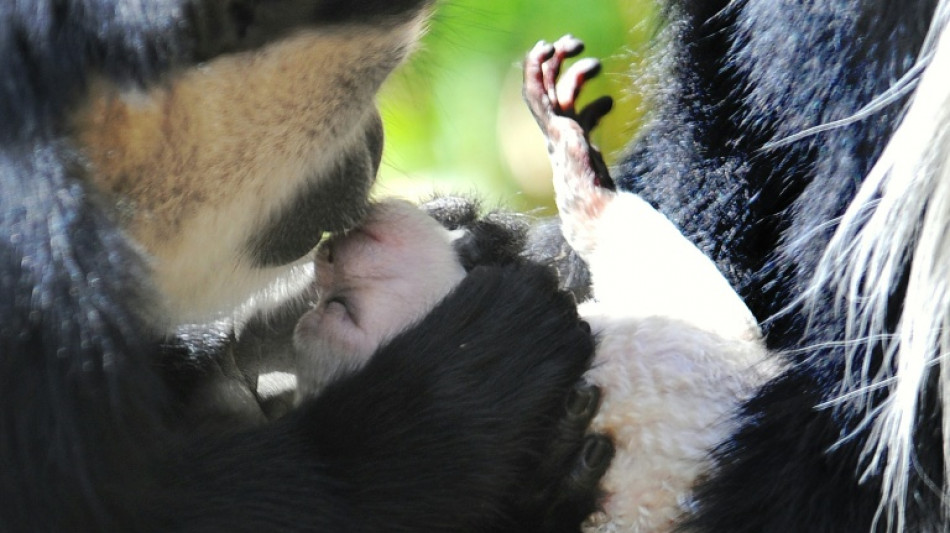
Monkey business: Neanderthals and ancient apes likely kissed too / Photo: © AFP

 Inside the Venezuelan prison meant to 'drive you insane'
 UK king braces as memoir by Diana's brother goes on sale

 No green light to lift EU sanctions on Russian oligarchs, talks to resume

 UK agrees support for Saudi in struggle with Houthis: reports

 EU foreign policy chief calls for continued sanctions on Russia
 Flights scrapped, evacuations urged as Typhoon Dujuan wallops Japan
 Fonseca to take break from tennis

 A Cuban zoo, and its animals, in epic battle for survival

 Infantino proposes consulting federations to reform FIFA

 El Nino weather pattern enters record territory: scientist

 OpenAI calls for US to lead global effort on AI standards

 South African ostriches plucked alive for luxury fashion: report

 US networks halt Trump coverage in revolt over White House ban

 Paramount settles with US states to clear Warner Bros. mega-merger

 Climate crisis a job for world leaders, not just activists: UK FM
 US networks halt Trump coverage over White House ban
 French singer accuses Miley Cyrus of plagiarism

 EU fines Google 403 mn euros for location data breach

 'Best is yet to come,' says De la Fuente after Spain extension

 Why diesel prices are rising more than crude oil

 COP31 host says AI's climate footprint to be a summit priority

 Renewables hit record in 2025, but world must move faster: report

 US media outlets to sue Trump administration after White House ban

 Global stocks rally on lower oil prices, US-China hopes

 EU proposes energy rating for data centres

Scientists have found evidence suggesting that kissing dates back up to 21 million years and that our ape ancestors and Neanderthals likely locked lips, research published Wednesday said.
Kissing has long presented an evolutionary puzzle to scientists as it appears to carry high risks such as disease transmission while having no obvious reproductive or survival advantages.
But the new study found that the practice has evolved over millions of years, and that our extinct human relatives, the Neanderthals, could have shared a peck to stay warm in the ice age.
The research led by scientists at the University of Oxford was published in the journal "Evolution and Human Behaviour".
"This is the first time anyone has taken a broad evolutionary lens to examine kissing," said co-author Matilda Brindle, an evolutionary biologist at the University of Oxford.
"Our findings add to a growing body of work highlighting the remarkable diversity of sexual behaviours exhibited by our primate cousins."
For the purpose of the study, researchers defined kissing as a "non-aggressive, mouth-to-mouth contact that did not involve food transfer".
"The results indicate that kissing is an ancient trait in the large apes," evolving in primate ancestors from 17 to 21 million years ago, according to an Oxford University statement.
"Kissing was retained over the course of evolution and is still present in most of the large apes," it added.
The researchers first collected data about modern primates that have been observed kissing, including chimpanzees, bonobos and orangutans.
Then, treating kissing as a "trait", they mapped it to the family tree of primates. By stimulating different evolutionary scenarios, they estimated the probability that ancient ancestors also engaged in kissing.
Previous studies have found that humans and Neanderthals had shared oral microbes through saliva transfer, suggesting that the species had kissed each other.
G.Schulte--BTB